

 登录
登录
一、阅读理解 英国的学校
素养:文化意识 难度:中 用时:8分钟
In the UK, September is usually the end of summer and the start of autumn. Children go back to school after their summer holidays. Do you want to know more about British schools?
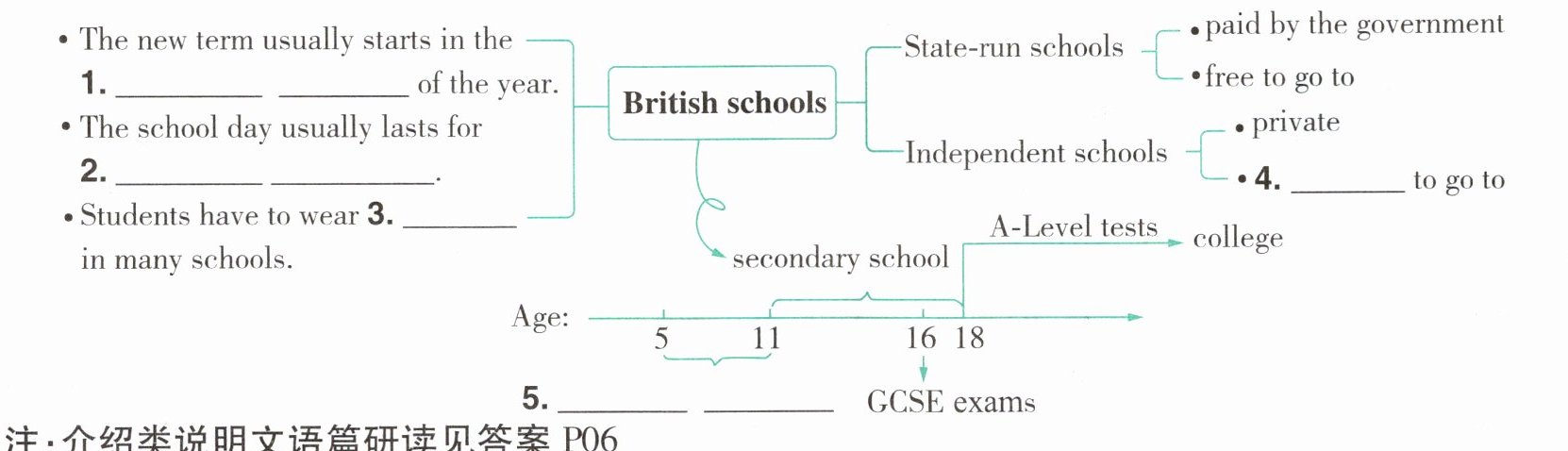
There are two kinds of schools in the UK. State-run schools are paid by the government(政府), so they are free to go to. Independent(私营的) schools are private, which means you have to pay to go to them.
The school day usually starts at 9 in the morning and finishes at 4 in the afternoon. In many schools, you have to wear uniforms too.
Children start their school when they are 5 years old. This is called primary school(小学). Children will stay in primary school until 11. Then they must study in secondary school till 16 years old. At 16, every student in the UK must take the tests called GCSE exams. After this,
students can stay in the same school for another 2 years and take A-Level tests. Students need to take these tests if they want to go to college at 18.
Colleges in the UK were free in the past, but many students now have to pay for part of their courses.
1. After summer holidays, British schools usually start in
A. January B. September
C. December D. February
2. What can we know from Paragraph 4?
A. Children start their school at the age of 6.
B. Students can go to college when they are 16 years old.
C. Every student must go to secondary school and college in the UK.
D. Students need to take GCSE and A-Level tests if they want to go to college.
3. What is this article mainly about?
A. British schools.
B. Colleges in the UK.
C. GCSE and A-Level tests.
D. September is a good time in the UK.
【语篇解构】 阅读文章,补充下面的结构图(每空一词)
注:介绍类说明文语篇研读见答案 P06
素养:文化意识 难度:中 用时:8分钟
In the UK, September is usually the end of summer and the start of autumn. Children go back to school after their summer holidays. Do you want to know more about British schools?
There are two kinds of schools in the UK. State-run schools are paid by the government(政府), so they are free to go to. Independent(私营的) schools are private, which means you have to pay to go to them.
The school day usually starts at 9 in the morning and finishes at 4 in the afternoon. In many schools, you have to wear uniforms too.
Children start their school when they are 5 years old. This is called primary school(小学). Children will stay in primary school until 11. Then they must study in secondary school till 16 years old. At 16, every student in the UK must take the tests called GCSE exams. After this,
students can stay in the same school for another 2 years and take A-Level tests. Students need to take these tests if they want to go to college at 18.
Colleges in the UK were free in the past, but many students now have to pay for part of their courses.
1. After summer holidays, British schools usually start in
September
.A. January B. September
C. December D. February
2. What can we know from Paragraph 4?
A. Children start their school at the age of 6.
B. Students can go to college when they are 16 years old.
C. Every student must go to secondary school and college in the UK.
D. Students need to take GCSE and A-Level tests if they want to go to college.
3. What is this article mainly about?
A. British schools.
B. Colleges in the UK.
C. GCSE and A-Level tests.
D. September is a good time in the UK.
【语篇解构】 阅读文章,补充下面的结构图(每空一词)
注:介绍类说明文语篇研读见答案 P06
答案
一、阅读理解
语篇研读
主题和内容 本文主要介绍了英国学校的情况,包括公立学校和私立学校的区别、日常安排、学制和收费等方面的信息。
意义和价值 帮助学生了解中英教育体系的差异,拓展国际视野,理解不同国家的教育文化,培养国际理解意识。
方式和方法 体裁:本文为说明文,从四个方面介绍了英国学校的情况。
篇章结构:本文为“总—分”结构。第一段引出“英国学校”这个主题,第二至五段分别从英国公立学校和私立学校的区别、日常安排、学制和收费四个方面介绍了英国学校的基本情况。
呈现方式:使用对比的手法比较了英国公立学校和私立学校的区别以及大学学费的变化,帮助学生抓住关键信息;按学生年龄(5岁→11岁→16岁→18岁)梳理学制,逻辑连贯,便于理解。
1 B 细节理解题。根据第一段中的“In the UK, September is usually the end of summer and the start of autumn. Children go back to school after their summer holidays”可知,英国的孩子们在暑假后回到学校通常是在夏末秋初的九月。
2 D 细节理解题。根据第四段中的“At 16, every student in the UK must take the tests called GCSE exams... and take A-Level tests. Students need to take these tests if they want to go to college at 18”可知,如果想在18岁上大学,学生必须参加 GCSE 考试和A-Level考试。
解题通法
带着问题找关键信息
细节理解题考查文章中提到的细节内容,如时间、地点、人物、事件、方式或原因等。这类题难度较低,通常能够直接从文章中找到答案。做这类题时,可以先看题目,然后带着问题去阅读材料,把原文信息跟题目对照,即可得到答案。
3 A 主旨大意题。通读全文,尤其是第一段中的“Do you want to know more about British schools?”可知,本文主要介绍了英国学校的情况。
【语篇解构】1 ninth month 2 7/seven hours
3 uniforms 4 pay 5 primary school
语篇研读
主题和内容 本文主要介绍了英国学校的情况,包括公立学校和私立学校的区别、日常安排、学制和收费等方面的信息。
意义和价值 帮助学生了解中英教育体系的差异,拓展国际视野,理解不同国家的教育文化,培养国际理解意识。
方式和方法 体裁:本文为说明文,从四个方面介绍了英国学校的情况。
篇章结构:本文为“总—分”结构。第一段引出“英国学校”这个主题,第二至五段分别从英国公立学校和私立学校的区别、日常安排、学制和收费四个方面介绍了英国学校的基本情况。
呈现方式:使用对比的手法比较了英国公立学校和私立学校的区别以及大学学费的变化,帮助学生抓住关键信息;按学生年龄(5岁→11岁→16岁→18岁)梳理学制,逻辑连贯,便于理解。
1 B 细节理解题。根据第一段中的“In the UK, September is usually the end of summer and the start of autumn. Children go back to school after their summer holidays”可知,英国的孩子们在暑假后回到学校通常是在夏末秋初的九月。
2 D 细节理解题。根据第四段中的“At 16, every student in the UK must take the tests called GCSE exams... and take A-Level tests. Students need to take these tests if they want to go to college at 18”可知,如果想在18岁上大学,学生必须参加 GCSE 考试和A-Level考试。
解题通法
带着问题找关键信息
细节理解题考查文章中提到的细节内容,如时间、地点、人物、事件、方式或原因等。这类题难度较低,通常能够直接从文章中找到答案。做这类题时,可以先看题目,然后带着问题去阅读材料,把原文信息跟题目对照,即可得到答案。
3 A 主旨大意题。通读全文,尤其是第一段中的“Do you want to know more about British schools?”可知,本文主要介绍了英国学校的情况。
【语篇解构】1 ninth month 2 7/seven hours
3 uniforms 4 pay 5 primary school
