

 登录
登录
第二节 阅读下面短文并填空(如有提示词,则填入提示词的正确形式;如无提示词,则填入1个适当的单词)。
Now, people take trips by watching live streaming(直播) on the Internet. This is called “cloud tourism(云旅游)”.
Zha Liguo, a 44-year-old man, 16.
A lot of people are 21.
The “cloud tourism” 25.
拓展设问
(
A. A Great Guide—Zha Liguo
B. The Beautiful Scenery of Mount Huangshan
C. Cloud Tourism—A New Way to Travel
Now, people take trips by watching live streaming(直播) on the Internet. This is called “cloud tourism(云旅游)”.
Zha Liguo, a 44-year-old man, 16.
is
(be) a guide. During the May Day holiday, Zha took a group of 17. tourists
(tourist) to Mount Huangshan and enjoyed sunrises(日出) there. A lot of people 18. joined
(join) him by watching his live streaming. It was not Zha's 19. first
(one) trip to Mount Huangshan. Last year, he stayed there 20. for
over 280 days. He showed the beautiful scenery and other interesting things on the Internet.A lot of people are 21.
interested
(interest) in Zha's live streaming. “Usually, many people are tired of staying at home and need to go out for a trip. 22. But
they have no time. I enjoy 23. myself
(I) every time I see the beautiful scenery, so I want 24. to share
(share) it with others,” said Zha.The “cloud tourism” 25.
really
(real) helps people a lot. They don't need to think about where to live, what to eat or how to go. What's more, the “cloud tourism” also makes a difference to a place's business(商业). People like to buy things while watching live streaming.拓展设问
(
C
)What is the best title for the passage?A. A Great Guide—Zha Liguo
B. The Beautiful Scenery of Mount Huangshan
C. Cloud Tourism—A New Way to Travel
答案
16. is 17. tourists 18. joined 19. first 20. for
21. interested 22. But 23. myself 24. to share
25. really 拓展设问 C
21. interested 22. But 23. myself 24. to share
25. really 拓展设问 C
三、写作。
阅读下面短文,按照题目要求用英语回答问题。
(2024-2025·德州市天衢新区期中)Many old lanes(巷子)in Beijing date back to(追溯到)hundreds of years ago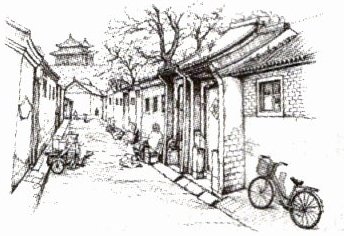
during the Ming and Qing dynasties. They keep alive not only traditional culture but also the ways of life in the past. People can go shopping, eat delicious food and experience the street life when they visit the Beijing hutongs. What’s more, it’s a good way to learn more about the daily life of people in Beijing.
A hutong is a lane formed by traditional courtyard compounds(筑有围墙的院子)on both sides. The compounds are called siheyuan, meaning “four joined-together courtyard”. The hutongs have interesting names, which tell their origin(起源), location(位置)or history. They are in these gray lanes where kids talk and play.
One of China’s most famous writers, Laoshe, was born in siheyuan in the west of the city. The memories of his childhood in hutongs were so important to him that even after he had been away from Beijing for more than 20 years, he still clearly remembered them and wrote them into a novel called Four Generations under One Roof.
Now, there are still many siheyuan in Beijing for people to live in. However, most hutongs are in great danger because people always want to build new buildings. So, we should try our best to protect Beijing hutongs, the treasure of traditional culture.
26. What can people do when visiting Beijing hutongs?
27. What can the names of hutongs tell us?
28. Why are most hutongs in great danger?
29. What may the writer talk about in the following paragraph?
30. Please give a title to the text.
▶* Project◀
编者按:本版块要求学生综合运用所学知识和技能,通过自主探究、合作交流等方式完成。因任务较为开放,故答案略。
活动① Work in groups. Think of a city you would like to visit and find some information about it.
●Location(位置):
●Tourist attractions(景点):
●Local food and special products(当地美食和特产):
●Transport(交通):
活动② Find more information about that city on the Internet. Complete the table below.
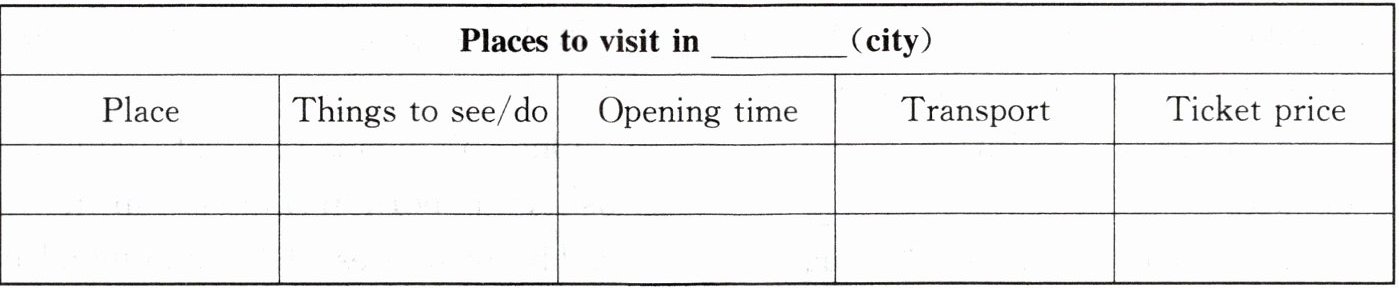
活动③ Use the table in Activity 2 to plan your activities in the city. Then complete the schedules below.
Day 1
Time
Place to go
How to get there
Things to see/do
Day 2
Time
Place to go
How to get there
Things to see/do
活动④ Share your group’s travel plan with the class.
▶* Reading Plus◀
请阅读教材 P81 的短文,完成下列任务。
01 词汇积累 查词典并写出下列单词的意思。
1. cycle/ˈsaɪkl/ v.
2. support/səˈpɔːt/ v. & n.
3. complete/kəmˈpliːt/ v.
4. proud/praʊd/adj.
5. dive/daɪv/ v.
6. point/pɔɪnt/ v.
阅读下面短文,按照题目要求用英语回答问题。
(2024-2025·德州市天衢新区期中)Many old lanes(巷子)in Beijing date back to(追溯到)hundreds of years ago
during the Ming and Qing dynasties. They keep alive not only traditional culture but also the ways of life in the past. People can go shopping, eat delicious food and experience the street life when they visit the Beijing hutongs. What’s more, it’s a good way to learn more about the daily life of people in Beijing.
A hutong is a lane formed by traditional courtyard compounds(筑有围墙的院子)on both sides. The compounds are called siheyuan, meaning “four joined-together courtyard”. The hutongs have interesting names, which tell their origin(起源), location(位置)or history. They are in these gray lanes where kids talk and play.
One of China’s most famous writers, Laoshe, was born in siheyuan in the west of the city. The memories of his childhood in hutongs were so important to him that even after he had been away from Beijing for more than 20 years, he still clearly remembered them and wrote them into a novel called Four Generations under One Roof.
Now, there are still many siheyuan in Beijing for people to live in. However, most hutongs are in great danger because people always want to build new buildings. So, we should try our best to protect Beijing hutongs, the treasure of traditional culture.
26. What can people do when visiting Beijing hutongs?
People/They can go shopping, eat delicious food, and experience the street life.
27. What can the names of hutongs tell us?
They can tell us their origin, location or history. / Their origin, location or history.
28. Why are most hutongs in great danger?
Because people always want to build new buildings.
29. What may the writer talk about in the following paragraph?
How to protect Beijing hutongs. /…
30. Please give a title to the text.
Beijing Hutongs
▶* Project◀
编者按:本版块要求学生综合运用所学知识和技能,通过自主探究、合作交流等方式完成。因任务较为开放,故答案略。
活动① Work in groups. Think of a city you would like to visit and find some information about it.
●Location(位置):
●Tourist attractions(景点):
●Local food and special products(当地美食和特产):
●Transport(交通):
活动② Find more information about that city on the Internet. Complete the table below.
活动③ Use the table in Activity 2 to plan your activities in the city. Then complete the schedules below.
Day 1
Time
Place to go
How to get there
Things to see/do
Day 2
Time
Place to go
How to get there
Things to see/do
活动④ Share your group’s travel plan with the class.
▶* Reading Plus◀
请阅读教材 P81 的短文,完成下列任务。
01 词汇积累 查词典并写出下列单词的意思。
1. cycle/ˈsaɪkl/ v.
2. support/səˈpɔːt/ v. & n.
3. complete/kəmˈpliːt/ v.
4. proud/praʊd/adj.
5. dive/daɪv/ v.
6. point/pɔɪnt/ v.
答案
26. People/They can go shopping, eat delicious food, and experience the street life.
27. They can tell us their origin, location or history. / Their origin, location or history.
28. Because people always want to build new buildings.
29. How to protect Beijing hutongs. /…
30. Beijing Hutongs
27. They can tell us their origin, location or history. / Their origin, location or history.
28. Because people always want to build new buildings.
29. How to protect Beijing hutongs. /…
30. Beijing Hutongs
骑自行车;骑自行车旅行
支持
完成
骄傲的;自豪的
潜水
指向
