

 登录
登录
【典例1】已知$△ ABC$的三边长$a,b,c$满足$a^2 - 2ab + b^2 = ac - bc$,判断$△ ABC$的形状,并说明理由。
答案
解:$\because a^{2}-2ab+b^{2}=ac-bc$,
$\therefore (a-b)^{2}=c(a-b)$,
$\therefore (a-b)^{2}-c(a-b)=0$,
$\therefore (a-b)(a-b-c)=0$,
$\because a,b,c$是$△ ABC$的三边长,
$\therefore a-b-c≠0,\therefore a-b=0,\therefore a=b$,
$\therefore △ ABC$为等腰三角形.
$\therefore (a-b)^{2}=c(a-b)$,
$\therefore (a-b)^{2}-c(a-b)=0$,
$\therefore (a-b)(a-b-c)=0$,
$\because a,b,c$是$△ ABC$的三边长,
$\therefore a-b-c≠0,\therefore a-b=0,\therefore a=b$,
$\therefore △ ABC$为等腰三角形.
变式.已知$a,b,c$是$△ ABC$的三边的长,且满足$a^2 + 2b^2 + c^2 - 2b(a + c)=0$,判断此三角形的形状.
答案
解:$a^{2}-2ab+b^{2}+b^{2}+c^{2}-2bc=0$,
$(a-b)^{2}+(b-c)^{2}=0$,
$\therefore a=b=c$,
$\therefore$ 此三角形为等边三角形.
$(a-b)^{2}+(b-c)^{2}=0$,
$\therefore a=b=c$,
$\therefore$ 此三角形为等边三角形.
【典例2】如果$a,b,c$是$△ ABC$三边的长,比较$a^2 - b^2 + c^2 - 2ac$与$0$的大小.
答案
解:$\because a^{2}-b^{2}+c^{2}-2ac$
$=(a^{2}-2ac+c^{2})-b^{2}$
$=(a-c)^{2}-b^{2}$
$=(a-c+b)(a-c-b)$
$\because a+b>c,a<b+c$,
$\therefore a-c+b>0,a-c-b<0$,
$\therefore a^{2}-b^{2}+c^{2}-2ac<0$.
$=(a^{2}-2ac+c^{2})-b^{2}$
$=(a-c)^{2}-b^{2}$
$=(a-c+b)(a-c-b)$
$\because a+b>c,a<b+c$,
$\therefore a-c+b>0,a-c-b<0$,
$\therefore a^{2}-b^{2}+c^{2}-2ac<0$.
【典例3】如图,将一张大长方形纸板按图中虚线裁剪成9块,其中有2块是边长为a厘米的大正方形,2块是边长都为b厘米的小正方形,5块是长为a厘米,宽为b厘米的相同的小长方形,且$a>b$.
(1)观察图形,可以发现代数式$2a^2 + 5ab + 2b^2$可以因式分解为________;
(2)若图中阴影部分的面积为242平方厘米,大长方形纸板的周长为78厘米,求图中空白部分的面积.
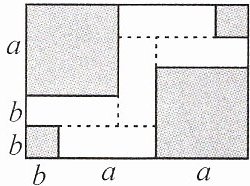
(1)观察图形,可以发现代数式$2a^2 + 5ab + 2b^2$可以因式分解为________;
(2)若图中阴影部分的面积为242平方厘米,大长方形纸板的周长为78厘米,求图中空白部分的面积.
答案
(1)$(a+2b)(2a+b)$;
(2)由已知得$\begin{cases}2(a^{2}+b^{2})=242\\6a+6b=78\end{cases}$,
化简得$\begin{cases}a^{2}+b^{2}=121&①\\a+b=13&②\end{cases}$,
$\therefore ②^{2}-①$得$2ab=48$,
$\therefore ab=24,S_{白}=5ab=120(\mathrm{cm}^{2})$.
答:图中空白部分的面积为$120\ \mathrm{cm}^{2}$.
(2)由已知得$\begin{cases}2(a^{2}+b^{2})=242\\6a+6b=78\end{cases}$,
化简得$\begin{cases}a^{2}+b^{2}=121&①\\a+b=13&②\end{cases}$,
$\therefore ②^{2}-①$得$2ab=48$,
$\therefore ab=24,S_{白}=5ab=120(\mathrm{cm}^{2})$.
答:图中空白部分的面积为$120\ \mathrm{cm}^{2}$.
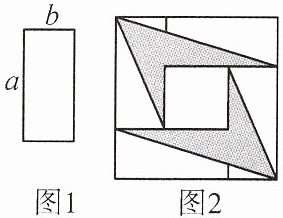
变式.4张如图1长为$a$,宽为$b(a>b)$的长方形纸片,按图2的方式放置,阴影部分的面积为$S_1$,空白部分的面积为$S_2$,若$S_2=2S_1$,则$a$,$b$满足(
A.$a=\dfrac{3}{2}b$
B.$a=2b$
C.$a=\dfrac{5}{2}b$
D.$a=3b$
B
)A.$a=\dfrac{3}{2}b$
B.$a=2b$
C.$a=\dfrac{5}{2}b$
D.$a=3b$
答案
解:由图形可知,$S_{2}=(a-b)^{2}+b(a+b)+ab=a^{2}+2b^{2}$,
$S_{1}=(a+b)^{2}-S_{2}=2ab-b^{2}$,
$\because S_{2}=2S_{1}$,
$\therefore a^{2}+2b^{2}=2(2ab-b^{2})$,
$\therefore a^{2}-4ab+4b^{2}=0$,
即$(a-2b)^{2}=0,\therefore a=2b$.
$S_{1}=(a+b)^{2}-S_{2}=2ab-b^{2}$,
$\because S_{2}=2S_{1}$,
$\therefore a^{2}+2b^{2}=2(2ab-b^{2})$,
$\therefore a^{2}-4ab+4b^{2}=0$,
即$(a-2b)^{2}=0,\therefore a=2b$.
