

 登录
五 按要求完成下列各题。(8分)
1. Mr Black can't use the computer.(用 before 改写句子)
Mr Black
2. My father rode a bike to work twenty years ago.(对画线部分提问)
3. Amy talks to the smart robot on the screen.(改为一般疑问句,并作否定回答)
—
—No,
4. There wasn't internet in my grandpa's time. There weren't TVs either.(合并为一句)
There
5. 那时我们花了很多时间在路上。现在高速列车行进得很快。(根据中文提示完成句子)
We
1. Mr Black can't use the computer.(用 before 改写句子)
Mr Black
couldn't
use
the computer before.2. My father rode a bike to work twenty years ago.(对画线部分提问)
When
did
your father ride
a bike to work?3. Amy talks to the smart robot on the screen.(改为一般疑问句,并作否定回答)
—
Does
Amy talk
to the smart robot on the screen?—No,
she
doesn't
.4. There wasn't internet in my grandpa's time. There weren't TVs either.(合并为一句)
There
wasn't
internet or
TVs in my grandpa's time.5. 那时我们花了很多时间在路上。现在高速列车行进得很快。(根据中文提示完成句子)
We
spent
a lot of time on the road then
. Now high-speed
trains travel
very fast
.答案
1. couldn't use 2. When did, ride 3. Does, talk, she doesn't 4. wasn't, or 5. spent, then, high-speed, travel, fast
解析
【分析】
本题考查英语句型转换、时态运用及固定搭配,需结合各小题的时间状语、句式要求分析:
1. 时间状语before表过去,原句情态动词can't需改为过去式couldn't,后接动词原形use;
2. 画线部分twenty years ago是时间,用When提问,原句为一般过去时,变疑问句加助动词did,动词rode还原为原形ride;
3. 原句是一般现在时,主语Amy为第三人称单数,改一般疑问句用Does开头,动词talk用原形,否定回答对应No, she doesn't;
4. 两个否定句合并,用or连接并列成分,there be句型就近原则,internet为单数,be动词用wasn't;
5. “那时”对应then,“花费时间”用spend的过去式spent,“高速列车”是high-speed trains,“行进快”用travel fast。
【解析】
1. 原句是一般现在时,时间状语before表示过去,需将情态动词can的否定式改为过去式couldn't,后接动词原形use,故填couldn't use;
2. 对时间状语提问用When,原句为一般过去时,变一般疑问句需加助动词did,实义动词rode变回原形ride,故填When did, ride;
3. 原句是一般现在时,主语Amy是第三人称单数,改一般疑问句用助动词Does开头,动词talk用原形;否定回答主语用she,对应doesn't,故填Does, talk, she doesn't;
4. 两个否定句合并,并列否定成分用or连接,there be句型遵循就近原则,internet是单数,be动词用wasn't,故填wasn't, or;
5. “那时”译为then,“花费时间”用spend的过去式spent;“高速列车”是high-speed trains,“行进快”译为travel fast,故填spent, then, high-speed, travel, fast。
【答案】
1. couldn't use 2. When did, ride 3. Does, talk, she doesn't 4. wasn't, or 5. spent, then, high-speed, travel, fast
【知识点】
一般过去时、句型转换、there be句型
【点评】
本题为基础英语题型,涵盖时态转换、疑问句构成、there be句型等核心知识点,考查学生对英语基础句式的掌握,难度适中,适合巩固低年级英语语法。
【难度系数】
0.6
六 从方框中选择合适的句子补全照片说明,并翻译画线句子。(6 分)
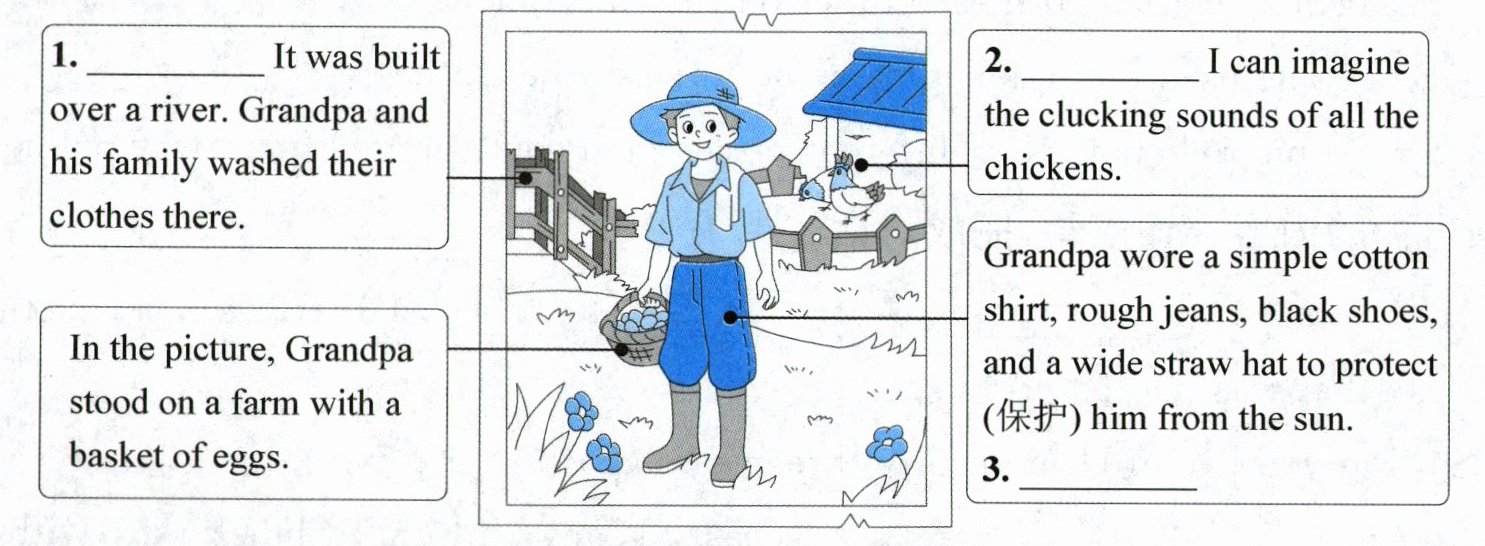
Yesterday I found a picture of my grandpa. He was only twelve years old at that time. It tells us a lot about the life in the past.
1.
In the picture, Grandpa stood on a farm with a basket of eggs.
2.
Grandpa wore a simple cotton shirt, rough jeans, black shoes, and a wide straw hat to protect (保护) him from the sun.
3.
A. My mother said that people made some of their own clothes back then.
B. Far behind Grandpa was a chicken coop(围栏).
C. There was an old wooden bridge on Grandpa's right.
4.
Yesterday I found a picture of my grandpa. He was only twelve years old at that time. It tells us a lot about the life in the past.
1.
C
It was built over a river. Grandpa and his family washed their clothes there.In the picture, Grandpa stood on a farm with a basket of eggs.
2.
B
I can imagine the clucking sounds of all the chickens.Grandpa wore a simple cotton shirt, rough jeans, black shoes, and a wide straw hat to protect (保护) him from the sun.
3.
A
A. My mother said that people made some of their own clothes back then.
B. Far behind Grandpa was a chicken coop(围栏).
C. There was an old wooden bridge on Grandpa's right.
4.
它告诉我们很多关于过去的生活。
答案
1. C 2. B 3. A 4. 它告诉我们很多关于过去的生活。
解析
【分析】
解题思路:先观察每个空后的句子描述,结合图片内容和选项语义匹配。第1空后提到“建在河上、家人在那里洗衣服”,对应选项C的木桥,桥建在河上符合语境;第2空后提到“鸡的咯咯声”,对应选项B的鸡围栏,围栏和鸡的声音呼应;第3空描述爷爷的穿着,对应选项A的自制衣服,和穿着描述衔接;最后翻译画线句,准确理解短语即可。
【解析】
1. 第1空:根据后文“它建在河上,爷爷和家人在那里洗衣服”,结合图片中爷爷右侧的木桥,选C(There was an old wooden bridge on Grandpa's right.),符合地点逻辑。
2. 第2空:根据后文“我能想象所有鸡的咯咯声”,结合图片中鸡的围栏,选B(Far behind Grandpa was a chicken coop.),围栏对应鸡的声音,逻辑通顺。
3. 第3空:根据前文描述爷爷的穿着,选项A(My mother said that people made some of their own clothes back then.)提到过去自制衣服,和穿着描述呼应,故选A。
4. 画线句翻译:“It tells us a lot about the life in the past.” 译为“它告诉我们很多关于过去的生活。”
【答案】
1. C 2. B 3. A 4. 它告诉我们很多关于过去的生活。
【知识点】
句子匹配、英译汉、词汇运用
【点评】
本题考查图文匹配、句子逻辑衔接及英译汉,需结合图片和上下文选句子,翻译时准确理解短语含义。
【难度系数】
0.7
七 阅读理解。(10分)
(A)
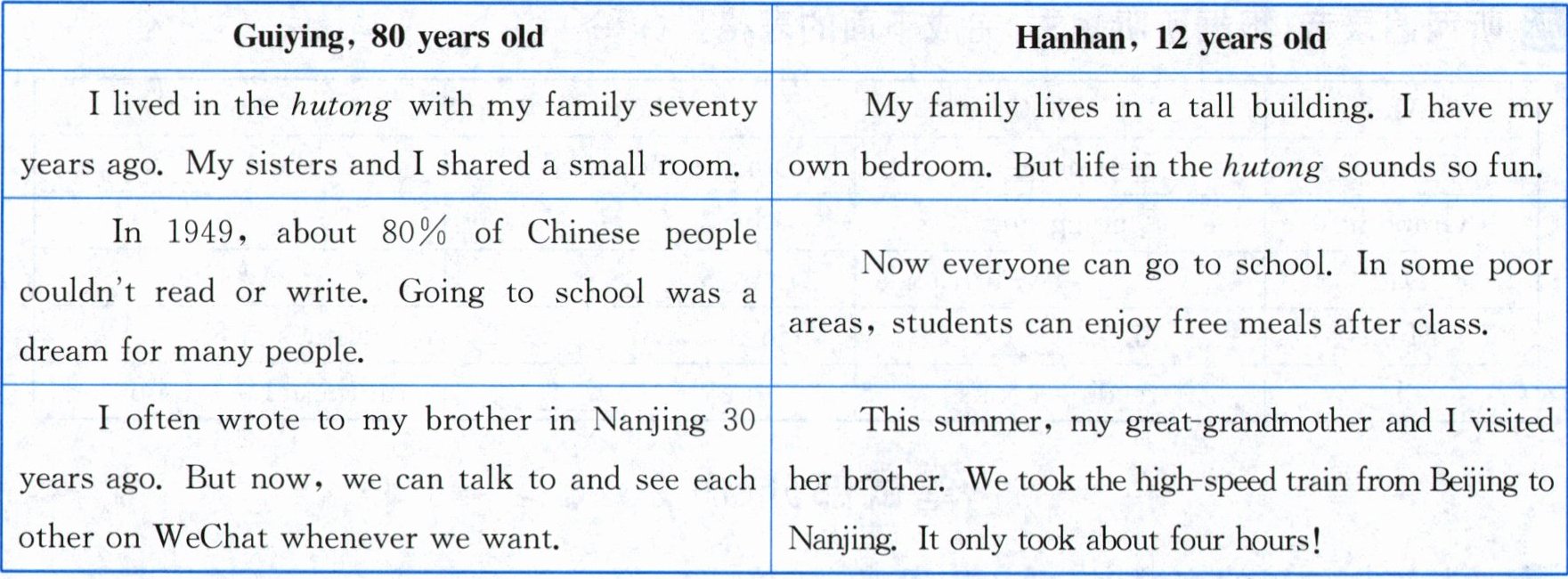
Hanhan's great-grandmother(曾祖母) Guiying often says to him, “When I was your age, life was different.” But how was it different?
阅读材料,判断正(T)误(F)。(5分)
(
(
(
(
(
(A)
Hanhan's great-grandmother(曾祖母) Guiying often says to him, “When I was your age, life was different.” But how was it different?
阅读材料,判断正(T)误(F)。(5分)
(
T
)1. Guiying lived in the hutong when she was little.(
F
)2. Hanhan lives in a tall building, but he does not have his own bedroom.(
F
)3. Guiying likes writing letters to her brother now.(
T
)4. Many Chinese people could not go to school many years ago.(
T
)5. We can infer that technology brings about a great change in Guiying's life.答案
(A) 1. T 2. F 3. F 4. T 5. T
解析
【分析】
做这类判断正误题的思路是:先明确每个小题的核心表述,再定位到原文对应人物的相关内容,对比表述是否一致,若涉及推理题则结合全文信息推导,最终判断对错。
【解析】
1. 定位Guiying的第一句原文:“I lived in the hutong with my family seventy years ago.”,说明她小时候(70年前)住胡同,与题目表述一致,故判断为T。
2. 定位Hanhan的第一句原文:“My family lives in a tall building. I have my own bedroom.”,说明Hanhan有自己的卧室,题目表述错误,故判断为F。
3. 定位Guiying的第三段原文:“I often wrote to my brother in Nanjing 30 years ago. But now, we can talk to and see each other on WeChat whenever we want.”,说明Guiying是30年前写信,现在用微信,题目说“现在喜欢写信”与原文不符,故判断为F。
4. 定位Guiying的第二段原文:“In 1949, about 80% of Chinese people couldn't read or write. Going to school was a dream for many people.”,说明很多年前很多中国人不能上学,与题目表述一致,故判断为T。
5. 结合Guiying的经历:过去靠写信联系、交通不便,现在用微信沟通、高铁出行,能看出科技带来了巨大变化,推理符合原文,故判断为T。
【答案】
1.T 2.F 3.F 4.T 5.T
【知识点】
阅读理解判断正误、细节理解、推理判断
【点评】
本题为阅读理解中的判断正误题,侧重考查学生对原文细节信息的定位与理解,以及简单的逻辑推理能力。解题时需注意区分时间状语(如“ago”“now”),避免因细节混淆出错。
【难度系数】
0.3
