

 登录
登录
B
[跨学科·语文]
Bamboo in the Rock
Upright stands the bamboo amid green mountains steep(陡峭的),
Its toothlike root in broken rock is planted deep.
It's strong and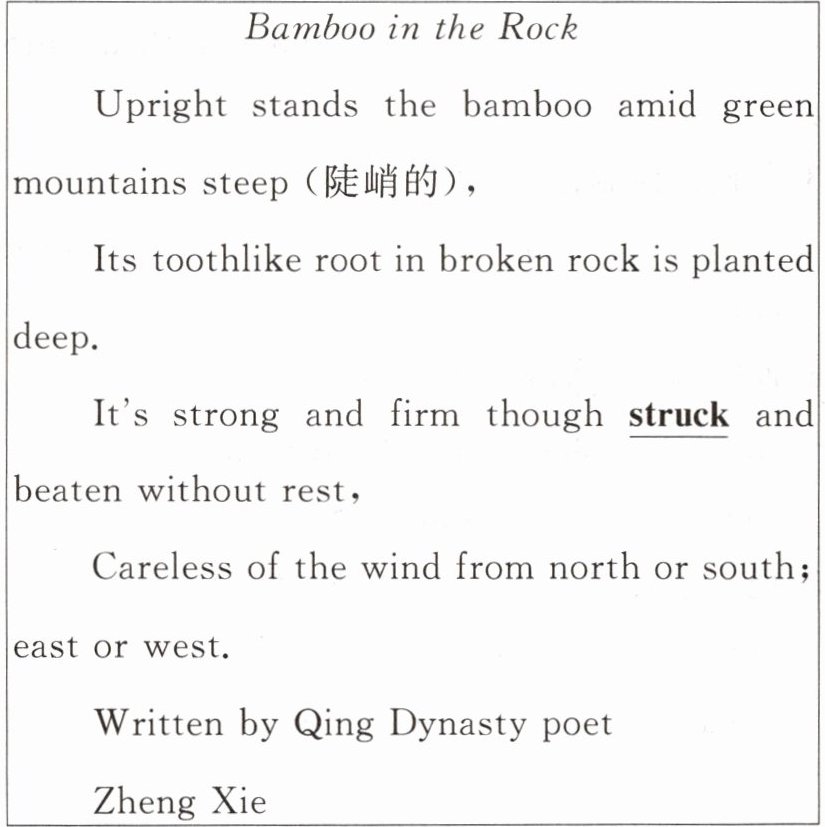 m though struck and beaten without rest,
Careless of the wind from north or south; east or west.
Written by Qing Dynasty poet
Zheng Xie
①The word “Upright” is an adjective (adj.). It means “straight”.
②The word “amid” is a preposition (prep.). It means “among”.
③The roots of a plant are the parts of it that grow under the ground.
④The text above was translated by Xu Yuanchong, who put his effort into translation for more than 80 years.
5. Which of the following is described in the text?

6. What does Zheng Xie think of bamboo?
A. Beautiful.
B. Successful.
C. Important.
D. Strong.
7. The underlined word “struck” probably means “
A. hit
B. touched
C. found
D. visited
8. The writer describes bamboo in the mountains in order to
A. teach English to children
B. introduce a plant
C. express his love for plants
D. show the quality of bamboo
9. The text is a
A. song
B. diary
C. poem
D. play
[跨学科·语文]
Bamboo in the Rock
Upright stands the bamboo amid green mountains steep(陡峭的),
Its toothlike root in broken rock is planted deep.
It's strong and
m though struck and beaten without rest,Careless of the wind from north or south; east or west.
Written by Qing Dynasty poet
Zheng Xie
①The word “Upright” is an adjective (adj.). It means “straight”.
②The word “amid” is a preposition (prep.). It means “among”.
③The roots of a plant are the parts of it that grow under the ground.
④The text above was translated by Xu Yuanchong, who put his effort into translation for more than 80 years.
5. Which of the following is described in the text?
6. What does Zheng Xie think of bamboo?
A. Beautiful.
B. Successful.
C. Important.
D. Strong.
7. The underlined word “struck” probably means “
A
” in the text.A. hit
B. touched
C. found
D. visited
8. The writer describes bamboo in the mountains in order to
D
.A. teach English to children
B. introduce a plant
C. express his love for plants
D. show the quality of bamboo
9. The text is a
C
.A. song
B. diary
C. poem
D. play
答案
5~9. ADADC
解析
【分析】
首先通读文本,明确文本是清代诗人郑燮《竹石》的英文译诗,针对各题目逐一分析:第5题需匹配文本描述的竹子形象;第6题定位文本中描述竹子特点的词汇,判断郑燮对竹子的看法;第7题根据并列结构猜测划线词词义;第8题分析作者描写竹子的写作意图;第9题判断文本的文体类型。
【解析】
5. 文本描述了生长在岩石中的竹子,结合选项插图,对应A选项(符合文本中“root in broken rock”等描述)。
6. 文本第三句提到“It's strong and...”,直接点明竹子的特点是强壮,因此郑燮认为竹子很强,选D。
7. 划线词“struck”与“beaten”是并列动作,“beaten”意为“击打”,因此“struck”意为“hit”,选A。
8. 作者通过描写竹子在恶劣环境中仍坚韧不拔,目的是展现竹子的品质,选D。
9. 文本是清代诗人郑燮的作品,具有诗歌的韵律和意象特点,属于诗,选C。
【答案】
ADADC
【知识点】
英语阅读理解、词义猜测、文体判断
【点评】
本题为跨学科英语阅读题,融合语文古诗知识,考查学生对文本细节、词义、写作意图及文体的理解,题型常规,难度适中。
【难度系数】
0.6
首先通读文本,明确文本是清代诗人郑燮《竹石》的英文译诗,针对各题目逐一分析:第5题需匹配文本描述的竹子形象;第6题定位文本中描述竹子特点的词汇,判断郑燮对竹子的看法;第7题根据并列结构猜测划线词词义;第8题分析作者描写竹子的写作意图;第9题判断文本的文体类型。
【解析】
5. 文本描述了生长在岩石中的竹子,结合选项插图,对应A选项(符合文本中“root in broken rock”等描述)。
6. 文本第三句提到“It's strong and...”,直接点明竹子的特点是强壮,因此郑燮认为竹子很强,选D。
7. 划线词“struck”与“beaten”是并列动作,“beaten”意为“击打”,因此“struck”意为“hit”,选A。
8. 作者通过描写竹子在恶劣环境中仍坚韧不拔,目的是展现竹子的品质,选D。
9. 文本是清代诗人郑燮的作品,具有诗歌的韵律和意象特点,属于诗,选C。
【答案】
ADADC
【知识点】
英语阅读理解、词义猜测、文体判断
【点评】
本题为跨学科英语阅读题,融合语文古诗知识,考查学生对文本细节、词义、写作意图及文体的理解,题型常规,难度适中。
【难度系数】
0.6
