

 登录
登录
4. 2026武汉期中 下表是深圳北到武汉的某次列车组运行时刻表。
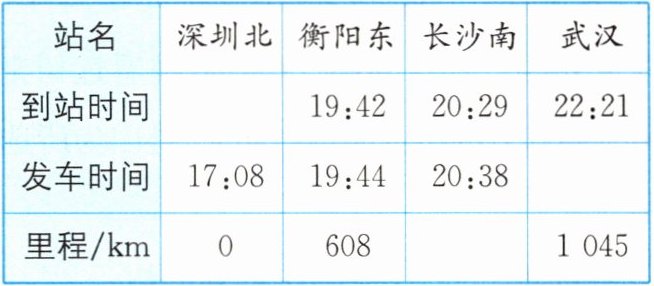
(1)求列车从深圳北到武汉的平均速度(保留整数)。
(2)该车从衡阳东到长沙南的平均速度为200 km/h,求衡阳东到长沙南的里程。
(3)有一辆长为10 m、宽为4 m的货车在宽为16 m的公路正中间以10 m/s的速度匀速行驶,某一时刻有一个学生在货车正前方20 m处的马路边上准备过马路,如果学生能保证安全,求学生的速度范围。
(1)求列车从深圳北到武汉的平均速度(保留整数)。
(2)该车从衡阳东到长沙南的平均速度为200 km/h,求衡阳东到长沙南的里程。
(3)有一辆长为10 m、宽为4 m的货车在宽为16 m的公路正中间以10 m/s的速度匀速行驶,某一时刻有一个学生在货车正前方20 m处的马路边上准备过马路,如果学生能保证安全,求学生的速度范围。
答案
(1)由列车组运行时刻表可知,深圳北到武汉的总路程$s_1=1\ 045\ \mathrm{km}$,深圳北到武汉的运行时间$t_1=22:21-17:08=5\ \mathrm{h}\ 13\ \mathrm{min}=5\frac{13}{60}\ \mathrm{h}$,列车从深圳北到武汉的平均速度$v_1=\frac{s_1}{t_1}=\frac{1\ 045\ \mathrm{km}}{5\frac{13}{60}\ \mathrm{h}}=200\ \mathrm{km/h}$。
(2)该车从衡阳东到长沙南的运行时间$t_2=20:29-19:44=45\ \mathrm{min}=0.75\ \mathrm{h}$;由$v=\frac{s}{t}$可得,衡阳东到长沙南的里程$s_2=v_2t_2=200\ \mathrm{km/h}×0.75\ \mathrm{h}=150\ \mathrm{km}$。
(3)由题可知,学生要安全通过,有两种情况:
①若货车到达前学生通过,则学生需通过的路程$s_{\mathrm{学生}1}=\frac{16\ \mathrm{m}}{2}+\frac{4\ \mathrm{m}}{2}=10\ \mathrm{m}$,货车需通过的路程$s_{\mathrm{货车}1}=20\ \mathrm{m}$,所以货车行驶时间$t_{\mathrm{货车}1}=\frac{s_{\mathrm{货车}1}}{v_\mathrm{车}}=\frac{20\ \mathrm{m}}{10\ \mathrm{m/s}}=2\ \mathrm{s}$,此时学生的速度$v_{\mathrm{学生}1}=\frac{s_{\mathrm{学生}1}}{t_{\mathrm{学生}1}}=\frac{s_{\mathrm{学生}1}}{t_{\mathrm{货车}1}}=\frac{10\ \mathrm{m}}{2\ \mathrm{s}}=5\ \mathrm{m/s}$;②若货车通过后学生通过,则学生需通过的路程$s_{\mathrm{学生}2}=\frac{16\ \mathrm{m}}{2}-\frac{4\ \mathrm{m}}{2}=6\ \mathrm{m}$,货车需通过的路程$s_{\mathrm{货车}2}=20\ \mathrm{m}+10\ \mathrm{m}=30\ \mathrm{m}$,所以货车行驶时间$t_{\mathrm{货车}2}=\frac{s_{\mathrm{货车}2}}{v_\mathrm{车}}=\frac{30\ \mathrm{m}}{10\ \mathrm{m/s}}=3\ \mathrm{s}$,此时学生的速度$v_{\mathrm{学生}2}=\frac{s_{\mathrm{学生}2}}{t_{\mathrm{学生}2}}=\frac{s_{\mathrm{学生}2}}{t_{\mathrm{货车}2}}=\frac{6\ \mathrm{m}}{3\ \mathrm{s}}=2\ \mathrm{m/s}$。综上,学生要安全通过,学生的速度要高于5 m/s,或低于2 m/s。
(2)该车从衡阳东到长沙南的运行时间$t_2=20:29-19:44=45\ \mathrm{min}=0.75\ \mathrm{h}$;由$v=\frac{s}{t}$可得,衡阳东到长沙南的里程$s_2=v_2t_2=200\ \mathrm{km/h}×0.75\ \mathrm{h}=150\ \mathrm{km}$。
(3)由题可知,学生要安全通过,有两种情况:
①若货车到达前学生通过,则学生需通过的路程$s_{\mathrm{学生}1}=\frac{16\ \mathrm{m}}{2}+\frac{4\ \mathrm{m}}{2}=10\ \mathrm{m}$,货车需通过的路程$s_{\mathrm{货车}1}=20\ \mathrm{m}$,所以货车行驶时间$t_{\mathrm{货车}1}=\frac{s_{\mathrm{货车}1}}{v_\mathrm{车}}=\frac{20\ \mathrm{m}}{10\ \mathrm{m/s}}=2\ \mathrm{s}$,此时学生的速度$v_{\mathrm{学生}1}=\frac{s_{\mathrm{学生}1}}{t_{\mathrm{学生}1}}=\frac{s_{\mathrm{学生}1}}{t_{\mathrm{货车}1}}=\frac{10\ \mathrm{m}}{2\ \mathrm{s}}=5\ \mathrm{m/s}$;②若货车通过后学生通过,则学生需通过的路程$s_{\mathrm{学生}2}=\frac{16\ \mathrm{m}}{2}-\frac{4\ \mathrm{m}}{2}=6\ \mathrm{m}$,货车需通过的路程$s_{\mathrm{货车}2}=20\ \mathrm{m}+10\ \mathrm{m}=30\ \mathrm{m}$,所以货车行驶时间$t_{\mathrm{货车}2}=\frac{s_{\mathrm{货车}2}}{v_\mathrm{车}}=\frac{30\ \mathrm{m}}{10\ \mathrm{m/s}}=3\ \mathrm{s}$,此时学生的速度$v_{\mathrm{学生}2}=\frac{s_{\mathrm{学生}2}}{t_{\mathrm{学生}2}}=\frac{s_{\mathrm{学生}2}}{t_{\mathrm{货车}2}}=\frac{6\ \mathrm{m}}{3\ \mathrm{s}}=2\ \mathrm{m/s}$。综上,学生要安全通过,学生的速度要高于5 m/s,或低于2 m/s。
解析
【分析】
本题围绕速度公式 $ v = \frac{s}{t} $ 展开,分三个小问题:第(1)问需从列车时刻表提取总路程和总时间,代入平均速度公式计算;第(2)问先求衡阳东到长沙南的运行时间,再用 $ s = vt $ 计算里程;第(3)问需分两种情况讨论学生安全过马路的速度范围,即学生在货车到达前通过、或货车完全通过后通过,分别计算对应速度。
【解析】
(1) 由列车时刻表得,深圳北到武汉的总路程 $ s_1 = 1045\ \mathrm{km} $,总运行时间:
$ t_1 = 22:21 - 17:08 = 5\ \mathrm{h}\ 13\ \mathrm{min} = \frac{313}{60}\ \mathrm{h} $
根据平均速度公式 $ v = \frac{s}{t} $,得:
$ v_1 = \frac{s_1}{t_1} = \frac{1045\ \mathrm{km}}{\frac{313}{60}\ \mathrm{h}} \approx 200\ \mathrm{km/h} $
(2) 衡阳东到长沙南的运行时间:
$ t_2 = 20:29 - 19:44 = 45\ \mathrm{min} = 0.75\ \mathrm{h} $
已知该段平均速度 $ v_2 = 200\ \mathrm{km/h} $,由 $ s = vt $ 得里程:
$ s_2 = v_2 t_2 = 200\ \mathrm{km/h} × 0.75\ \mathrm{h} = 150\ \mathrm{km} $
(3) 学生安全过马路分两种情况:
① 货车到达前学生通过:
学生需通过的路程 $ s_{\mathrm{学生}1} = \frac{16\ \mathrm{m}}{2} + \frac{4\ \mathrm{m}}{2} = 10\ \mathrm{m} $,货车需通过的路程 $ s_{\mathrm{货车}1} = 20\ \mathrm{m} $,货车行驶时间:
$ t_{\mathrm{货车}1} = \frac{s_{\mathrm{货车}1}}{v_{\mathrm{车}}} = \frac{20\ \mathrm{m}}{10\ \mathrm{m/s}} = 2\ \mathrm{s} $
学生速度需满足 $ v_{\mathrm{学生}1} = \frac{s_{\mathrm{学生}1}}{t_{\mathrm{货车}1}} = \frac{10\ \mathrm{m}}{2\ \mathrm{s}} = 5\ \mathrm{m/s} $,即速度大于5 m/s。
② 货车通过后学生通过:
学生需通过的路程 $ s_{\mathrm{学生}2} = \frac{16\ \mathrm{m}}{2} - \frac{4\ \mathrm{m}}{2} = 6\ \mathrm{m} $,货车需通过的路程 $ s_{\mathrm{货车}2} = 20\ \mathrm{m} + 10\ \mathrm{m} = 30\ \mathrm{m} $,货车行驶时间:
$ t_{\mathrm{货车}2} = \frac{s_{\mathrm{货车}2}}{v_{\mathrm{车}}} = \frac{30\ \mathrm{m}}{10\ \mathrm{m/s}} = 3\ \mathrm{s} $
学生速度需满足 $ v_{\mathrm{学生}2} = \frac{s_{\mathrm{学生}2}}{t_{\mathrm{货车}2}} = \frac{6\ \mathrm{m}}{3\ \mathrm{s}} = 2\ \mathrm{m/s} $,即速度小于2 m/s。
综上,学生安全的速度范围是:速度高于5 m/s,或低于2 m/s。
【答案】
(1) 200 km/h;(2) 150 km;(3) 学生速度高于5 m/s或低于2 m/s
【知识点】
平均速度计算、速度公式应用、运动学实际问题
【点评】
本题结合列车时刻表和生活实际场景,考查速度公式的灵活应用,第(3)问需分情况讨论,培养学生的逻辑分析能力,是一道联系实际的运动学基础题。
【难度系数】
0.5
本题围绕速度公式 $ v = \frac{s}{t} $ 展开,分三个小问题:第(1)问需从列车时刻表提取总路程和总时间,代入平均速度公式计算;第(2)问先求衡阳东到长沙南的运行时间,再用 $ s = vt $ 计算里程;第(3)问需分两种情况讨论学生安全过马路的速度范围,即学生在货车到达前通过、或货车完全通过后通过,分别计算对应速度。
【解析】
(1) 由列车时刻表得,深圳北到武汉的总路程 $ s_1 = 1045\ \mathrm{km} $,总运行时间:
$ t_1 = 22:21 - 17:08 = 5\ \mathrm{h}\ 13\ \mathrm{min} = \frac{313}{60}\ \mathrm{h} $
根据平均速度公式 $ v = \frac{s}{t} $,得:
$ v_1 = \frac{s_1}{t_1} = \frac{1045\ \mathrm{km}}{\frac{313}{60}\ \mathrm{h}} \approx 200\ \mathrm{km/h} $
(2) 衡阳东到长沙南的运行时间:
$ t_2 = 20:29 - 19:44 = 45\ \mathrm{min} = 0.75\ \mathrm{h} $
已知该段平均速度 $ v_2 = 200\ \mathrm{km/h} $,由 $ s = vt $ 得里程:
$ s_2 = v_2 t_2 = 200\ \mathrm{km/h} × 0.75\ \mathrm{h} = 150\ \mathrm{km} $
(3) 学生安全过马路分两种情况:
① 货车到达前学生通过:
学生需通过的路程 $ s_{\mathrm{学生}1} = \frac{16\ \mathrm{m}}{2} + \frac{4\ \mathrm{m}}{2} = 10\ \mathrm{m} $,货车需通过的路程 $ s_{\mathrm{货车}1} = 20\ \mathrm{m} $,货车行驶时间:
$ t_{\mathrm{货车}1} = \frac{s_{\mathrm{货车}1}}{v_{\mathrm{车}}} = \frac{20\ \mathrm{m}}{10\ \mathrm{m/s}} = 2\ \mathrm{s} $
学生速度需满足 $ v_{\mathrm{学生}1} = \frac{s_{\mathrm{学生}1}}{t_{\mathrm{货车}1}} = \frac{10\ \mathrm{m}}{2\ \mathrm{s}} = 5\ \mathrm{m/s} $,即速度大于5 m/s。
② 货车通过后学生通过:
学生需通过的路程 $ s_{\mathrm{学生}2} = \frac{16\ \mathrm{m}}{2} - \frac{4\ \mathrm{m}}{2} = 6\ \mathrm{m} $,货车需通过的路程 $ s_{\mathrm{货车}2} = 20\ \mathrm{m} + 10\ \mathrm{m} = 30\ \mathrm{m} $,货车行驶时间:
$ t_{\mathrm{货车}2} = \frac{s_{\mathrm{货车}2}}{v_{\mathrm{车}}} = \frac{30\ \mathrm{m}}{10\ \mathrm{m/s}} = 3\ \mathrm{s} $
学生速度需满足 $ v_{\mathrm{学生}2} = \frac{s_{\mathrm{学生}2}}{t_{\mathrm{货车}2}} = \frac{6\ \mathrm{m}}{3\ \mathrm{s}} = 2\ \mathrm{m/s} $,即速度小于2 m/s。
综上,学生安全的速度范围是:速度高于5 m/s,或低于2 m/s。
【答案】
(1) 200 km/h;(2) 150 km;(3) 学生速度高于5 m/s或低于2 m/s
【知识点】
平均速度计算、速度公式应用、运动学实际问题
【点评】
本题结合列车时刻表和生活实际场景,考查速度公式的灵活应用,第(3)问需分情况讨论,培养学生的逻辑分析能力,是一道联系实际的运动学基础题。
【难度系数】
0.5
5. 立德树人+安全意识 “闯黄灯”已成为引发路口交通事故的主因之一,如图所示,在某十字路口,交通信号灯红灯亮之前,会有3 s亮黄灯的时间。当东西方向的交通信号灯变为绿灯时,甲车向西运动且车头恰好到达停止线A处;此时南北方向的交通信号灯恰好由黄灯变为红灯,乙车向北运动且车尾恰好到达停止线B处,过了停止线的乙车继续向前行驶。若两车始终如图所示紧靠道路中心线保持匀速行驶,且$v_乙=8\ \mathrm{m/s}$,两车的尺寸均为:长度$L=4\ \mathrm{m}$,宽度$d=2\ \mathrm{m}$。停止线到前方道路中心线的距离均为14 m。求:
(1)黄灯刚亮时,乙车车头到停止线B的距离。
(2)甲车车速在什么范围,甲、乙两车不相撞。

(1)黄灯刚亮时,乙车车头到停止线B的距离。
(2)甲车车速在什么范围,甲、乙两车不相撞。
答案
(1)黄灯亮起的时间内,乙车行驶的距离$s_\mathrm{乙}=v_\mathrm{乙}t_\mathrm{黄}=8\ \mathrm{m/s}×3\ \mathrm{s}=24\ \mathrm{m}$,因为黄灯结束时,乙车车尾恰好到达停止线B,所以黄灯刚亮时,乙车车头到停止线B的距离$s_\mathrm{头}=s_\mathrm{乙}-L=24\ \mathrm{m}-4\ \mathrm{m}=20\ \mathrm{m}$。
(2)取两种极端的情况,①当甲车的车头刚好撞上乙车的车尾时,甲车行驶的路程$s_1=14\ \mathrm{m}-2\ \mathrm{m}=12\ \mathrm{m}$,乙车行驶的路程$s_2=14\ \mathrm{m}+2\ \mathrm{m}=16\ \mathrm{m}$,已知$v_\mathrm{乙}=8\ \mathrm{m/s}$,则此时甲、乙两车行驶的时间$t=\frac{s_2}{v_\mathrm{乙}}=\frac{16\ \mathrm{m}}{8\ \mathrm{m/s}}=2\ \mathrm{s}$,此时甲车的速度$v_\mathrm{甲}=\frac{s_1}{t}=\frac{12\ \mathrm{m}}{2\ \mathrm{s}}=6\ \mathrm{m/s}$,即甲车的平均速度小于6 m/s不会撞上乙车;
②当乙车的车头刚好撞上甲车的车尾,则有甲车行驶的路程$s_1'=14\ \mathrm{m}+4\ \mathrm{m}=18\ \mathrm{m}$,乙车行驶的路程$s_2'=14\ \mathrm{m}-4\ \mathrm{m}=10\ \mathrm{m}$,此时甲、乙两车行驶的时间$t'=\frac{s_2'}{v_\mathrm{乙}}=\frac{10\ \mathrm{m}}{8\ \mathrm{m/s}}=1.25\ \mathrm{s}$,此时甲车的速度$v_\mathrm{甲}'=\frac{s_1'}{t'}=\frac{18\ \mathrm{m}}{1.25\ \mathrm{s}}=14.4\ \mathrm{m/s}$,即甲车的平均速度大于14.4 m/s,不会撞上乙车。综上所述,甲车车速小于6 m/s或大于14.4 m/s时,甲、乙两车不相撞。
(2)取两种极端的情况,①当甲车的车头刚好撞上乙车的车尾时,甲车行驶的路程$s_1=14\ \mathrm{m}-2\ \mathrm{m}=12\ \mathrm{m}$,乙车行驶的路程$s_2=14\ \mathrm{m}+2\ \mathrm{m}=16\ \mathrm{m}$,已知$v_\mathrm{乙}=8\ \mathrm{m/s}$,则此时甲、乙两车行驶的时间$t=\frac{s_2}{v_\mathrm{乙}}=\frac{16\ \mathrm{m}}{8\ \mathrm{m/s}}=2\ \mathrm{s}$,此时甲车的速度$v_\mathrm{甲}=\frac{s_1}{t}=\frac{12\ \mathrm{m}}{2\ \mathrm{s}}=6\ \mathrm{m/s}$,即甲车的平均速度小于6 m/s不会撞上乙车;
②当乙车的车头刚好撞上甲车的车尾,则有甲车行驶的路程$s_1'=14\ \mathrm{m}+4\ \mathrm{m}=18\ \mathrm{m}$,乙车行驶的路程$s_2'=14\ \mathrm{m}-4\ \mathrm{m}=10\ \mathrm{m}$,此时甲、乙两车行驶的时间$t'=\frac{s_2'}{v_\mathrm{乙}}=\frac{10\ \mathrm{m}}{8\ \mathrm{m/s}}=1.25\ \mathrm{s}$,此时甲车的速度$v_\mathrm{甲}'=\frac{s_1'}{t'}=\frac{18\ \mathrm{m}}{1.25\ \mathrm{s}}=14.4\ \mathrm{m/s}$,即甲车的平均速度大于14.4 m/s,不会撞上乙车。综上所述,甲车车速小于6 m/s或大于14.4 m/s时,甲、乙两车不相撞。
解析
【分析】
要解决这道题,需明确两车的运动状态:甲车向西匀速行驶,乙车向北匀速行驶,结合黄灯时间、两车尺寸及路口距离分析位移关系。
(1) 第一问中,先根据匀速运动公式算出黄灯时间内乙车行驶的距离,再结合“黄灯结束时乙车车尾到达停止线B”,即可求出黄灯刚亮时乙车车头到停止线B的距离。
(2) 第二问需考虑两车不相撞的两种临界情况:①甲车速度过慢,在乙车通过路口前甲车未到达,此时甲车车头刚好撞上乙车车尾;②甲车速度过快,在乙车通过路口前甲车已完全通过,此时乙车车头刚好撞上甲车车尾。分别计算两种临界情况的甲车速度,就能得到不相撞的速度范围。
【解析】
(1) 已知黄灯时间$ t_{\mathrm{黄}}=3\ \mathrm{s} $,乙车速度$ v_{\mathrm{乙}}=8\ \mathrm{m/s} $,根据匀速直线运动位移公式$ s=vt $,黄灯时间内乙车行驶的距离:
$ s_{\mathrm{乙}}=v_{\mathrm{乙}}t_{\mathrm{黄}}=8\ \mathrm{m/s} × 3\ \mathrm{s}=24\ \mathrm{m} $
因为黄灯结束时乙车车尾恰好到达停止线B,所以黄灯刚亮时,乙车车头到停止线B的距离为乙车行驶距离减去车长$ L $:
$ s_{\mathrm{头}}=s_{\mathrm{乙}} - L=24\ \mathrm{m} - 4\ \mathrm{m}=20\ \mathrm{m} $
(2) 两车不相撞需分析两种临界情况:
① 当甲车车头刚好撞上乙车车尾时:
甲车行驶的路程为停止线A到道路中心线的距离减去乙车宽度,即$ s_1=14\ \mathrm{m} - 2\ \mathrm{m}=12\ \mathrm{m} $;
乙车行驶的路程为停止线B到道路中心线的距离加上甲车宽度,即$ s_2=14\ \mathrm{m} + 2\ \mathrm{m}=16\ \mathrm{m} $;
两车运动时间相同,$ t=\frac{s_2}{v_{\mathrm{乙}}}=\frac{16\ \mathrm{m}}{8\ \mathrm{m/s}}=2\ \mathrm{s} $;
此时甲车速度$ v_{\mathrm{甲}}=\frac{s_1}{t}=\frac{12\ \mathrm{m}}{2\ \mathrm{s}}=6\ \mathrm{m/s} $,即甲车速度小于6 m/s时,不会撞上乙车。
② 当乙车车头刚好撞上甲车车尾时:
甲车行驶的路程为停止线A到道路中心线的距离加上甲车长度,即$ s_1'=14\ \mathrm{m} + 4\ \mathrm{m}=18\ \mathrm{m} $;
乙车行驶的路程为停止线B到道路中心线的距离减去乙车长度,即$ s_2'=14\ \mathrm{m} - 4\ \mathrm{m}=10\ \mathrm{m} $;
两车运动时间相同,$ t'=\frac{s_2'}{v_{\mathrm{乙}}}=\frac{10\ \mathrm{m}}{8\ \mathrm{m/s}}=1.25\ \mathrm{s} $;
此时甲车速度$ v_{\mathrm{甲}}'=\frac{s_1'}{t'}=\frac{18\ \mathrm{m}}{1.25\ \mathrm{s}}=14.4\ \mathrm{m/s} $,即甲车速度大于14.4 m/s时,不会撞上乙车。
综上,甲车车速小于6 m/s或大于14.4 m/s时,甲、乙两车不相撞。
【答案】
(1) 20 m;(2) 甲车车速小于6 m/s或大于14.4 m/s时,两车不相撞。
【知识点】
匀速直线运动、速度公式应用
【点评】
本题结合实际交通场景,考查匀速直线运动的位移分析,需理清两车运动关系和临界条件,重点是找准两种碰撞临界情况的位移关系,难度适中。
【难度系数】
0.3
要解决这道题,需明确两车的运动状态:甲车向西匀速行驶,乙车向北匀速行驶,结合黄灯时间、两车尺寸及路口距离分析位移关系。
(1) 第一问中,先根据匀速运动公式算出黄灯时间内乙车行驶的距离,再结合“黄灯结束时乙车车尾到达停止线B”,即可求出黄灯刚亮时乙车车头到停止线B的距离。
(2) 第二问需考虑两车不相撞的两种临界情况:①甲车速度过慢,在乙车通过路口前甲车未到达,此时甲车车头刚好撞上乙车车尾;②甲车速度过快,在乙车通过路口前甲车已完全通过,此时乙车车头刚好撞上甲车车尾。分别计算两种临界情况的甲车速度,就能得到不相撞的速度范围。
【解析】
(1) 已知黄灯时间$ t_{\mathrm{黄}}=3\ \mathrm{s} $,乙车速度$ v_{\mathrm{乙}}=8\ \mathrm{m/s} $,根据匀速直线运动位移公式$ s=vt $,黄灯时间内乙车行驶的距离:
$ s_{\mathrm{乙}}=v_{\mathrm{乙}}t_{\mathrm{黄}}=8\ \mathrm{m/s} × 3\ \mathrm{s}=24\ \mathrm{m} $
因为黄灯结束时乙车车尾恰好到达停止线B,所以黄灯刚亮时,乙车车头到停止线B的距离为乙车行驶距离减去车长$ L $:
$ s_{\mathrm{头}}=s_{\mathrm{乙}} - L=24\ \mathrm{m} - 4\ \mathrm{m}=20\ \mathrm{m} $
(2) 两车不相撞需分析两种临界情况:
① 当甲车车头刚好撞上乙车车尾时:
甲车行驶的路程为停止线A到道路中心线的距离减去乙车宽度,即$ s_1=14\ \mathrm{m} - 2\ \mathrm{m}=12\ \mathrm{m} $;
乙车行驶的路程为停止线B到道路中心线的距离加上甲车宽度,即$ s_2=14\ \mathrm{m} + 2\ \mathrm{m}=16\ \mathrm{m} $;
两车运动时间相同,$ t=\frac{s_2}{v_{\mathrm{乙}}}=\frac{16\ \mathrm{m}}{8\ \mathrm{m/s}}=2\ \mathrm{s} $;
此时甲车速度$ v_{\mathrm{甲}}=\frac{s_1}{t}=\frac{12\ \mathrm{m}}{2\ \mathrm{s}}=6\ \mathrm{m/s} $,即甲车速度小于6 m/s时,不会撞上乙车。
② 当乙车车头刚好撞上甲车车尾时:
甲车行驶的路程为停止线A到道路中心线的距离加上甲车长度,即$ s_1'=14\ \mathrm{m} + 4\ \mathrm{m}=18\ \mathrm{m} $;
乙车行驶的路程为停止线B到道路中心线的距离减去乙车长度,即$ s_2'=14\ \mathrm{m} - 4\ \mathrm{m}=10\ \mathrm{m} $;
两车运动时间相同,$ t'=\frac{s_2'}{v_{\mathrm{乙}}}=\frac{10\ \mathrm{m}}{8\ \mathrm{m/s}}=1.25\ \mathrm{s} $;
此时甲车速度$ v_{\mathrm{甲}}'=\frac{s_1'}{t'}=\frac{18\ \mathrm{m}}{1.25\ \mathrm{s}}=14.4\ \mathrm{m/s} $,即甲车速度大于14.4 m/s时,不会撞上乙车。
综上,甲车车速小于6 m/s或大于14.4 m/s时,甲、乙两车不相撞。
【答案】
(1) 20 m;(2) 甲车车速小于6 m/s或大于14.4 m/s时,两车不相撞。
【知识点】
匀速直线运动、速度公式应用
【点评】
本题结合实际交通场景,考查匀速直线运动的位移分析,需理清两车运动关系和临界条件,重点是找准两种碰撞临界情况的位移关系,难度适中。
【难度系数】
0.3
