

 登录
1. 一元二次方程 $x^{2}-px + q = 0(p^{2}-4q>0)$ 的两个根是(
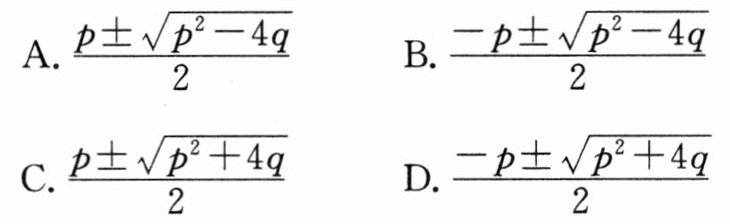
A.$\frac{p\pm\sqrt{p^{2}-4q}}{2}$
B.$\frac{-p\pm\sqrt{p^{2}-4q}}{2}$
C.$\frac{p\pm\sqrt{p^{2}+4q}}{2}$
D.$\frac{-p\pm\sqrt{p^{2}+4q}}{2}$
A
)A.$\frac{p\pm\sqrt{p^{2}-4q}}{2}$
B.$\frac{-p\pm\sqrt{p^{2}-4q}}{2}$
C.$\frac{p\pm\sqrt{p^{2}+4q}}{2}$
D.$\frac{-p\pm\sqrt{p^{2}+4q}}{2}$
答案
1.A
解析
解:对于一元二次方程 $x^{2}-px + q = 0$,其中 $a = 1$,$b=-p$,$c = q$。
判别式$\Delta=b^{2}-4ac=(-p)^{2}-4×1× q=p^{2}-4q$,已知$p^{2}-4q>0$,方程有两个不相等的实数根。
由求根公式可得:$x=\frac{-b\pm\sqrt{\Delta}}{2a}=\frac{p\pm\sqrt{p^{2}-4q}}{2}$
答案:A
2. 用公式法解方程:$2x^{2}+4x = x + 2$.
解:方程化为一般形式,得
$\because a=$
$\therefore\Delta = b^{2}-4ac=$
$\therefore$方程有
$x=\frac{-b\pm\sqrt{b^{2}-4ac}}{2a}=$
即 $x_{1}=$
解:方程化为一般形式,得
2x^{2}+3x-2=0
.$\because a=$
2
,$b=$3
,$c=$-2
,$\therefore\Delta = b^{2}-4ac=$
25
$>0$.$\therefore$方程有
两个不相等的
实数根,为$x=\frac{-b\pm\sqrt{b^{2}-4ac}}{2a}=$
\frac{-3\pm\sqrt{25}}{2×2}
,即 $x_{1}=$
\frac{1}{2}
,$x_{2}=$-2
.答案
$2.2x^{2}+3x-2=0 2 3 -2 25 $两个不相等的$ \frac{-3\pm\sqrt{25}}{2×2}$
$ \frac{1}{2} -2$
3. 方程 $2x^{2}-x - 1 = 0$ 的根是
x_{1}=1,x_{2}=-\frac{1}{2}
.答案
$3.x_{1}=1,x_{2}=-\frac{1}{2}$
4. 用公式法解下列方程:
(1) $x^{2}-3x + 2 = 0$.
(2) $2x^{2}+5x - 3 = 0$.
(3) $x^{2}+10 = 2\sqrt{5}x$.
(4) $x^{2}-4x = x-\frac{25}{4}$.
答案
4.解:$(1)\because a=1,b=-3,c=2,\therefore\Delta=b^{2}-4ac=(-3)^{2}-4×1×2=1$
$>0.\therefore$方程有两个不相等的实数根$.\therefore x=\frac{3\pm\sqrt{1}}{2×2}=\frac{3\pm1}{2}.\therefore x_{1}=2,$
$x_{2}=1.(2)\because a=2,b=5,c=-3,\therefore\Delta=b^{2}-4ac=5^{2}-4×2×(-3)$
$=49>0.\therefore$方程有两个不相等的实数根$.\therefore x=\frac{-5\pm\sqrt{49}}{2×2}=$
$\frac{-5\pm7}{4}.\therefore x_{1}=-3,x_{2}=\frac{1}{2}.(3)x^{2}-2\sqrt{5}x+10=0,\therefore a=1,b=$
$-2\sqrt{5},c=10,\Delta=b^{2}-4ac=(-2\sqrt{5})^{2}-4×1×10=-20<0.$
$\therefore$此方程无实数根$.(4)x^{2}-5x+\frac{25}{4}=0,\because a=1,b=-5,c=\frac{25}{4}$
$\therefore\Delta=b^{2}-4ac=(-5)^{2}-4×1×\frac{25}{4}=0.\therefore$方程有两个相等的实数
根$.\therefore x=\frac{5\pm\sqrt{0}}{2}.\therefore x_{1}=x_{2}=\frac{5}{2}.$
5. 若代数式 $3x^{2}+1$ 的值与 $x + 3$ 的值相等,求 $x$ 的值.
答案
5.解:由题意,得$3x^{2}+1=x+3,$整理,得$3x^{2}-x-2=0.\because a=3,b=$
$-1,c=-2,\therefore\Delta=b^{2}-4ac=(-1)^{2}-4×3×(-2)=25>0.\therefore$方程
有两个不相等的实数根$.\therefore x=\frac{1\pm\sqrt{25}}{2×3}=\frac{1\pm5}{6}.\therefore x_{1}=-\frac{2}{3},x_{2}=$
1.故x的值为$-\frac{2}{3}$或1.
6. 小明在利用公式法解方程 $x^{2}-5x = 1$ 时出现了错误,他的解答过程如下:
$\because a = 1$,$b=-5$,$c = 1$,(第一步)
$\therefore\Delta = b^{2}-4ac=(-5)^{2}-4×1×1 = 21>0$.(第二步)
$\therefore$方程有两个不相等的实数根.
$\therefore x=\frac{5\pm\sqrt{21}}{2}$.(第三步)
$\therefore x_{1}=\frac{5+\sqrt{21}}{2}$,$x_{2}=\frac{5-\sqrt{21}}{2}$.(第四步)
(1) 小明的解答过程是从第
(2) 写出此题正确的解答过程.
$\because a = 1$,$b=-5$,$c = 1$,(第一步)
$\therefore\Delta = b^{2}-4ac=(-5)^{2}-4×1×1 = 21>0$.(第二步)
$\therefore$方程有两个不相等的实数根.
$\therefore x=\frac{5\pm\sqrt{21}}{2}$.(第三步)
$\therefore x_{1}=\frac{5+\sqrt{21}}{2}$,$x_{2}=\frac{5-\sqrt{21}}{2}$.(第四步)
(1) 小明的解答过程是从第
一
步开始出错的.(2) 写出此题正确的解答过程.
答案
6.解:
(1)-
(2)方程化为一般形式,得$x^{2}-5x-1=0.\because a=1,b=$
$-5,c=-1,\therefore\Delta=b^{2}-4ac=(-5)^{2}-4×1×(-1)=29>0.\therefore$方程
有两个不相等的实数根$.\therefore x=\frac{5\pm\sqrt{29}}{2}.\therefore x_{1}=\frac{5+\sqrt{29}}{2},x_{2}=\frac${
$5-\sqrt{29}$}{2}
