

 登录
登录
Ⅳ. 任务型阅读(每题1分,满分10分)
阅读下面的短文,并根据所读内容在文章后表格中的空格里填入一个最恰当的单词。(每空一词)
逐题讲解
Maps mark(标记) seas, countries, cities and our homes, and guide us through the world. To know them better, let’s take a look at how maps have changed over the centuries.
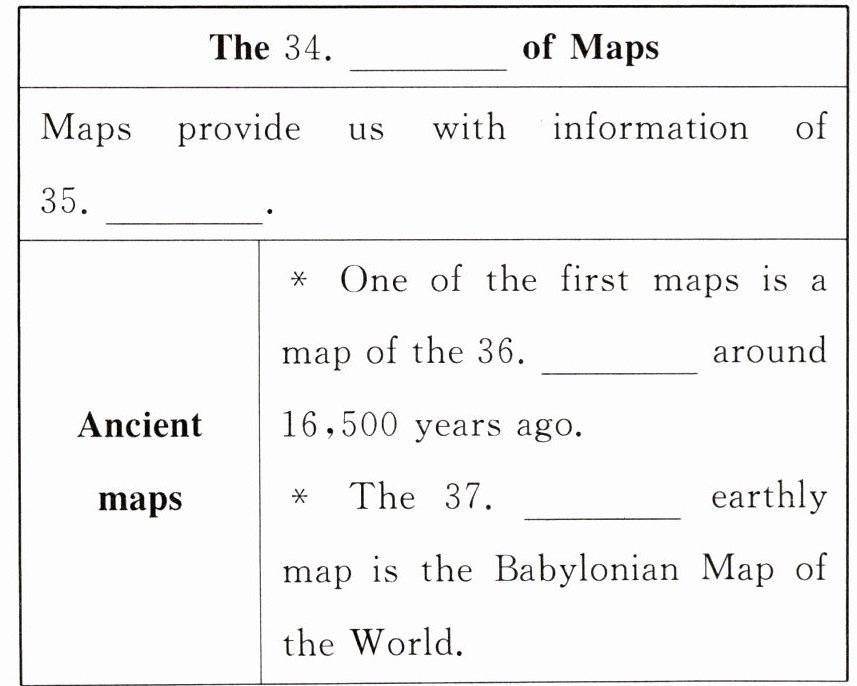
Many ancient countries used maps. One of the first is thought to have been drawn on the wall in Lascaux, France, around 16,500 years ago. Hidden among the drawings of birds and bulls(公牛)is a map of the stars. The Babylonian Map of the World is the oldest known earthly map, which shows Babylon and its neighbouring towns on the stone.
Claudius Ptolemy made maps go worldwide. Born in Egypt around 100 CE, he was the first person to try to make a world map. With the help of maths, Ptolemy marked around 10,000 locations from Britain to Asia and Africa.
Perhaps the most commonly used world map is the Mercator Projection. It was introduced in 1569 by Gerardus Mercator. An important part of maps is the imaginary(假想的)lines of longitude, latitude and the equator(赤道).
Mercator took the globe and made it flat(平的), but to do this, he had to make the areas further north and south larger, while the areas nearer the middle stay about the right size. The reason for this is that the Earth is like a ball, but a map is flat. It is easy to find places, but some people said it was unfair because places including Canada, the UK and Europe appeared much bigger than they really were.
In the 19th and 20th centuries, modern technology allowed map makers to produce maps showing locations exactly. Today, many people view maps on their phones. Researchers are working to map the floor of the oceans and to locate every tree on the Earth. Scientists are also trying to map the past by using the James Webb Space Telescope(JWST). This invention will collect light from stars and may find the secrets about the beginning of the universe(宇宙).
阅读下面的短文,并根据所读内容在文章后表格中的空格里填入一个最恰当的单词。(每空一词)
逐题讲解
Maps mark(标记) seas, countries, cities and our homes, and guide us through the world. To know them better, let’s take a look at how maps have changed over the centuries.
Many ancient countries used maps. One of the first is thought to have been drawn on the wall in Lascaux, France, around 16,500 years ago. Hidden among the drawings of birds and bulls(公牛)is a map of the stars. The Babylonian Map of the World is the oldest known earthly map, which shows Babylon and its neighbouring towns on the stone.
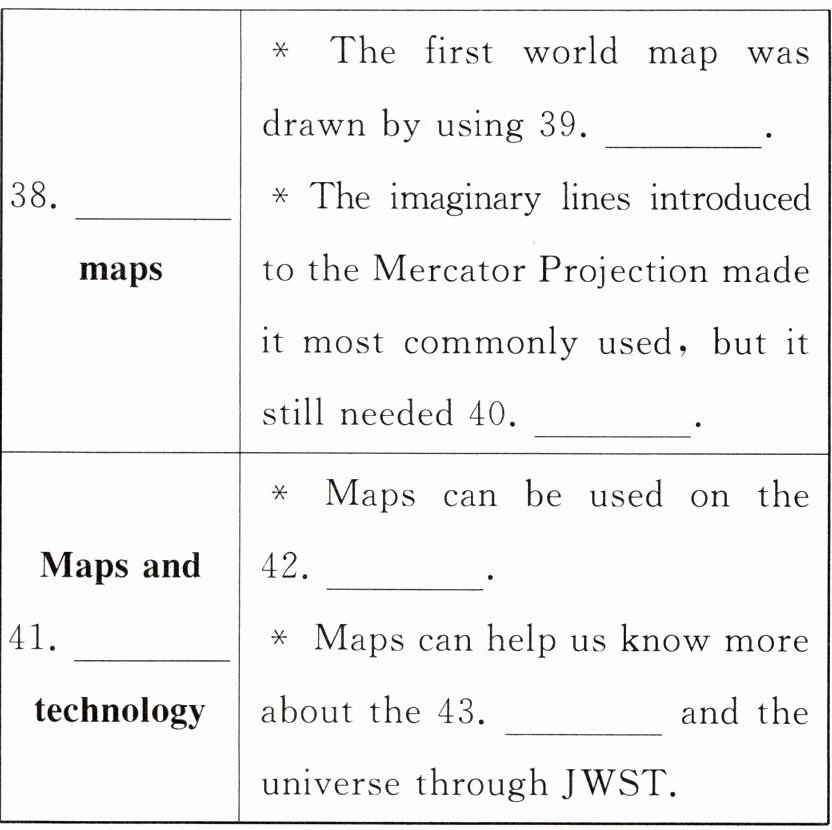
Claudius Ptolemy made maps go worldwide. Born in Egypt around 100 CE, he was the first person to try to make a world map. With the help of maths, Ptolemy marked around 10,000 locations from Britain to Asia and Africa.
Perhaps the most commonly used world map is the Mercator Projection. It was introduced in 1569 by Gerardus Mercator. An important part of maps is the imaginary(假想的)lines of longitude, latitude and the equator(赤道).
Mercator took the globe and made it flat(平的), but to do this, he had to make the areas further north and south larger, while the areas nearer the middle stay about the right size. The reason for this is that the Earth is like a ball, but a map is flat. It is easy to find places, but some people said it was unfair because places including Canada, the UK and Europe appeared much bigger than they really were.
In the 19th and 20th centuries, modern technology allowed map makers to produce maps showing locations exactly. Today, many people view maps on their phones. Researchers are working to map the floor of the oceans and to locate every tree on the Earth. Scientists are also trying to map the past by using the James Webb Space Telescope(JWST). This invention will collect light from stars and may find the secrets about the beginning of the universe(宇宙).
答案
Ⅳ. [文章大意]本文是一篇说明文,主要介绍了地图的发展历程。
34. History/Development/Changes 35. geography 36. stars
37. oldest 38. World 39. maths 40. improvement/improving
41. modern 42. phone 43. Earth
34. History/Development/Changes 35. geography 36. stars
37. oldest 38. World 39. maths 40. improvement/improving
41. modern 42. phone 43. Earth
