

 登录
登录
一、任务型阅读。
阅读下面短文,从 A—E 中选出适当的选项填在横线上,并回答第 5 小题。有一项多余。
Laozi was a great thinker in ancient China. He lived about 2,500 years ago. He started Taoism. His book *Tao Te Ching* has many smart ideas. 1.
Confucius was another important person. He lived around the same time as Laozi. Confucius started Confucianism. His teachings were about being good, respecting old people, and studying hard. 2.
Chinese books have a lot of great stories. Many famous novels were written in the Ming and Qing dynasties. These novels showed what life was like then and what people hoped for. One very well-known novel is *Journey to the West*. The Monkey King in it is very popular. His trips are really interesting.
3.
Do you know the story of the Cowherd and the Weaver Girl? 4.
Chinese culture has so many great characters and stories. They are important to China and the whole world.
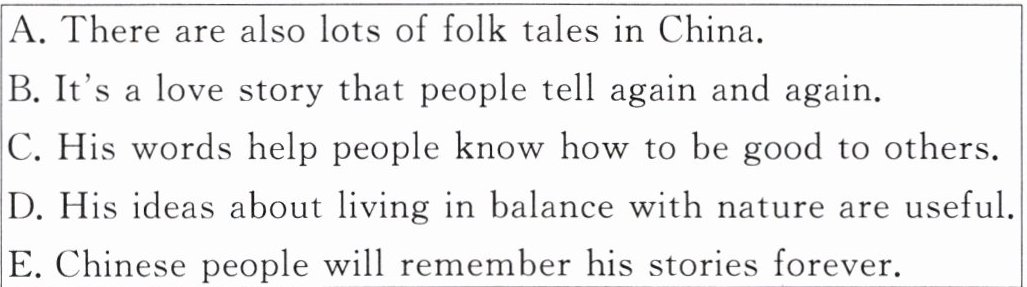
5. What do you think of these characters in Chinese culture?(回答不多于 15 词)
阅读下面短文,从 A—E 中选出适当的选项填在横线上,并回答第 5 小题。有一项多余。
Laozi was a great thinker in ancient China. He lived about 2,500 years ago. He started Taoism. His book *Tao Te Ching* has many smart ideas. 1.
D
These ideas still help Chinese people think and live today.Confucius was another important person. He lived around the same time as Laozi. Confucius started Confucianism. His teachings were about being good, respecting old people, and studying hard. 2.
C
His words are in a book called *The Analects*, and many people know them.Chinese books have a lot of great stories. Many famous novels were written in the Ming and Qing dynasties. These novels showed what life was like then and what people hoped for. One very well-known novel is *Journey to the West*. The Monkey King in it is very popular. His trips are really interesting.
3.
A
These stories are not just for fun. They teach us good things. For example, Mulan dressed like a man to take her father’s place in the army. This shows she was brave and loved her family.Do you know the story of the Cowherd and the Weaver Girl? 4.
B
This story made a Chinese festival called Qixi Festival. It’s a festival for lovers.Chinese culture has so many great characters and stories. They are important to China and the whole world.
5. What do you think of these characters in Chinese culture?(回答不多于 15 词)
I think they're symbols of Chinese values, inspiring us and spreading Chinese culture.(合理即可)
答案
1—4. DCAB
5. I think they're symbols of Chinese values, inspiring us and spreading Chinese culture.(合理即可)
5. I think they're symbols of Chinese values, inspiring us and spreading Chinese culture.(合理即可)
解析
【分析】
解题时需结合上下文语境,梳理句子间的逻辑关联,匹配对应选项:
1. 第1空:前文介绍老子《道德经》的智慧观点,后文强调这些观点至今仍有帮助,需选择和老子观点相关且体现其作用的选项。
2. 第2空:前文讲孔子的教义内容,后文提及他的言论收录在《论语》中,需选择和孔子言论作用相关的选项。
3. 第3空:前文介绍中国小说,后文讲民间故事的教育意义,需选择能引出民间故事的过渡语句。
4. 第4空:前文提到牛郎织女的故事,后文说明该故事和七夕节(情侣节日)的关联,需选择点明故事属性的选项。
5. 第5题:需围绕中国文化里这些角色的价值、意义回答,控制在15词以内,表意合理即可。
【解析】
1. 第1空:前文提到老子的《道德经》有诸多智慧观点,D选项“His ideas about living in balance with nature are useful.”中的“His ideas”对应前文的“smart ideas”,“useful”呼应后文“still help Chinese people think and live today”,逻辑匹配,故选D。
2. 第2空:前文介绍孔子的教义内容,C选项“His words help people know how to be good to others.”中的“His words”对应后文的“His words are in a book called *The Analects*”,内容也契合孔子“行善”的教义,故选C。
3. 第3空:前文讲中国的小说,后文讲具有教育意义的民间故事,A选项“There are also lots of folk tales in China.”中的“also”承接前文的书籍内容,“folk tales”引出后文的故事,起到过渡作用,故选A。
4. 第4空:前文提到牛郎织女的故事,后文说明这个故事衍生出七夕节(情侣的节日),B选项“It’s a love story that people tell again and again.”点明这是爱情故事,和后文的节日属性匹配,故选B。
5. 第5题:需简洁表达对这些文化角色的看法,示例答案表意合理且符合字数要求即可。
【答案】
1—4. DCAB
5. I think they're symbols of Chinese values, inspiring us.(合理即可)
【知识点】
1. 语境语句匹配
2. 中国文化常识
3. 英语逻辑衔接
【点评】
本题考查学生结合语境进行语句匹配的能力,同时融入中国传统文化常识,既考查英语语言运用能力,也引导学生了解中国文化,要求学生具备较强的语境分析和逻辑推理能力。
【难度系数】
0.6
解题时需结合上下文语境,梳理句子间的逻辑关联,匹配对应选项:
1. 第1空:前文介绍老子《道德经》的智慧观点,后文强调这些观点至今仍有帮助,需选择和老子观点相关且体现其作用的选项。
2. 第2空:前文讲孔子的教义内容,后文提及他的言论收录在《论语》中,需选择和孔子言论作用相关的选项。
3. 第3空:前文介绍中国小说,后文讲民间故事的教育意义,需选择能引出民间故事的过渡语句。
4. 第4空:前文提到牛郎织女的故事,后文说明该故事和七夕节(情侣节日)的关联,需选择点明故事属性的选项。
5. 第5题:需围绕中国文化里这些角色的价值、意义回答,控制在15词以内,表意合理即可。
【解析】
1. 第1空:前文提到老子的《道德经》有诸多智慧观点,D选项“His ideas about living in balance with nature are useful.”中的“His ideas”对应前文的“smart ideas”,“useful”呼应后文“still help Chinese people think and live today”,逻辑匹配,故选D。
2. 第2空:前文介绍孔子的教义内容,C选项“His words help people know how to be good to others.”中的“His words”对应后文的“His words are in a book called *The Analects*”,内容也契合孔子“行善”的教义,故选C。
3. 第3空:前文讲中国的小说,后文讲具有教育意义的民间故事,A选项“There are also lots of folk tales in China.”中的“also”承接前文的书籍内容,“folk tales”引出后文的故事,起到过渡作用,故选A。
4. 第4空:前文提到牛郎织女的故事,后文说明这个故事衍生出七夕节(情侣的节日),B选项“It’s a love story that people tell again and again.”点明这是爱情故事,和后文的节日属性匹配,故选B。
5. 第5题:需简洁表达对这些文化角色的看法,示例答案表意合理且符合字数要求即可。
【答案】
1—4. DCAB
5. I think they're symbols of Chinese values, inspiring us.(合理即可)
【知识点】
1. 语境语句匹配
2. 中国文化常识
3. 英语逻辑衔接
【点评】
本题考查学生结合语境进行语句匹配的能力,同时融入中国传统文化常识,既考查英语语言运用能力,也引导学生了解中国文化,要求学生具备较强的语境分析和逻辑推理能力。
【难度系数】
0.6
二、完形填空。
Many people consider Albert Einstein a genius (天才). This story about him shows that he also had a great sense of 6.
Einstein often received invitations to explain his ideas at 7.
One evening, on their way to a university, Einstein said, “I’m so tired. I wish I could avoid 9.
“Mr Einstein,” said Hans, his eyes shining with an idea. “I can give the speech for you 11.
Einstein agreed with Hans though he was a little worried. So, they 14.
However, before Hans left, a man shouted, “I’d like to ask you a question.” He then asked a question so 16.
Einstein turned pale. “Oh, no!” he thought. “Now we’re 17.
Einstein 19.
(
B. humour
C. duty
D. pride
(
B. few
C. same
D. different
(
B. help
C. drive
D. defeat
(
B. talking
C. teaching
D. planning
(
B. let
C. put
D. look
(
B. until
C. if
D. when
(
B. video
C. speech
D. system
(
B. Nobody
C. Somebody
D. Anybody
(
B. shared
C. left
D. cleaned
(
B. sadly
C. angrily
D. weakly
(
B. boring
C. easy
D. difficult
(
B. in peace
C. in trouble
D. on time
(
B. student
C. friend
D. driver
(
B. sat down
C. pointed out
D. showed off
(
B. forgot
C. offered
D. learned
Many people consider Albert Einstein a genius (天才). This story about him shows that he also had a great sense of 6.
B
.Einstein often received invitations to explain his ideas at 7.
D
universities. On these trips, his driver Hans often said to him, “It’s a pleasure to 8. C
a genius like you, Dr Einstein.”One evening, on their way to a university, Einstein said, “I’m so tired. I wish I could avoid 9.
A
my speech tonight, Hans. But I don’t want to 10. B
my listeners down.”“Mr Einstein,” said Hans, his eyes shining with an idea. “I can give the speech for you 11.
C
you trust me. I’ve listened to your 12. C
so many times that I’ve learned it by heart. 13. B
knows what you look like at this university, so they won’t find out the truth. I promise I’ll do my best.”Einstein agreed with Hans though he was a little worried. So, they 14.
A
places. At the university, Hans was led to the front of the hall. Einstein took a seat, listened to his speech 15. A
, and joined in the applause (掌声) at the end.However, before Hans left, a man shouted, “I’d like to ask you a question.” He then asked a question so 16.
D
that Hans had no idea what he was talking about.Einstein turned pale. “Oh, no!” he thought. “Now we’re 17.
C
.” But Hans just laughed and said, “That’s such an easy question that even my 18. D
can answer it. Hans, please …”Einstein 19.
A
and answered the question perfectly. Then they left the university, with Einstein driving. A little later, Hans 20. C
to drive. “No,” replied Einstein humorously. “It’s a pleasure to drive a genius like you, Hans.”(
B
)6. A. directionB. humour
C. duty
D. pride
(
D
)7. A. similarB. few
C. same
D. different
(
C
)8. A. takeB. help
C. drive
D. defeat
(
A
)9. A. givingB. talking
C. teaching
D. planning
(
B
)10. A. takeB. let
C. put
D. look
(
C
)11. A. becauseB. until
C. if
D. when
(
C
)12. A. musicB. video
C. speech
D. system
(
B
)13. A. EverybodyB. Nobody
C. Somebody
D. Anybody
(
A
)14. A. changedB. shared
C. left
D. cleaned
(
A
)15. A. carefullyB. sadly
C. angrily
D. weakly
(
D
)16. A. interestingB. boring
C. easy
D. difficult
(
C
)17. A. in a hurryB. in peace
C. in trouble
D. on time
(
D
)18. A. teacherB. student
C. friend
D. driver
(
A
)19. A. stood upB. sat down
C. pointed out
D. showed off
(
C
)20. A. refusedB. forgot
C. offered
D. learned
答案
二、6—10. BDCAB 11—15. CCBAA 16—20. DCDAC
【文章大意】本文是一篇记叙文。文章主要讲述了一则爱因斯坦和司机 Hans 之间的有趣的故事。
6. B【思路点拨】考查名词辨析。根据文章结尾爱因斯坦的幽默回应可知,此处指爱因斯坦有很强的幽默感。故选 B。
7. D【思路点拨】考查形容词辨析。根据上下文“invitations to explain his ideas at... universities”及语境可知,爱因斯坦是在不同的大学做演讲。故选 D。
8. C【思路点拨】考查动词辨析。根据上文“his driver Hans”可知,此处指 Hans 很荣幸能开车送爱因斯坦。故选 C。
9. A【思路点拨】考查动词辨析。根据下文“my speech”及语境可知,此处指做演讲。故选 A。
10. B【思路点拨】考查动词辨析。根据上文“don't want to...”和下文“my listeners down”可知,爱因斯坦不想让他的听众失望。故选 B。
11. C【思路点拨】考查连词辨析。根据上文“I can give the speech for you...”和下文“you trust me”可知,Hans 认为如果爱因斯坦信任他,他可以去演讲。故选 C。
12. C【思路点拨】考查动词辨析。根据上文“I can give the speech for you”可知,Hans 听过很多次爱因斯坦演讲。故选 C。
13. B【思路点拨】考查代词辨析。根据下文“they won't find out the truth”及语境可知,此处指这所大学里没人知道爱因斯坦的长相。故选 B。
14. A【思路点拨】考查动词辨析。根据 Hans 替爱因斯坦演讲的情节可知,他们交换了位置。故选 A。
15. A【思路点拨】考查副词辨析。根据上文“listened to his speech”和下文“joined in the applause”可知,爱因斯坦在认真地听 Hans 演讲。故选 A。
16. D【思路点拨】考查形容词辨析。根据下文“Hans had no idea what he was talking about”可知,这个问题很难。故选 D。
17. C【思路点拨】考查固定搭配辨析。根据上文汉斯答不出问题的情况可知,爱因斯坦觉得陷入了麻烦。故选 C。
18. D【思路点拨】考查名词辨析。根据上文爱因斯坦和 Hans 交换身份及下文爱因斯坦上台回答问题的情节可知,Hans 说他的司机都能回答这个问题。故选 D。
19. A【思路点拨】考查动词词组辨析。根据上文“Einstein took a seat”和下文“answered the question perfectly”可知,此处指爱因斯坦站起来回答问题。故选 A。
20. C【思路点拨】考查动词辨析。根据语境可知,Hans 主动提出开车。故选 C。
【文章大意】本文是一篇记叙文。文章主要讲述了一则爱因斯坦和司机 Hans 之间的有趣的故事。
6. B【思路点拨】考查名词辨析。根据文章结尾爱因斯坦的幽默回应可知,此处指爱因斯坦有很强的幽默感。故选 B。
7. D【思路点拨】考查形容词辨析。根据上下文“invitations to explain his ideas at... universities”及语境可知,爱因斯坦是在不同的大学做演讲。故选 D。
8. C【思路点拨】考查动词辨析。根据上文“his driver Hans”可知,此处指 Hans 很荣幸能开车送爱因斯坦。故选 C。
9. A【思路点拨】考查动词辨析。根据下文“my speech”及语境可知,此处指做演讲。故选 A。
10. B【思路点拨】考查动词辨析。根据上文“don't want to...”和下文“my listeners down”可知,爱因斯坦不想让他的听众失望。故选 B。
11. C【思路点拨】考查连词辨析。根据上文“I can give the speech for you...”和下文“you trust me”可知,Hans 认为如果爱因斯坦信任他,他可以去演讲。故选 C。
12. C【思路点拨】考查动词辨析。根据上文“I can give the speech for you”可知,Hans 听过很多次爱因斯坦演讲。故选 C。
13. B【思路点拨】考查代词辨析。根据下文“they won't find out the truth”及语境可知,此处指这所大学里没人知道爱因斯坦的长相。故选 B。
14. A【思路点拨】考查动词辨析。根据 Hans 替爱因斯坦演讲的情节可知,他们交换了位置。故选 A。
15. A【思路点拨】考查副词辨析。根据上文“listened to his speech”和下文“joined in the applause”可知,爱因斯坦在认真地听 Hans 演讲。故选 A。
16. D【思路点拨】考查形容词辨析。根据下文“Hans had no idea what he was talking about”可知,这个问题很难。故选 D。
17. C【思路点拨】考查固定搭配辨析。根据上文汉斯答不出问题的情况可知,爱因斯坦觉得陷入了麻烦。故选 C。
18. D【思路点拨】考查名词辨析。根据上文爱因斯坦和 Hans 交换身份及下文爱因斯坦上台回答问题的情节可知,Hans 说他的司机都能回答这个问题。故选 D。
19. A【思路点拨】考查动词词组辨析。根据上文“Einstein took a seat”和下文“answered the question perfectly”可知,此处指爱因斯坦站起来回答问题。故选 A。
20. C【思路点拨】考查动词辨析。根据语境可知,Hans 主动提出开车。故选 C。
解析
【分析】
首先通读全文,了解这是一则关于爱因斯坦和司机汉斯的幽默小故事,整体把握故事脉络后,再逐个分析每个空的解题思路:
1. 第6题:根据文章结尾爱因斯坦幽默的回应“It’s a pleasure to drive a genius like you, Hans.”,可判断爱因斯坦有很强的幽默感,需选对应含义的选项。
2. 第7题:结合“received invitations to explain his ideas at...universities”的语境,爱因斯坦收到的是去不同大学演讲的邀请,要选表示“不同的”形容词。
3. 第8题:由前文“his driver Hans”可知汉斯是司机,此处是他表达荣幸开车送爱因斯坦,选“驾驶”相关动词。
4. 第9题:根据后文“my speech”,“give a speech”是固定搭配,此处指避免做演讲,选give的动名词形式。
5. 第10题:“let sb. down”是固定搭配,意为“让某人失望”,结合语境爱因斯坦不想让听众失望,选对应动词。
6. 第11题:汉斯说“我可以替你演讲”和“你信任我”是条件关系,选表示“如果”的连词。
7. 第12题:汉斯要替爱因斯坦演讲,说明他听了很多次爱因斯坦的演讲,选“演讲”相关名词。
8. 第13题:根据“they won’t find out the truth”,可知这所大学没人认识爱因斯坦,选对应代词。
9. 第14题:汉斯替爱因斯坦演讲,所以他们交换了身份位置,选“交换、改变”的动词。
10. 第15题:爱因斯坦坐在台下听完演讲后鼓掌,说明他听得很认真,选“认真地”这个副词。
11. 第16题:根据“Hans had no idea what he was talking about”,可知问题很难,汉斯无法作答,选“困难的”形容词。
12. 第17题:汉斯答不出问题,爱因斯坦觉得他们陷入了麻烦,选表示“陷入困境”的固定搭配。
13. 第18题:汉斯为了圆场,说问题连他的司机都能回答,此时爱因斯坦正扮演他的司机,选“司机”这个名词。
14. 第19题:之前爱因斯坦坐在台下,现在要回答问题,所以是站起来,选对应动词短语。
15. 第20题:结合后文爱因斯坦的回应,可知汉斯主动提出要开车,选“主动提出”的动词。
【解析】
6. B 考查名词辨析。根据文章结尾爱因斯坦的幽默回应可知,此处表示爱因斯坦有很强的幽默感,direction(方向)、duty(职责)、pride(骄傲)均不符合语境,故选B。
7. D 考查形容词辨析。根据“received invitations to explain his ideas at...universities”及语境,爱因斯坦收到去不同大学演讲的邀请,similar(相似的)、few(很少的)、same(相同的)均不符合,故选D。
8. C 考查动词辨析。由前文“his driver Hans”可知汉斯是司机,此处指他很荣幸开车送爱因斯坦,take(带走)、help(帮助)、defeat(打败)均不符合,故选C。
9. A 考查动词辨析。“give a speech”是固定搭配,意为“做演讲”,结合语境爱因斯坦不想做演讲,talking(谈论)、teaching(教)、planning(计划)均不符合,故选A。
10. B 考查动词辨析。“let sb. down”是固定搭配,意为“让某人失望”,爱因斯坦不想让听众失望,take(拿)、put(放)、look(看)均不符合,故选B。
11. C 考查连词辨析。“我可以替你演讲”和“你信任我”之间是条件关系,用if引导条件状语从句,because(因为)、until(直到)、when(当……时)均不符合,故选C。
12. C 考查名词辨析。汉斯要替爱因斯坦演讲,说明他听了很多次爱因斯坦的演讲,music(音乐)、video(视频)、system(系统)均不符合,故选C。
13. B 考查代词辨析。根据“they won’t find out the truth”可知这所大学没人认识爱因斯坦,Everybody(每个人)、Somebody(某人)、Anybody(任何人)均不符合,故选B。
14. A 考查动词辨析。汉斯替爱因斯坦演讲,所以他们交换了位置,shared(分享)、left(离开)、cleaned(打扫)均不符合,故选A。
15. A 考查副词辨析。根据“joined in the applause at the end”可知爱因斯坦认真地听汉斯演讲,sadly(伤心地)、angrily(生气地)、weakly(虚弱地)均不符合,故选A。
16. D 考查形容词辨析。根据“Hans had no idea what he was talking about”可知这个问题很难,interesting(有趣的)、boring(无聊的)、easy(简单的)均不符合,故选D。
17. C 考查固定搭配辨析。汉斯答不出问题,爱因斯坦觉得他们陷入了麻烦,in a hurry(匆忙)、in peace(和平地)、on time(准时)均不符合,故选C。
18. D 考查名词辨析。汉斯为了圆场,说这个问题连他的司机都能回答,此时爱因斯坦扮演他的司机,teacher(老师)、student(学生)、friend(朋友)均不符合,故选D。
19. A 考查动词词组辨析。之前爱因斯坦坐在台下,现在要回答问题,所以站起来,sat down(坐下)、pointed out(指出)、showed off(炫耀)均不符合,故选A。
20. C 考查动词辨析。结合后文爱因斯坦的幽默回应,汉斯主动提出要开车,refused(拒绝)、forgot(忘记)、learned(学习)均不符合,故选C。
【答案】
6—10. BDCAB;11—15. CCBAA;16—20. DCDAC
【知识点】
1. 词汇辨析
2. 连词用法
3. 固定搭配
【点评】
本文通过爱因斯坦与司机的幽默小故事,考查学生对词汇辨析、固定搭配及语境理解的能力。解题时需结合上下文语境,把握故事脉络,同时掌握常见固定搭配和词汇用法,有助于提升阅读理解和词汇运用能力。
【难度系数】
0.6
首先通读全文,了解这是一则关于爱因斯坦和司机汉斯的幽默小故事,整体把握故事脉络后,再逐个分析每个空的解题思路:
1. 第6题:根据文章结尾爱因斯坦幽默的回应“It’s a pleasure to drive a genius like you, Hans.”,可判断爱因斯坦有很强的幽默感,需选对应含义的选项。
2. 第7题:结合“received invitations to explain his ideas at...universities”的语境,爱因斯坦收到的是去不同大学演讲的邀请,要选表示“不同的”形容词。
3. 第8题:由前文“his driver Hans”可知汉斯是司机,此处是他表达荣幸开车送爱因斯坦,选“驾驶”相关动词。
4. 第9题:根据后文“my speech”,“give a speech”是固定搭配,此处指避免做演讲,选give的动名词形式。
5. 第10题:“let sb. down”是固定搭配,意为“让某人失望”,结合语境爱因斯坦不想让听众失望,选对应动词。
6. 第11题:汉斯说“我可以替你演讲”和“你信任我”是条件关系,选表示“如果”的连词。
7. 第12题:汉斯要替爱因斯坦演讲,说明他听了很多次爱因斯坦的演讲,选“演讲”相关名词。
8. 第13题:根据“they won’t find out the truth”,可知这所大学没人认识爱因斯坦,选对应代词。
9. 第14题:汉斯替爱因斯坦演讲,所以他们交换了身份位置,选“交换、改变”的动词。
10. 第15题:爱因斯坦坐在台下听完演讲后鼓掌,说明他听得很认真,选“认真地”这个副词。
11. 第16题:根据“Hans had no idea what he was talking about”,可知问题很难,汉斯无法作答,选“困难的”形容词。
12. 第17题:汉斯答不出问题,爱因斯坦觉得他们陷入了麻烦,选表示“陷入困境”的固定搭配。
13. 第18题:汉斯为了圆场,说问题连他的司机都能回答,此时爱因斯坦正扮演他的司机,选“司机”这个名词。
14. 第19题:之前爱因斯坦坐在台下,现在要回答问题,所以是站起来,选对应动词短语。
15. 第20题:结合后文爱因斯坦的回应,可知汉斯主动提出要开车,选“主动提出”的动词。
【解析】
6. B 考查名词辨析。根据文章结尾爱因斯坦的幽默回应可知,此处表示爱因斯坦有很强的幽默感,direction(方向)、duty(职责)、pride(骄傲)均不符合语境,故选B。
7. D 考查形容词辨析。根据“received invitations to explain his ideas at...universities”及语境,爱因斯坦收到去不同大学演讲的邀请,similar(相似的)、few(很少的)、same(相同的)均不符合,故选D。
8. C 考查动词辨析。由前文“his driver Hans”可知汉斯是司机,此处指他很荣幸开车送爱因斯坦,take(带走)、help(帮助)、defeat(打败)均不符合,故选C。
9. A 考查动词辨析。“give a speech”是固定搭配,意为“做演讲”,结合语境爱因斯坦不想做演讲,talking(谈论)、teaching(教)、planning(计划)均不符合,故选A。
10. B 考查动词辨析。“let sb. down”是固定搭配,意为“让某人失望”,爱因斯坦不想让听众失望,take(拿)、put(放)、look(看)均不符合,故选B。
11. C 考查连词辨析。“我可以替你演讲”和“你信任我”之间是条件关系,用if引导条件状语从句,because(因为)、until(直到)、when(当……时)均不符合,故选C。
12. C 考查名词辨析。汉斯要替爱因斯坦演讲,说明他听了很多次爱因斯坦的演讲,music(音乐)、video(视频)、system(系统)均不符合,故选C。
13. B 考查代词辨析。根据“they won’t find out the truth”可知这所大学没人认识爱因斯坦,Everybody(每个人)、Somebody(某人)、Anybody(任何人)均不符合,故选B。
14. A 考查动词辨析。汉斯替爱因斯坦演讲,所以他们交换了位置,shared(分享)、left(离开)、cleaned(打扫)均不符合,故选A。
15. A 考查副词辨析。根据“joined in the applause at the end”可知爱因斯坦认真地听汉斯演讲,sadly(伤心地)、angrily(生气地)、weakly(虚弱地)均不符合,故选A。
16. D 考查形容词辨析。根据“Hans had no idea what he was talking about”可知这个问题很难,interesting(有趣的)、boring(无聊的)、easy(简单的)均不符合,故选D。
17. C 考查固定搭配辨析。汉斯答不出问题,爱因斯坦觉得他们陷入了麻烦,in a hurry(匆忙)、in peace(和平地)、on time(准时)均不符合,故选C。
18. D 考查名词辨析。汉斯为了圆场,说这个问题连他的司机都能回答,此时爱因斯坦扮演他的司机,teacher(老师)、student(学生)、friend(朋友)均不符合,故选D。
19. A 考查动词词组辨析。之前爱因斯坦坐在台下,现在要回答问题,所以站起来,sat down(坐下)、pointed out(指出)、showed off(炫耀)均不符合,故选A。
20. C 考查动词辨析。结合后文爱因斯坦的幽默回应,汉斯主动提出要开车,refused(拒绝)、forgot(忘记)、learned(学习)均不符合,故选C。
【答案】
6—10. BDCAB;11—15. CCBAA;16—20. DCDAC
【知识点】
1. 词汇辨析
2. 连词用法
3. 固定搭配
【点评】
本文通过爱因斯坦与司机的幽默小故事,考查学生对词汇辨析、固定搭配及语境理解的能力。解题时需结合上下文语境,把握故事脉络,同时掌握常见固定搭配和词汇用法,有助于提升阅读理解和词汇运用能力。
【难度系数】
0.6
