

 登录
登录
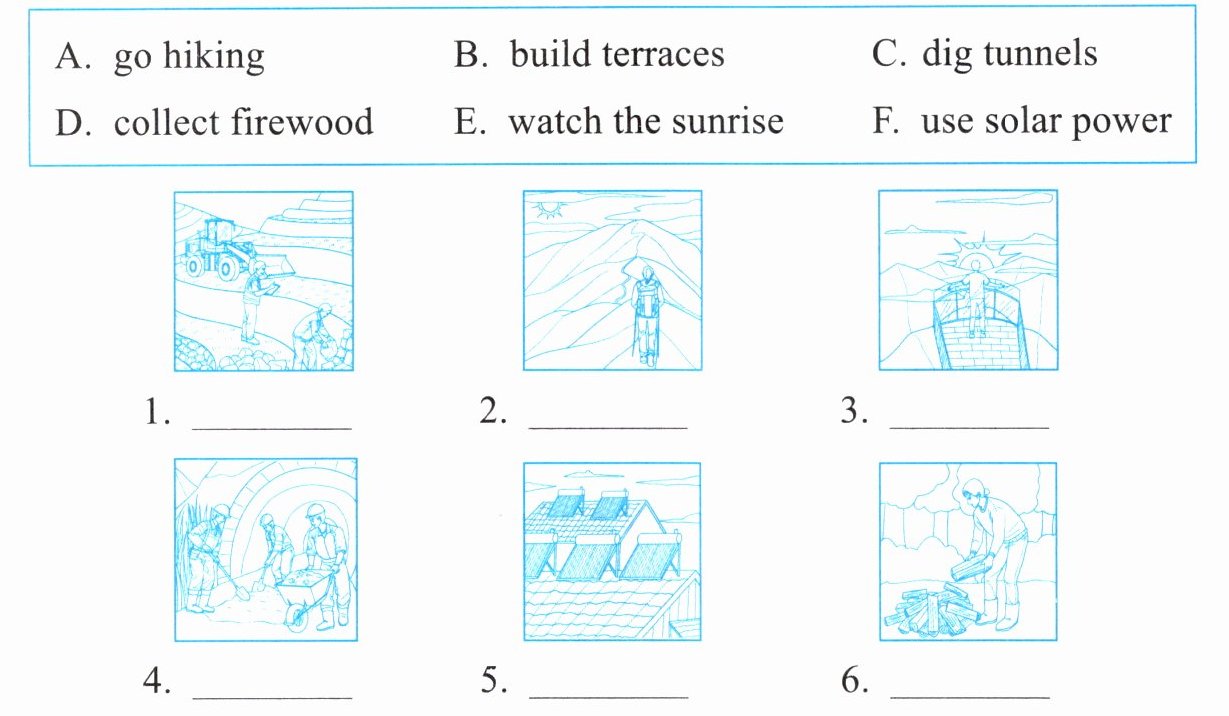
1Ⅰ. Match the activities with the pictures.
答案
Ⅰ. 1. B 2. A 3. E 4. C 5. F 6. D
解析
【解析】
这是一道图文匹配题,需结合图片内容与选项中动词短语的含义进行对应:
1. 插图1的第一幅图对应B(build terraces,造梯田);
2. 插图1的第二幅图对应A(go hiking,远足);
3. 插图1的第三幅图对应E(watch the sunrise,看日出);
4. 插图2的第一幅图对应C(dig tunnels,挖隧道);
5. 插图2的第二幅图对应F(use solar power,使用太阳能);
6. 插图2的第三幅图对应D(collect firewood,捡柴火)。
【答案】
Ⅰ. 1. B 2. A 3. E 4. C 5. F 6. D
【知识点】
动词短语辨析、图文匹配
【点评】
本题考查对常见户外及生产生活类动词短语的理解,以及图文信息的对应能力,需结合短语含义和生活常识完成匹配,有助于提升学生的词汇应用与观察能力。
【难度系数】
0.8
这是一道图文匹配题,需结合图片内容与选项中动词短语的含义进行对应:
1. 插图1的第一幅图对应B(build terraces,造梯田);
2. 插图1的第二幅图对应A(go hiking,远足);
3. 插图1的第三幅图对应E(watch the sunrise,看日出);
4. 插图2的第一幅图对应C(dig tunnels,挖隧道);
5. 插图2的第二幅图对应F(use solar power,使用太阳能);
6. 插图2的第三幅图对应D(collect firewood,捡柴火)。
【答案】
Ⅰ. 1. B 2. A 3. E 4. C 5. F 6. D
【知识点】
动词短语辨析、图文匹配
【点评】
本题考查对常见户外及生产生活类动词短语的理解,以及图文信息的对应能力,需结合短语含义和生活常识完成匹配,有助于提升学生的词汇应用与观察能力。
【难度系数】
0.8
Ⅱ. Complete the conversations with the proper form of the expressions in Exercise Ⅰ.
1. Betty: What did you do last weekend?
Jack: We
Betty: That sounds nice! Did you see anything special?
Jack: Yes! We got up early to
2. Lucky: How do you cook and keep warm in your village?
Mike: Well, we often
3. Tom: How do farmers grow crops on the hillsides?
Lily: They
Tom: I see. And how do people build roads through the mountains?
Lily: They have to
1. Betty: What did you do last weekend?
Jack: We
went hiking
in the mountains. It was so beautiful.Betty: That sounds nice! Did you see anything special?
Jack: Yes! We got up early to
watch the sunrise
. It was amazing.2. Lucky: How do you cook and keep warm in your village?
Mike: Well, we often
collected firewood
to make a fire in the past. But now, we use solar power
for electricity.3. Tom: How do farmers grow crops on the hillsides?
Lily: They
build terraces
to create flat land. It’s hard work.Tom: I see. And how do people build roads through the mountains?
Lily: They have to
dig tunnels
. It changes the shape of the mountain.答案
Ⅱ. 1. went hiking, watch the sunrise 2. collected firewood, use solar power 3. build terraces, dig tunnels
解析
【解析】
这道题要求用Exercise Ⅰ中短语的适当形式补全对话,需结合对话语境和时态确定短语形式:
1. 第一组对话中,last weekend提示第一空用一般过去时,故填went hiking;第二空为不定式结构,to后接动词原形,故填watch the sunrise。
2. 第二组对话中,in the past提示第一空用一般过去时,故填collected firewood;now提示第二空用一般现在时,故填use solar power。
3. 第三组对话描述客观情况,用一般现在时,故分别填build terraces和dig tunnels。
【答案】
Ⅱ. 1. went hiking, watch the sunrise 2. collected firewood, use solar power 3. build terraces, dig tunnels
【知识点】
短语形式变换,一般过去时,一般现在时
【点评】
本题考查固定短语运用及时态掌握,需结合对话时间提示与语境确定短语正确形式,能提升学生在实际语境中的语言运用能力。
【难度系数】
0.6
这道题要求用Exercise Ⅰ中短语的适当形式补全对话,需结合对话语境和时态确定短语形式:
1. 第一组对话中,last weekend提示第一空用一般过去时,故填went hiking;第二空为不定式结构,to后接动词原形,故填watch the sunrise。
2. 第二组对话中,in the past提示第一空用一般过去时,故填collected firewood;now提示第二空用一般现在时,故填use solar power。
3. 第三组对话描述客观情况,用一般现在时,故分别填build terraces和dig tunnels。
【答案】
Ⅱ. 1. went hiking, watch the sunrise 2. collected firewood, use solar power 3. build terraces, dig tunnels
【知识点】
短语形式变换,一般过去时,一般现在时
【点评】
本题考查固定短语运用及时态掌握,需结合对话时间提示与语境确定短语正确形式,能提升学生在实际语境中的语言运用能力。
【难度系数】
0.6
Ⅲ. Read and answer the questions.
I don’t have a dishwasher. Fish clean my dishes for me. In my garden there’s a small room called the kabata. In the room, there’s a lot of water from our town’s river. My family uses the water to clean vegetables and wash dishes. A little food comes off the bowls—but that’s OK! The fish there eat the food and keep the water clean! After the water comes to my kabata, it goes into the river or onto farms. — Riku, Japan
There isn’t a heating system or an air conditioner in my house. I live in a traditional cave house—a house that’s built inside a hill. The ground keeps the house cool when the weather is hot, and warm when it is cold. My house is great because it doesn’t use much electricity. People think that I don’t have Wi-Fi or even electricity in my cave house—but I do! — Ariadna, Spain
My city is by the sea. Years ago, people built roads and houses near the water, which was not good for the mangroves (红树). These special trees are very important for keeping the water clean and providing homes for birds and fish. To fix this, we decided to change the coastline again. We moved some roads and planted a large and new mangrove forest. Now, more birds are flying back, and the water is cleaner. — Lin, China
(
A. Saving food.
B. Washing dishes.
C. Growing plants.
D. Keeping fish for eating.
(
A. There is no Wi-Fi.
B. The weather is always warm.
C. It uses a special air conditioner.
D. It doesn’t need heating or air conditioner.
(
A. To tell family stories.
B. To explain city problems.
C. To show life with local environment.
D. To teach about building traditional houses.
4. How do you and your family use natural resources wisely? (No more than 15 words)
I don’t have a dishwasher. Fish clean my dishes for me. In my garden there’s a small room called the kabata. In the room, there’s a lot of water from our town’s river. My family uses the water to clean vegetables and wash dishes. A little food comes off the bowls—but that’s OK! The fish there eat the food and keep the water clean! After the water comes to my kabata, it goes into the river or onto farms. — Riku, Japan
There isn’t a heating system or an air conditioner in my house. I live in a traditional cave house—a house that’s built inside a hill. The ground keeps the house cool when the weather is hot, and warm when it is cold. My house is great because it doesn’t use much electricity. People think that I don’t have Wi-Fi or even electricity in my cave house—but I do! — Ariadna, Spain
My city is by the sea. Years ago, people built roads and houses near the water, which was not good for the mangroves (红树). These special trees are very important for keeping the water clean and providing homes for birds and fish. To fix this, we decided to change the coastline again. We moved some roads and planted a large and new mangrove forest. Now, more birds are flying back, and the water is cleaner. — Lin, China
(
B
)1. What is the kabata used for?A. Saving food.
B. Washing dishes.
C. Growing plants.
D. Keeping fish for eating.
(
D
)2. Why does the cave house need little electricity?A. There is no Wi-Fi.
B. The weather is always warm.
C. It uses a special air conditioner.
D. It doesn’t need heating or air conditioner.
(
C
)3. What is the main purpose of the passage?A. To tell family stories.
B. To explain city problems.
C. To show life with local environment.
D. To teach about building traditional houses.
4. How do you and your family use natural resources wisely? (No more than 15 words)
Possible versions: My family and I save water by using rainwater to water plants./My family and I save electricity by turning off lights when leaving rooms./My family and I save paper by using both sides of it.
答案
Ⅲ. 1. B 2. D 3. C 4. Possible versions: My family and I save water by using rainwater to water plants./My family and I save electricity by turning off lights when leaving rooms./My family and I save paper by using both sides of it.
解析
【解析】
1. 第1题:根据Riku的描述“In my garden there’s a small room called the kabata... My family uses the water to clean vegetables and wash dishes.”,可知kabata是用来洗碗的,故选B。
2. 第2题:由Ariadna的内容“There isn’t a heating system or an air conditioner in my house... My house is great because it doesn’t use much electricity.”可知,窑洞用电少是因为不需要暖气和空调,故选D。
3. 第3题:三篇短文分别介绍了日本、西班牙、中国结合当地环境的生活与环保方式,主旨是展示结合当地环境的生活,故选C。
4. 第4题是开放性试题,需围绕“合理利用自然资源”作答,控制在15词以内即可。
【答案】
1. B
2. D
3. C
4. 示例:We use rainwater to water plants.(或其他符合要求的答案)
【知识点】
细节信息查找、主旨大意归纳、开放性表达
【点评】
本文选取不同国家的环保生活案例,既考查学生的阅读提取信息能力,又引导学生树立环保意识,关注自然资源的合理利用。
【难度系数】
0.7
1. 第1题:根据Riku的描述“In my garden there’s a small room called the kabata... My family uses the water to clean vegetables and wash dishes.”,可知kabata是用来洗碗的,故选B。
2. 第2题:由Ariadna的内容“There isn’t a heating system or an air conditioner in my house... My house is great because it doesn’t use much electricity.”可知,窑洞用电少是因为不需要暖气和空调,故选D。
3. 第3题:三篇短文分别介绍了日本、西班牙、中国结合当地环境的生活与环保方式,主旨是展示结合当地环境的生活,故选C。
4. 第4题是开放性试题,需围绕“合理利用自然资源”作答,控制在15词以内即可。
【答案】
1. B
2. D
3. C
4. 示例:We use rainwater to water plants.(或其他符合要求的答案)
【知识点】
细节信息查找、主旨大意归纳、开放性表达
【点评】
本文选取不同国家的环保生活案例,既考查学生的阅读提取信息能力,又引导学生树立环保意识,关注自然资源的合理利用。
【难度系数】
0.7
