

 登录
8. 如图30.1-14,$\odot O$的半径为1,点O到直线l的距离为4,点P是直线l上的一个动点,PQ与$\odot O$相切于点Q,则PQ的最小值为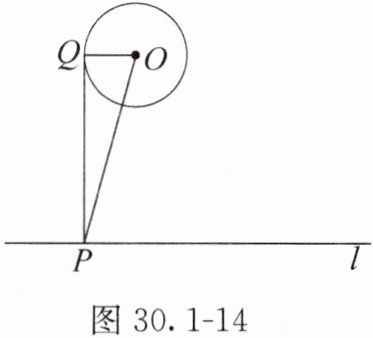
$\sqrt{15}$
。答案
8. $\sqrt{15}$
解析
【分析】
首先根据切线的性质可知,切线垂直于过切点的半径,因此OQ⊥PQ,△OPQ为直角三角形。由勾股定理可推导得PQ=√(OP²-OQ²),已知OQ是⊙O的半径,长度固定为1,因此要使PQ最小,只需OP最小。根据垂线段最短的性质,点O到直线l的垂线段长度是OP的最小值,已知O到l的距离为4,将OP的最小值代入即可求出PQ的最小值。
【解析】
连接OQ,
∵PQ与⊙O相切于点Q,
∴OQ⊥PQ,即△OPQ是直角三角形。
在Rt△OPQ中,由勾股定理得:
$PQ^2 + OQ^2 = OP^2$,
变形得$PQ=\sqrt{OP^2 - OQ^2}$。
∵⊙O的半径$OQ=1$为定值,
∴要使PQ最小,需OP取最小值。
根据垂线段最短可知,OP的最小值为点O到直线l的距离4,
将$OP=4$,$OQ=1$代入得:
$PQ=\sqrt{4^2 - 1^2}=\sqrt{16-1}=\sqrt{15}$。
【答案】
$\sqrt{15}$
【知识点】
切线的性质,勾股定理,垂线段最短
【点评】
本题属于几何最值类典型题,解题核心是利用转化思想,将求PQ的最小值转化为求OP的最小值,需要熟练掌握切线的性质和垂线段最短的性质,灵活运用勾股定理计算线段长度。
【难度系数】
0.7
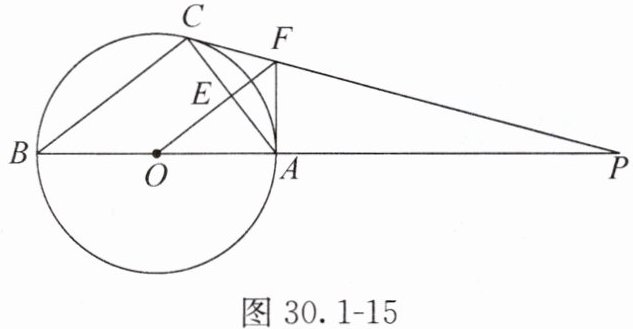
9. 如图30.1-15,△ABC内接于⊙O,AB是⊙O的直径,⊙O的切线PC交BA的延长线于点P,OF//BC交AC于点E,交PC于点F,连接AF.
(1)试判断AF与⊙O的位置关系,并说明理由;
(2)若⊙O的半径为4,AF=3,求AC的长.
(1)试判断AF与⊙O的位置关系,并说明理由;
(2)若⊙O的半径为4,AF=3,求AC的长.
答案
9. 解:(1) AF与$\odot O$相切. 理由如下:
如图,连接OC.
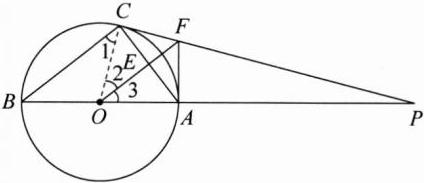
$\because OF// BC$,
$\therefore ∠ 1=∠ 2$,$∠ B=∠ 3$.
$\because OC=OB$,$\therefore ∠ B=∠ 1$. $\therefore ∠ 3=∠ 2$.
$\because OA=OC$,$OF=OF$,
$\therefore △ OAF≌△ OCF$.
$\therefore ∠ OAF=∠ OCF$.
$\because PC$是$\odot O$的切线,$\therefore ∠ OCF=90°$.
$\therefore ∠ OAF=90°$. $\therefore FA⊥ OA$.
$\therefore AF$与$\odot O$相切.
(2) $\because \odot O$的半径为4,$AF=3$,$∠ OAF=90°$,
$\therefore OF=\sqrt{AF^2+OA^2}=\sqrt{3^2+4^2}=5$.
$\because △ OAF≌△ OCF$,
$\therefore CF=AF=3$.
$\because OA=OC$,$\therefore OF⊥ AC$. $\therefore AC=2AE$.
$\because AF⊥ OA$,
$\therefore S_{△ OAF}=\frac{1}{2}AF· OA=\frac{1}{2}OF· AE$.
$\therefore \frac{1}{2}×3×4=\frac{1}{2}×5× AE$. 解得$AE=\frac{12}{5}$.
$\therefore AC=2AE=\frac{24}{5}$.
解析
【分析】
(1)要判断AF与$\odot O$的位置关系,根据切线判定定理,只需证明AF垂直于半径OA即可。先连接辅助线OC,利用PC是切线得到$∠ OCF=90°$,再通过OF//BC、等腰三角形等边对等角的性质推导角相等,证明$△ OAF$和$△ OCF$全等,即可推出$∠ OAF=∠ OCF=90°$,证得AF是$\odot O$的切线。
(2)先在$Rt△ OAF$中用勾股定理求出OF的长度,再结合全等三角形的性质得$CF=AF$,由等腰三角形三线合一可知OF垂直平分AC,最后利用$△ OAF$的两种面积表示方法求出AE的长度,即可得到$AC=2AE$的结果。
【解析】
(1) AF与$\odot O$相切,理由如下:
如图,连接OC。
$\because OF// BC$,
$\therefore ∠ 1=∠ 2$,$∠ B=∠ 3$。
$\because OC=OB$,$\therefore ∠ B=∠ 1$,$\therefore ∠ 3=∠ 2$。
$\because OA=OC$,$OF=OF$,
$\therefore △ OAF≌△ OCF$(SAS)。
$\therefore ∠ OAF=∠ OCF$。
$\because PC$是$\odot O$的切线,$\therefore OC⊥ PC$,即$∠ OCF=90°$,
$\therefore ∠ OAF=90°$,即$FA⊥ OA$,
又$\because$OA是$\odot O$的半径,
$\therefore AF$与$\odot O$相切。
(2) $\because \odot O$的半径为4,$\therefore OA=4$,
$\because AF=3$,$∠ OAF=90°$,
$\therefore$在$Rt△ OAF$中,由勾股定理得:$OF=\sqrt{AF^2+OA^2}=\sqrt{3^2+4^2}=5$。
$\because △ OAF≌△ OCF$,$\therefore CF=AF=3$,
$\because OA=OC$,$\therefore OF$是等腰$△ OAC$的角平分线,根据三线合一得$OF⊥ AC$,$AC=2AE$。
$\because AF⊥ OA$,
$\therefore S_{△ OAF}=\frac{1}{2}AF· OA=\frac{1}{2}OF· AE$,
代入数值:$\frac{1}{2}×3×4=\frac{1}{2}×5× AE$,
解得$AE=\frac{12}{5}$,
$\therefore AC=2AE=2×\frac{12}{5}=\frac{24}{5}$。
【答案】
(1) AF与$\odot O$相切,理由如下:
如图,连接OC。
$\because OF// BC$,
$\therefore ∠ 1=∠ 2$,$∠ B=∠ 3$。
$\because OC=OB$,$\therefore ∠ B=∠ 1$。 $\therefore ∠ 3=∠ 2$。
$\because OA=OC$,$OF=OF$,
$\therefore △ OAF≌△ OCF$。
$\therefore ∠ OAF=∠ OCF$。
$\because PC$是$\odot O$的切线,$\therefore ∠ OCF=90°$。
$\therefore ∠ OAF=90°$。 $\therefore FA⊥ OA$。
$\therefore AF$与$\odot O$相切。
(2) AC的长为$\frac{24}{5}$。
【知识点】
切线的判定与性质;全等三角形的判定与性质;勾股定理
【点评】
本题是圆的综合应用题,解题关键是合理作出辅助线,通过倒角证明三角形全等,再结合勾股定理、面积法完成计算,能有效考查对圆相关性质和三角形知识的综合运用能力。
【难度系数】
0.6
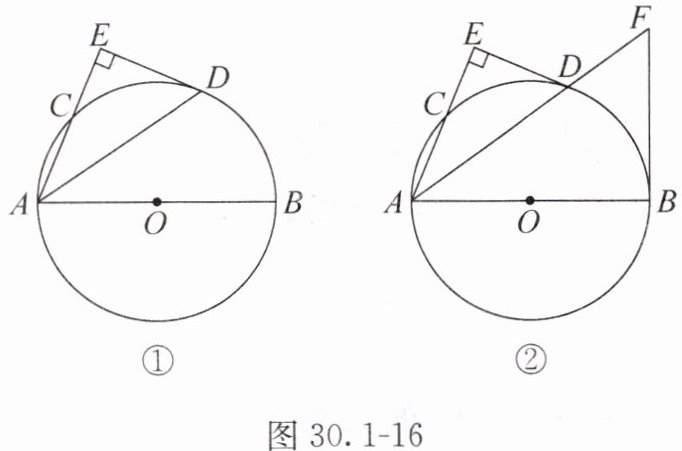
10. 如图30.1-16,已知AB是$\odot O$的直径,AC是弦,$∠ BAC$的平分线交$\odot O$于点D,$DE ⊥ AC$,垂足为E.
(1)求证:DE是$\odot O$的切线;
(2)如图30.1-16①,若$AB=13$,$AC=5$,求ED的长;
(3)如图30.1-16②,过点B作$\odot O$的切线,交AD的延长线于点F. 若$ED=DF=x$,$AD=y$,求$\frac{y}{x}$的值.
(1)求证:DE是$\odot O$的切线;
(2)如图30.1-16①,若$AB=13$,$AC=5$,求ED的长;
(3)如图30.1-16②,过点B作$\odot O$的切线,交AD的延长线于点F. 若$ED=DF=x$,$AD=y$,求$\frac{y}{x}$的值.
答案
(1) 证明:如图,连接OD.
$\because OA=OD, \therefore ∠OAD=∠ODA.$
$\because AD$平分$∠BAC, \therefore ∠EAD=∠BAD.$
$\therefore ∠ADO=∠EAD. \therefore OD// AE.$
$\therefore ∠E+∠ODE=180°.$
$\because DE⊥ AC, \therefore ∠E=90°.$
$\therefore ∠ODE=90°.$
又OD是$\odot O$的半径,
$\therefore DE$是$\odot O$的切线.
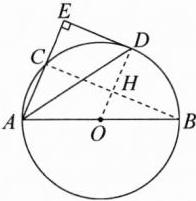
(2) 解:如图,连接BC,与OD交于点H.
$\because AB$是$\odot O$的直径,
$\therefore ∠ACB=∠BCE=90°.$
在$\mathrm{Rt}△ ABC$中,$AB=13, AC=5,$
$\therefore BC=\sqrt{AB^2-AC^2}=12.$
又$∠E=∠HDE=90°,$
$\therefore$ 四边形ECHD是矩形.
$\therefore DE=CH, ∠CHD=90°.$
$\therefore CH=BH=\frac{1}{2}BC=6.$
$\therefore DE=CH=6.$
(3) 解:如图,连接BD.
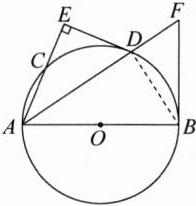
$\because AB$是$\odot O$的直径,
$\therefore ∠BDA=∠BDF=90°.$
$\therefore ∠F+∠FBD=90°.$
$\because AD$平分$∠BAC,$
$\therefore ∠EAD=∠BAD.$
$\because BF$是$\odot O$的切线,$\therefore ∠ABF=90°.$
$\therefore ∠F+∠FAB=90°.$
$\therefore ∠EAD=∠BAD=∠FBD.$
$\because ∠E=∠BDF=90°, ED=FD,$
$\therefore △ AED≌△ BDF. \therefore AD=BF.$
$\because BD^2=AB^2-AD^2=BF^2-DF^2, AB^2=AF^2-BF^2,$
$\therefore AF^2-BF^2-AD^2=BF^2-DF^2.$
$\therefore (AD+DF)^2-AD^2-AD^2=AD^2-DF^2.$
$\therefore DF^2+AD· DF-AD^2=0,$
即$DE^2+AD· DE-AD^2=0.$
$\therefore (\frac{DE}{AD})^2+\frac{DE}{AD}-1=0.$
设$\frac{DE}{AD}=t, \therefore t^2+t-1=0.$
解方程,得$t=\frac{\sqrt{5}-1}{2}$或$t=-\frac{1+\sqrt{5}}{2}$(舍去).
$\therefore \frac{DE}{AD}=\frac{\sqrt{5}-1}{2}.$
$\because ED=DF=x, AD=y,$
$\therefore \frac{y}{x}=\frac{AD}{DE}=\frac{2}{\sqrt{5}-1}=\frac{\sqrt{5}+1}{2}.$
解析
【分析】
(1)证切线的核心思路是“连半径,证垂直”,先连接OD,利用等腰三角形等边对等角的性质和角平分线的定义推出OD//AE,结合DE⊥AC即可得到OD⊥DE,满足切线的判定条件。
(2)求ED长度时,利用直径所对圆周角为直角,连接BC构造Rt△ABC,先由勾股定理算出BC的长;再结合OD//AE、DE⊥AC证明四边形ECHD是矩形,根据垂径定理得CH为BC的一半,即可得到ED的长度。
(3)求$\frac{y}{x}$的比值时,先连接BD,利用直径的性质和切线的性质推导角相等,证明△AED≌△BDF得到AD=BF;再结合勾股定理建立关于x、y的方程,整理后解一元二次方程即可求出比值,注意舍去不符合实际的负根。
【解析】
(1) 证明:如图,连接OD.
$\because OA=OD, \therefore ∠OAD=∠ODA.$
$\because AD$平分$∠BAC, \therefore ∠EAD=∠BAD.$
$\therefore ∠ADO=∠EAD. \therefore OD// AE.$
$\therefore ∠E+∠ODE=180°.$
$\because DE⊥ AC, \therefore ∠E=90°.$
$\therefore ∠ODE=90°.$
又OD是$\odot O$的半径,
$\therefore DE$是$\odot O$的切线.
(2) 解:如图,连接BC,与OD交于点H.
$\because AB$是$\odot O$的直径,
$\therefore ∠ACB=∠BCE=90°.$
在$\mathrm{Rt}△ ABC$中,$AB=13, AC=5,$
$\therefore BC=\sqrt{AB^2-AC^2}=12.$
又$∠E=∠HDE=90°,$
$\therefore$ 四边形ECHD是矩形.
$\therefore DE=CH, ∠CHD=90°.$
$\therefore CH=BH=\frac{1}{2}BC=6.$
$\therefore DE=CH=6.$
(3) 解:如图,连接BD.
$\because AB$是$\odot O$的直径,
$\therefore ∠BDA=∠BDF=90°.$
$\therefore ∠F+∠FBD=90°.$
$\because AD$平分$∠BAC,$
$\therefore ∠EAD=∠BAD.$
$\because BF$是$\odot O$的切线,$\therefore ∠ABF=90°.$
$\therefore ∠F+∠FAB=90°.$
$\therefore ∠EAD=∠BAD=∠FBD.$
$\because ∠E=∠BDF=90°, ED=FD,$
$\therefore △ AED≌△ BDF. \therefore AD=BF.$
$\because BD^2=AB^2-AD^2=BF^2-DF^2, AB^2=AF^2-BF^2,$
$\therefore AF^2-BF^2-AD^2=BF^2-DF^2.$
$\therefore (AD+DF)^2-AD^2-AD^2=AD^2-DF^2.$
$\therefore DF^2+AD· DF-AD^2=0,$
即$DE^2+AD· DE-AD^2=0.$
$\therefore (\frac{DE}{AD})^2+\frac{DE}{AD}-1=0.$
设$\frac{DE}{AD}=t, \therefore t^2+t-1=0.$
解方程,得$t=\frac{\sqrt{5}-1}{2}$或$t=-\frac{1+\sqrt{5}}{2}$(舍去).
$\therefore \frac{DE}{AD}=\frac{\sqrt{5}-1}{2}.$
$\because ED=DF=x, AD=y,$
$\therefore \frac{y}{x}=\frac{AD}{DE}=\frac{2}{\sqrt{5}-1}=\frac{\sqrt{5}+1}{2}.$
【答案】
(1)DE是$\odot O$的切线,证明如上;
(2)$ED=6$;
(3)$\frac{y}{x}=\frac{\sqrt{5}+1}{2}$
【知识点】
切线的判定;圆周角定理;勾股定理
【点评】
本题属于圆的综合题,覆盖了切线判定、圆周角性质、全等三角形、勾股定理等多个核心考点,解题时要熟练掌握圆相关辅助线的常规作法,同时注意方程思想在几何计算中的应用,能够较好地考查综合分析与运算能力。
【难度系数】
0.6
