

 登录
Ⅰ. Complete the tasks according to the textbook.
What do we learn about Voyager 1?
Voyager 1 is the man-made object that has travelled 1.
What’s the challenge of visiting the stars?
The 5.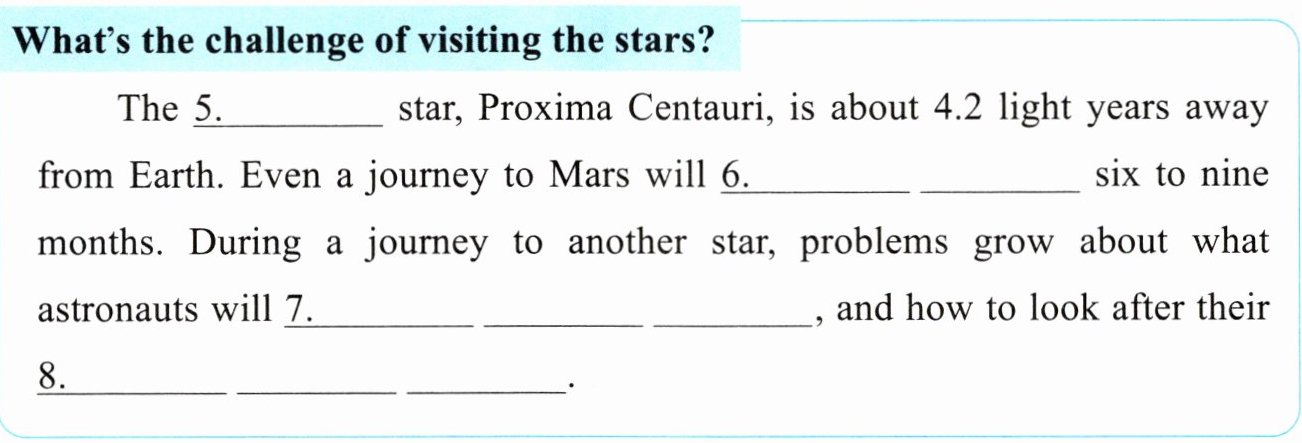 star, problems grow about what astronauts will 7.
Is visiting the stars a completely wild dream?
No. Scientists believe that with nations and scientists 9.
What do we learn about Voyager 1?
Voyager 1 is the man-made object that has travelled 1.
farthest
from Earth. It 2.was
launched
in 1977. On board Voyager 1, there is a special record with 3.sounds
and
pictures
from Earth. By 2025, Voyager 1 was over 25 billion kilometres 4.away
from
Earth.What’s the challenge of visiting the stars?
The 5.
second-closest
star, Proxima Centauri, is about 4.2 light years away from Earth. Even a journey to Mars will 6.take
around
six to nine months. During a journey to an star, problems grow about what astronauts will 7.eat
and
drink
, and how to look after their 8.health
and
safety
.Is visiting the stars a completely wild dream?
No. Scientists believe that with nations and scientists 9.
cooperating
with
one another, the necessary technology 10.will
be
developed
. One day we will 11.reach
the
stars
.答案
1. farthest 2. was launched 3. sounds and pictures 4. away from
5. second-closest 6. take around 7. eat and drink 8. health and safety
9. cooperating with 10. will be developed 11. reach the stars
5. second-closest 6. take around 7. eat and drink 8. health and safety
9. cooperating with 10. will be developed 11. reach the stars
解析
【分析】
这是一道围绕太空探索主题的英语填空题,解题思路为:先通读全文理解文本大意,结合上下文语境、固定搭配、语法规则及太空科普常识,逐个分析每个空所需的词汇或短语,确保填入内容符合逻辑和语法要求。
【解析】
1. 根据常识,旅行者1号是离地球最远的人造物体,此处需用形容词最高级,故填farthest;
2. 旅行者1号在1977年被发射,需用一般过去时的被动语态,故填was launched;
3. 旅行者1号上的特殊记录包含地球的声音和图片,符合太空探测常识,故填sounds and pictures;
4. 表示“距离某地多远”用固定搭配away from,故填away from;
5. 比邻星是距离地球第二近的恒星,故填second-closest;
6. 表示“花费(时间)”的固定搭配take around,符合语境,故填take around;
7. 太空旅程中宇航员需要解决饮食问题,故填eat and drink;
8. 太空旅行需关注宇航员的健康和安全,故填health and safety;
9. 表示“互相合作”用固定搭配cooperating with,符合语境,故填cooperating with;
10. 技术会被开发,需用一般将来时的被动语态,故填will be developed;
11. 结合主题,最终目标是到达恒星,故填reach the stars。
【答案】
1. farthest 2. was launched 3. sounds and pictures 4. away from 5. second-closest 6. take around 7. eat and drink 8. health and safety 9. cooperating with 10. will be developed 11. reach the stars
【知识点】
英语固定搭配;英语被动语态;太空科普词汇
【点评】
本题以太空探索为主题,综合考查学生的词汇运用、语境理解及语法掌握能力,结合科普常识可辅助解题,难度适中。
【难度系数】
0.5
Ⅱ. Read and complete the tasks.
Four astronauts have returned to Earth safely. They completed a 10-day trip around the moon. This was the first crewed lunar mission since 1972.
The mission was called Artemis Ⅱ. The astronauts travelled 1.12 million kilometres in the Orion capsule(舱体). They set a new record too. They went 406,797 kilometres away from Earth. That is farther than any human has ever gone before.
During the trip, the astronauts tested the spacecraft’s life support systems. They also checked the heat shield(隔热罩). The heat shield protects the capsule when it comes back into Earth’s atmosphere. On the way back, the capsule
entered the atmosphere at nearly 38,390 km per hour. It splashed down in the Pacific Ocean on 10 April, 2026.
The four crew members were Commander Reid Wiseman, pilot Victor Glover, mission specialist Christina Koch, and Canadian astronaut Jeremy Hansen. After splashdown, all of them were in good condition.
So, what will be done next? NASA plans to land astronauts on the moon in 2028. A base on the moon will be built in the future. That base will be used for further space research. More international cooperation will be encouraged as well. Working together, humans will explore deeper into space.
The Artemis Ⅱ mission is an important step. It shows that humans are ready to go to the moon and beyond.
A. Complete the sentences according to the passage.
1. NASA plans that astronauts on the moon in 2028.
2. In the future, a base on the moon.
3. The lunar base for further space research.
4. More international cooperation as well.
B. Answer the questions.
()1. What is the main purpose of the Artemis Ⅱ mission?
A. To land on the moon.
B. To break a space record.
C. To build a base on the moon.
D. To prepare for future landings.
()2. What did the astronauts do during the Artemis Ⅱ mission?
A. They tested the spacecraft’s life support systems.
B. They built a base near the south pole of the moon.
C. They landed on the moon and walked on its surface.
D. They sent a rover to explore the far side of the moon.
3. Do you think it’s worth spending so much time and money on visiting the stars? Why or why not?
答案
A. 1. will be landed 2. will be built 3. will be used 4. will be encouraged
B. 1. D 2. A
3. One possible version: Yes, because it helps us understand the universe and may find a new home for humans.
B. 1. D 2. A
3. One possible version: Yes, because it helps us understand the universe and may find a new home for humans.
解析
【分析】
本题分为A、B两部分,A部分要求根据原文完成句子,需定位原文对应内容,结合一般将来时的被动语态结构填空;B部分1为主旨大意题,需理解ArtemisⅡ任务的目的,2为细节理解题,定位宇航员在任务中的行为,3为开放性问答,需结合自身观点合理作答。解题时需仔细阅读原文,找准对应信息,注意被动语态的正确使用。
【解析】
A. 1. 原文提到“NASA plans to land astronauts on the moon in 2028”,此处为that引导的宾语从句,需用一般将来时的被动语态,故填will be landed;
2. 原文提到“A base on the moon will be built in the future”,直接对应结构,填will be built;
3. 原文提到“That base will be used for further space research”,对应结构,填will be used;
4. 原文提到“More international cooperation will be encouraged as well”,对应结构,填will be encouraged;
B. 1. ArtemisⅡ是绕月任务,目的是为2028年登月做准备,故选D;
2. 原文明确“During the trip, the astronauts tested the spacecraft’s life support systems”,故选A;
3. 开放性问题,需结合太空探索的意义作答,合理即可。
【答案】
A. 1. will be landed 2. will be built 3. will be used 4. will be encouraged
B. 1. D 2. A
3. One possible version: Yes, because it helps us understand the universe and may find a new home for humans.
【知识点】
英语阅读理解、一般将来时的被动语态
【点评】
本题考查学生的英语阅读理解能力,涵盖细节填空、主旨选择和开放问答,既要求准确提取原文信息,又考查语言运用能力,是典型的综合类阅读理解题。
【难度系数】
0.7
