

 登录
一、词汇运用
1. They met at the gate of Suzhou Museum on a
2. Life is like a
3. Does your grandma know how to open a WeChat
4. Jessie
5. Money isn't everything, but it
6. Kate has a tight(不宽裕的)
7. Things made in China are popular around the world because they are of high quality(品质), but not e
8. The key(关键)to learning a language well is to use it in our d
1. They met at the gate of Suzhou Museum on a
rainy
(有雨的)morning.2. Life is like a
bank
(银行). If you put a lot of happiness in it, you can enjoy some when you feel sad.3. Does your grandma know how to open a WeChat
account
(账户)?4. Jessie
saves
(储蓄)enough money and buys her mum a sweeping robot as a gift.5. Money isn't everything, but it
matters
(要紧)a lot to the poor.6. Kate has a tight(不宽裕的)
budget
(预算), but she still plans to buy her best friend a birthday gift.7. Things made in China are popular around the world because they are of high quality(品质), but not e
xpensive
.8. The key(关键)to learning a language well is to use it in our d
aily
lives.答案
1. rainy 2. bank 3. account 4. saves 5. matters 6. budget 7. expensive 8. daily
解析
【分析】
本题为词汇运用题,需根据括号内的中文提示或首字母提示,结合句子的词性、时态及固定搭配等知识填写正确单词。具体思路:1. 修饰名词morning需用形容词,对应“有雨的”填rainy;2. 介词like后需名词,对应“银行”填bank;3. 结合固定搭配WeChat account,对应“账户”填account;4. 主语Jessie为第三人称单数,一般现在时下动词“储蓄”用第三人称单数形式;5. 主语it为第三人称单数,一般现在时下动词“要紧”用第三人称单数形式;6. 形容词tight后需名词,对应“预算”填budget;7. 结合句意及首字母e,需填“昂贵的”对应单词;8. 结合固定搭配daily lives及首字母d,填对应单词。
【解析】
1. 空格修饰名词morning,需用形容词,“有雨的”英文为rainy,故填rainy;
2. 介词like后接名词作表语,“银行”英文为bank,故填bank;
3. 固定表达WeChat account意为“微信账户”,“账户”英文为account,故填account;
4. 主语Jessie是第三人称单数,句子为一般现在时,动词“储蓄”需用第三人称单数形式saves,故填saves;
5. 主语it是第三人称单数,句子为一般现在时,动词“要紧”需用第三人称单数形式matters,故填matters;
6. 形容词tight后接名词,“预算”英文为budget,故填budget;
7. 结合句意“中国产品因品质高受欢迎,但并非______”及首字母e,需填“昂贵的”,对应英文expensive,故填expensive;
8. 固定搭配daily lives意为“日常生活”,结合首字母d,故填daily。
【答案】
1. rainy 2. bank 3. account 4. saves 5. matters 6. budget 7. expensive 8. daily
【知识点】
形容词的用法;名词的用法;动词第三人称单数形式
【点评】
本题考查初中英语基础词汇的运用,涉及词性判断、动词时态变化及固定搭配,是常见的词汇运用题型,难度适中,需学生掌握核心词汇及基本语法知识。
【难度系数】
0.8
(
A.have
B.has
C.having
D.to have
A
) 1. 40 per cent of the students in my class a computer.A.have
B.has
C.having
D.to have
答案
1. A
解析
【分析】首先明确句子缺少谓语动词,先排除非谓语动词选项;再根据主谓一致规则,“百分数+of+复数名词”作主语时,谓语动词用复数形式,进而确定正确选项。
【解析】1. 句子成分分析:本句空格处需填谓语动词,选项C(having)和D(to have)为非谓语动词,不能作谓语,先排除;2. 主谓一致规则:当“百分数/分数+of+名词”作主语时,谓语动词的单复数由of后面的名词决定;本题中of后的名词是students(复数),因此谓语动词用复数形式have;3. 选项B(has)是第三人称单数形式,不符合要求,故排除,选A。
【答案】A
【知识点】主谓一致、一般现在时
【点评】本题考查英语主谓一致的基础考点,核心是掌握“百分数+of+名词”作主语时的谓语单复数判断规则,属于初中英语基础题型,难度较低。
【难度系数】0.7
(
A.spend; in
B.take; on
C.pay; for
D.cost; in
C
) 2. I have to 3 000 yuan the house rent (房租) every month.A.spend; in
B.take; on
C.pay; for
D.cost; in
答案
2. C
解析
【分析】本题考查表示“花费”的动词及介词的固定搭配,需先明确spend、take、pay、cost四个动词的用法差异:①spend主语为人,搭配为spend + 钱/时间 + on sth/(in) doing sth;②take主语通常为it,句型为It takes sb + 时间/钱 + to do sth;③pay主语为人,搭配为pay + 钱 + for sth;④cost主语为物,句型为sth costs sb + 钱。结合句子主语为I(人),且搭配“房租”这一事物,需匹配正确的动词搭配。
【解析】逐一分析选项:
选项A:spend的正确搭配为spend...on sth/(in) doing sth,无spend...in sth的用法,排除;
选项B:take的主语需为it,不能是人,不符合句子主语I,排除;
选项C:pay的搭配pay + 钱 + for sth,符合“人+钱+为某物付款”的结构,匹配句子语境,正确;
选项D:cost的主语需为物,不能是人,且无cost...in sth的搭配,排除。
因此正确答案为C。
【答案】C
【知识点】动词搭配、介词搭配
【点评】本题是初中英语基础词汇考查题,聚焦“花费”类动词的固定搭配,需牢记不同动词的主语和介词搭配规则,属于易得分的基础题。
【难度系数】0.7
(
A.must
B.can
C.need
D.should
B
)3. Don't forget(忘记)to bring an umbrella when you come to visit Suzhou in July. It be really rainy in that time.A.must
B.can
C.need
D.should
答案
3. B
解析
【分析】首先通读句子理解语境:七月来苏州别忘带伞,那个时候会下雨,需选择表推测的合适情态动词。回忆各选项情态动词的用法:must表强肯定推测(一定),can表理论上的可能性(有时会),need表需要,should表应该,结合语境判断即可。
【解析】本题考查情态动词的用法。首先分析句意:“七月来苏州参观时别忘记带伞,那个时候会经常下雨”,此处需表达客观存在的可能性。A选项must表肯定推测,语气过于绝对,不符合实际;B选项can可表示理论上的可能性,意为“可能、会”,符合语境;C选项need表“需要”,不符合推测语境;D选项should表“应该”,多用于义务或建议,不符合推测用法。因此选B。
【答案】B
【知识点】情态动词的用法
【点评】本题结合生活场景考查情态动词表推测的用法,需准确区分不同情态动词的语义差异,是初中英语的基础考点,难度适中。
【难度系数】0.6
(
A.finishes
B.reads
C.means
D.covers
D
)4. All inclusive package(一价全包)tours are popular now. The price(价格)usually everything in the travelling and people needn't pay more.A.finishes
B.reads
C.means
D.covers
答案
4. D
解析
【分析】这是一道动词词义辨析题,解题思路是先理解句子语境:一价全包旅行的价格________旅行中的所有费用,人们无需额外付费。再逐一分析选项词义,选出符合语境的动词。
【解析】首先明确各选项含义:A.finishes意为“完成”;B.reads意为“阅读”;C.means意为“意思是”;D.covers意为“涵盖,包含”。结合句子语境,价格“涵盖”所有费用才符合“一价全包”的特点,因此选D。
【答案】D
【知识点】动词词义辨析
【点评】本题考查动词在具体语境中的词义辨析,需要学生掌握常见动词的不同含义,并能结合句子语境准确选择。
【难度系数】0.6
(
— .
A.No, you are busy too
B.You are welcome
C.Thanks, but I can manage
D.Help yourself
C
) 5. — Annie, there's a lot to do to get ready for the dinner. Let me help you.— .
A.No, you are busy too
B.You are welcome
C.Thanks, but I can manage
D.Help yourself
答案
5. C
解析
【分析】首先明确对话场景:对方主动提出帮助Annie准备晚餐,需选择符合语境的礼貌回应。通过逐一分析选项,排除不符合场景的表达,确定正确答案。
【解析】A选项语气生硬,不符合日常礼貌回应的要求;B选项“You are welcome”用于回应他人的感谢,此处是他人提供帮助,不适用;C选项“Thanks, but I can manage”意为“谢谢,不过我能应付”,既礼貌回应了帮助,又表达了自己能处理,契合语境;D选项“Help yourself”多用于让他人随意取用食物等,与本题场景不符。因此选C。
【答案】C
【知识点】情景交际;日常用语
【点评】本题考查日常情景交际用语,结合生活场景设置,难度较低,需掌握常见的礼貌回应表达。
【难度系数】0.3
三、完成句子
1. 这条牛仔裤太贵了。我想要试穿另一条。
This pair of jeans . I'd like .
2. 这个家庭花费百分之五十的预算在孩子的教育上。
The family spends 50 their child's education.
3. 妈妈在她的银行账户中存了20 000元,以备不时之需。
Mum saves 20 000 yuan for .
4. 在日常生活中,你常常会做预算吗?
Do you often in your ?
答案
1. is too expensive/costs too much, to try another pair on 2. per cent of the budget on 3. in her bank account, a rainy day 4. make a budget, daily life
解析
【分析】
本题为英语完成句子题,需结合中文句意、语法规则及固定搭配填写空缺:1. 第一句主语this pair of jeans为单数,“太贵了”对应is too expensive或costs too much;“想要试穿另一条”需用would like to do结构,“试穿”为try on,“另一条牛仔裤”为another pair,故填对应不定式短语。2. “百分之五十的预算”用per cent of the budget,“花费在...上”符合spend...on的固定搭配。3. “在她的银行账户中”为介词短语,“以备不时之需”是固定习语。4. “做预算”是固定短语,“日常生活”为固定表达,助动词do后接动词原形。
【解析】
1. 第一空:主语this pair of jeans为单数,“太贵了”可译为is too expensive或costs too much;后两空:would like后接不定式,“试穿”是try on,“另一条牛仔裤”是another pair,故填to try another pair on。
2. “百分之”用per cent,“预算”是budget,“spend...on”为固定搭配,故填per cent of the budget on。
3. “在银行账户中”是介词短语in her bank account;“以备不时之需”是固定习语a rainy day,故填对应内容。
4. “做预算”是固定短语make a budget,“日常生活”是daily life,助动词do后接动词原形,故填对应内容。
【答案】
1. is too expensive/costs too much, to try another pair on 2. per cent of the budget on 3. in her bank account, a rainy day 4. make a budget, daily life
【知识点】
固定短语运用、主谓一致、介词搭配
【点评】
本题考查英语基础词汇、固定搭配及语法细节,属于基础题型,需学生掌握课本常用表达,难度适中。
【难度系数】
0.6
四、阅读理解
The Spring Festival is a time for children to get lucky money. Do you think parents should keep their children's lucky money? Here, some middle school students are sharing their ideas online.
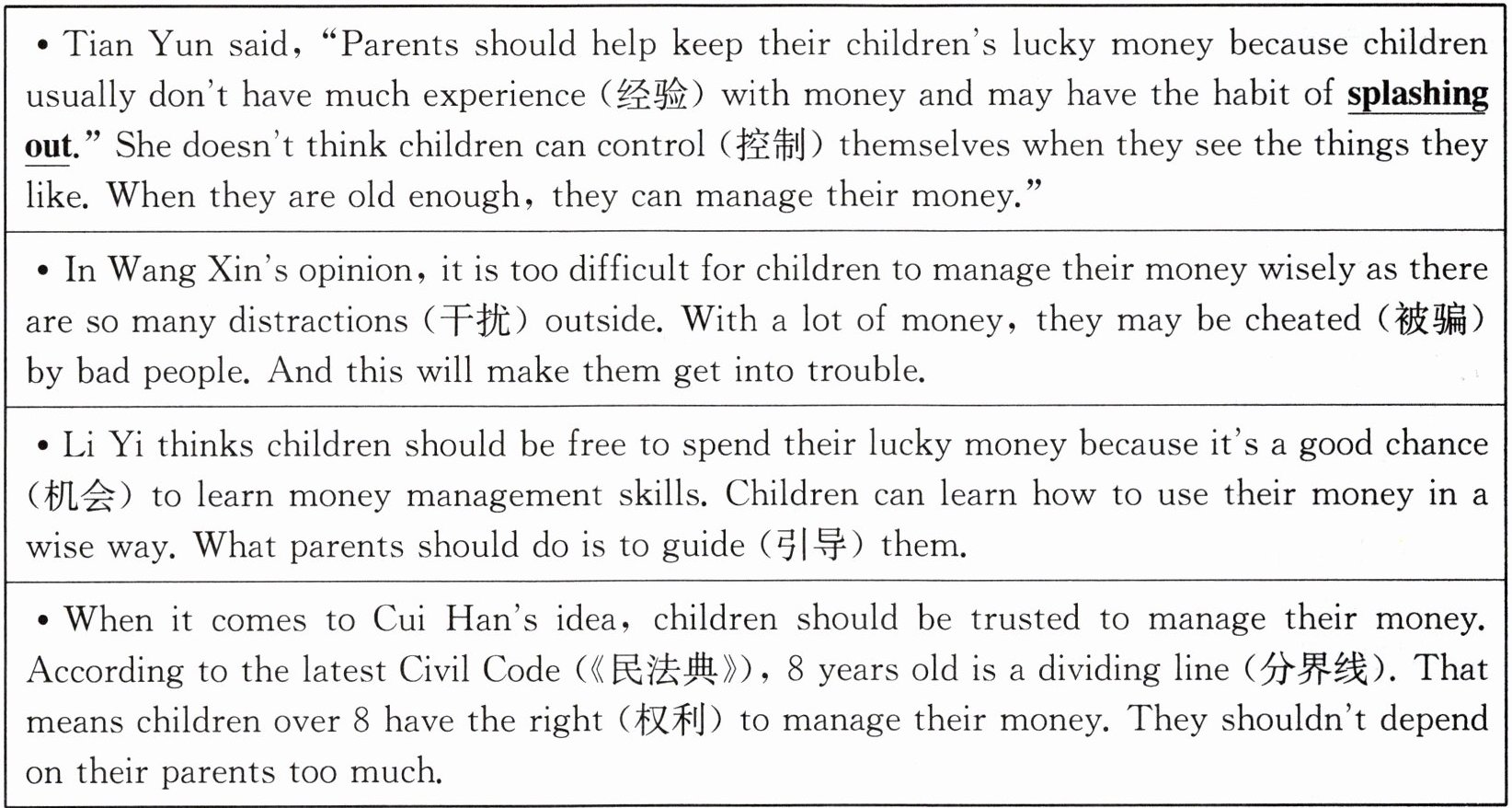
• Tian Yun said, “Parents should help keep their children's lucky money because children usually don't have much experience(经验)with money and may have the habit of splashing out.” She doesn't think children can control(控制)themselves when they see the things they like. When they are old enough, they can manage their money.”
• In Wang Xin's opinion, it is too difficult for children to manage their money wisely as there are so many distractions(干扰)outside. With a lot of money, they may be cheated(被骗)by bad people. And this will make them get into trouble.
• Li Yi thinks children should be free to spend their lucky money because it's a good chance(机会)to learn money management skills. Children can learn how to use their money in a wise way. What parents should do is to guide(引导)them.
• When it comes to Cui Han's idea, children should be trusted to manage their money. According to the latest Civil Code(《民法典》), 8 years old is a dividing line(分界线). That means children over 8 have the right(权利)to manage their money. They shouldn't depend on their parents too much.
(
A. Saving money.
B. Borrowing money from others.
C. Giving money to others.
D. Spending money like running water.
(
① Tian Yun ② Wang Xin ③ Li Yi ④ Cui Han
a. Children may be cheated if they have a lot of money.
b. Children older than eight can manage their money.
c. Parents can guide children to spend money in a right way.
d. Children can manage their money when they grow up.
A. ①-a; ②-d; ③-b; ④-c
B. ①-d; ②-a; ③-c; ④-b
C. ①-d; ②-b; ③-a; ④-c
D. ①-a; ②-c; ③-d; ④-b
(
A. Who can keep lucky money.
B. Where to save lucky money.
C. How to use lucky money.
D. When to get lucky money.
(
A. Health and exercise.
B. Family and society(社会).
C. Nature and history.
D. Festivals and traditions.
The Spring Festival is a time for children to get lucky money. Do you think parents should keep their children's lucky money? Here, some middle school students are sharing their ideas online.
• Tian Yun said, “Parents should help keep their children's lucky money because children usually don't have much experience(经验)with money and may have the habit of splashing out.” She doesn't think children can control(控制)themselves when they see the things they like. When they are old enough, they can manage their money.”
• In Wang Xin's opinion, it is too difficult for children to manage their money wisely as there are so many distractions(干扰)outside. With a lot of money, they may be cheated(被骗)by bad people. And this will make them get into trouble.
• Li Yi thinks children should be free to spend their lucky money because it's a good chance(机会)to learn money management skills. Children can learn how to use their money in a wise way. What parents should do is to guide(引导)them.
• When it comes to Cui Han's idea, children should be trusted to manage their money. According to the latest Civil Code(《民法典》), 8 years old is a dividing line(分界线). That means children over 8 have the right(权利)to manage their money. They shouldn't depend on their parents too much.
(
D
)1. What do the underlined words “splashing out” probably mean?A. Saving money.
B. Borrowing money from others.
C. Giving money to others.
D. Spending money like running water.
(
B
)2. Match the students with their ideas and choose the right answer.① Tian Yun ② Wang Xin ③ Li Yi ④ Cui Han
a. Children may be cheated if they have a lot of money.
b. Children older than eight can manage their money.
c. Parents can guide children to spend money in a right way.
d. Children can manage their money when they grow up.
A. ①-a; ②-d; ③-b; ④-c
B. ①-d; ②-a; ③-c; ④-b
C. ①-d; ②-b; ③-a; ④-c
D. ①-a; ②-c; ③-d; ④-b
(
A
)3. What are the students talking about?A. Who can keep lucky money.
B. Where to save lucky money.
C. How to use lucky money.
D. When to get lucky money.
(
B
)4. In which part of a magazine can you read the text?A. Health and exercise.
B. Family and society(社会).
C. Nature and history.
D. Festivals and traditions.
答案
1. D 2. B 3. A 4. B
解析
【分析】
这是一篇关于学生对压岁钱管理观点讨论的阅读理解题,需根据不同题型的解题方法逐一解答:1. 词义猜测题,结合上下文语境推测划线短语含义;2. 细节匹配题,定位每个学生的观点并与对应选项匹配;3. 主旨大意题,抓住文章核心话题;4. 文章出处题,根据内容判断所属板块。
【解析】
1. 词义猜测题:根据第一段Tian Yun的表述“children usually don't have much experience with money and may have the habit of splashing out. She doesn't think children can control themselves when they see the things they like”,可知孩子因缺乏金钱经验,看到喜欢的东西无法控制,养成的是乱花钱的习惯,“splashing out”意为“花钱如流水”,对应选项D。
2. 细节匹配题:逐一对应学生观点与选项:①Tian Yun提到“When they are old enough, they can manage their money”,对应d;②Wang Xin指出“With a lot of money, they may be cheated by bad people”,对应a;③Li Yi认为“What parents should do is to guide them”,对应c;④Cui Han说明“children over 8 have the right to manage their money”,对应b。因此匹配为①-d、②-a、③-c、④-b,对应选项B。
3. 主旨大意题:文章开篇提出核心问题“Do you think parents should keep their children's lucky money?”,四位学生均围绕“谁保管孩子的压岁钱”展开讨论,因此选A。
4. 文章出处题:文章内容是关于家庭中孩子压岁钱管理的观点交流,属于家庭与社会话题范畴,因此可在“Family and society”板块读到,选B。
【答案】
1.D 2.B 3.A 4.B
【知识点】
词义猜测题、细节理解题、主旨大意题
【点评】
本文以学生分享压岁钱管理观点为话题,贴近生活实际,考查阅读理解核心题型,侧重学生对语境的理解、细节的定位与主旨的把握,难度适中。
【难度系数】
0.6
