

 登录
登录
三、信息还原。阅读下面短文,从所给选项中选出能填入空白处的最佳选项,使短文通顺、结构完整。
(江苏南京期末)China is famous for the fans. Fans are everywhere in our daily life. 1. During the Shang Dynasty(朝代), people used fans to cool the air. At that time, fans were made of feathers(羽毛), bamboo or silk(丝绸). 2.
A. Today, fans are popular gifts.
B. This made the fans into artworks.
C. But how much do you know about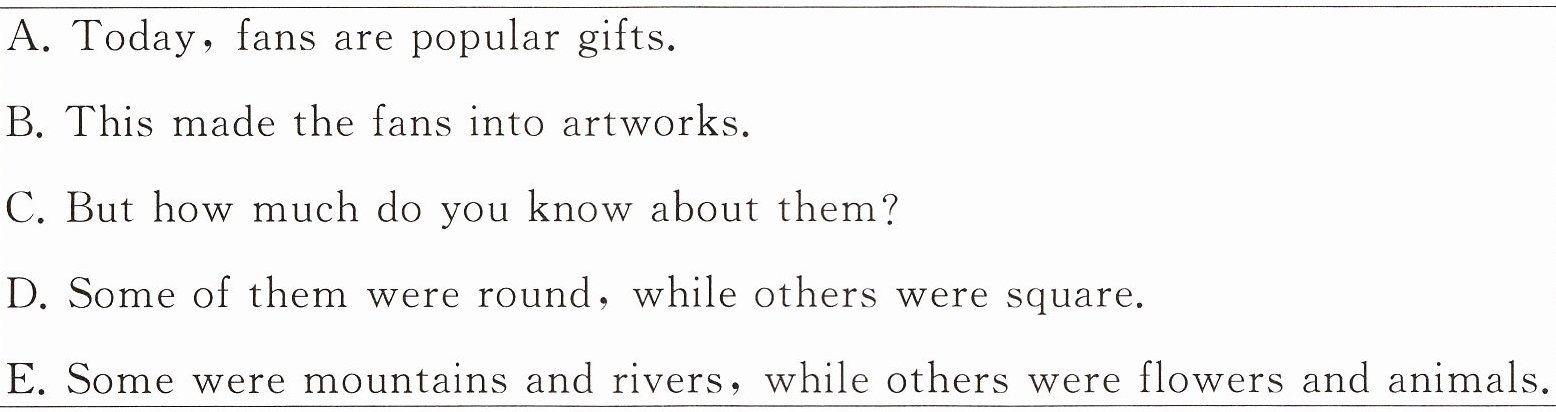 hem?
hem?
D. Some of them were round, while others were square.
E. Some were mountains and rivers, while others were flowers and animals.
(江苏南京期末)China is famous for the fans. Fans are everywhere in our daily life. 1.
C
During the Shang Dynasty(朝代), people used fans to cool the air. At that time, fans were made of feathers(羽毛), bamboo or silk(丝绸). 2. D
Folding paper fans(折扇) first became popular during the Song Dynasty. There were usually beautiful pictures on the fans. 3. E
Many poets(诗人), including Su Dongpo, even painted and wrote poems on fans. 4. B
Many rich and important people liked holding fans. 5. A
During the 2008 Beijing Olympic Games, leaders and officials from other countries got folding fans as gifts. Audience(观众) got them too. Many people are experiencing Chinese culture.A. Today, fans are popular gifts.
B. This made the fans into artworks.
C. But how much do you know about
hem?D. Some of them were round, while others were square.
E. Some were mountains and rivers, while others were flowers and animals.
答案
1. C 上句说:扇子在我们的日常生活中无处不在。可推知下句是问关于扇子你了解多少呢,选项C"但你们对它们了解多少呢?"符合语境,故选C。
2. D 上句说:当时,扇子是由羽毛、竹子或丝绸制成的。可推知下句是关于扇子的形状,选项D"它们有的是圆形,有的是方形。"符合语境,故选D。
3. E 上句说:扇子上通常有美丽的图画。可推知下句是介绍图画有什么,选项E"有些是山水,有些是花卉和动物。"符合语境,故选E。
4. B 上句说:许多诗人,包括苏东坡,甚至在扇子上作画和写诗。可推知下句是介绍扇子变成艺术品,选项B"这使得扇子成为艺术品。"符合语境,故选B。
5. A 上句说:许多富人和重要人物喜欢手持扇子。可推知下句是关于扇子作为礼物的现代流行性,选项A"如今,扇子是流行的礼物。"符合语境,故选A。
2. D 上句说:当时,扇子是由羽毛、竹子或丝绸制成的。可推知下句是关于扇子的形状,选项D"它们有的是圆形,有的是方形。"符合语境,故选D。
3. E 上句说:扇子上通常有美丽的图画。可推知下句是介绍图画有什么,选项E"有些是山水,有些是花卉和动物。"符合语境,故选E。
4. B 上句说:许多诗人,包括苏东坡,甚至在扇子上作画和写诗。可推知下句是介绍扇子变成艺术品,选项B"这使得扇子成为艺术品。"符合语境,故选B。
5. A 上句说:许多富人和重要人物喜欢手持扇子。可推知下句是关于扇子作为礼物的现代流行性,选项A"如今,扇子是流行的礼物。"符合语境,故选A。
四、语法填空。用括号内所给单词的适当形式填空。
(河南郑州期末)Bill Cray is an Australian boy. He 1.
(河南郑州期末)Bill Cray is an Australian boy. He 1.
studies
(study) at Darwin School. His father is a worker. He 2. works
(work) in a big car factory. His mother is a teacher. She 3. teaches
(teach) English in a small town. The Chinese students 4. work
(work) hard at English. Bill's mother is pleased with the Chinese students. Bill 5. says
(say) he 6. wants
(want) to 7. be
(be) an English teacher too. He would like 8. to teach
(teach) Chinese students because he 9. wants
(want) to learn Chinese from them.答案
1. studies 句意:他在达尔文学校学习。句子是一般现在时,主语He是第三人称单数,动词study也用第三人称单数形式studies。故答案为studies。
2. works 句意:他在一家大型汽车工厂工作。句子是一般现在时,主语He是第三人称单数,动词work也用第三人称单数形式works。故答案为works。
3. teaches 句意:她在一个小镇上教英语。句子是一般现在时,主语She是第三人称单数,动词teach也用第三人称单数形式teaches。故答案为teaches。
4. work 句意:中国学生努力学习英语。句子是一般现在时,主语The Chinese students是复数,动词work用原形。故答案为work。
5. says 句意:比尔说他也想成为一名英语教师。句子是一般现在时,主语Bill是第三人称单数,动词say也用第三人称单数形式says。故答案为says。
6. wants 句意:比尔说他也想成为一名英语教师。句子是一般现在时,从句中主语he是第三人称单数,动词want也用第三人称单数形式wants。故答案为wants。
7. be 句意:比尔说他也想成为一名英语教师。want to do sth.想要做某事,to后接动词原形。故答案为be。
8. to teach 句意:他想教中国学生,因为他想向他们学习汉语。would like to do想要做某事,故该空用动词不定式to teach。故答案为to teach。
9. wants 句意:他想教中国学生,因为他想向他们学习汉语。句子是一般现在时,主语he是第三人称单数,动词want也用第三人称单数形式wants。故答案为wants。
2. works 句意:他在一家大型汽车工厂工作。句子是一般现在时,主语He是第三人称单数,动词work也用第三人称单数形式works。故答案为works。
3. teaches 句意:她在一个小镇上教英语。句子是一般现在时,主语She是第三人称单数,动词teach也用第三人称单数形式teaches。故答案为teaches。
4. work 句意:中国学生努力学习英语。句子是一般现在时,主语The Chinese students是复数,动词work用原形。故答案为work。
5. says 句意:比尔说他也想成为一名英语教师。句子是一般现在时,主语Bill是第三人称单数,动词say也用第三人称单数形式says。故答案为says。
6. wants 句意:比尔说他也想成为一名英语教师。句子是一般现在时,从句中主语he是第三人称单数,动词want也用第三人称单数形式wants。故答案为wants。
7. be 句意:比尔说他也想成为一名英语教师。want to do sth.想要做某事,to后接动词原形。故答案为be。
8. to teach 句意:他想教中国学生,因为他想向他们学习汉语。would like to do想要做某事,故该空用动词不定式to teach。故答案为to teach。
9. wants 句意:他想教中国学生,因为他想向他们学习汉语。句子是一般现在时,主语he是第三人称单数,动词want也用第三人称单数形式wants。故答案为wants。
