

 登录
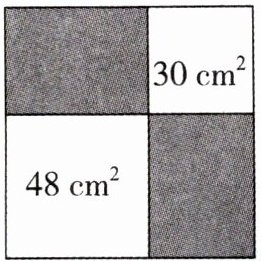
10. (2026·怀化期末)如图,从一个大正方形中裁去面积为30 cm²和48 cm²的两个小正方形,则余下部分的面积为(
A.78 cm²
B.$(4\sqrt{3}+\sqrt{30}) cm²$
C.$12\sqrt{10} cm²$
D.$24\sqrt{10} cm²$
D
)A.78 cm²
B.$(4\sqrt{3}+\sqrt{30}) cm²$
C.$12\sqrt{10} cm²$
D.$24\sqrt{10} cm²$
答案
10. D 解析:$\because$ 两个小正方形的面积为 30 cm² 和 48 cm²,$\therefore$ 两个小正方形的边长为 $\sqrt{48}=4\sqrt{3}$ cm 和 $\sqrt{30}$ cm,$\therefore$ 大正方形的边长为$(4\sqrt{3}+\sqrt{30})$ cm,$\therefore$ 余下部分的面积为$(4\sqrt{3}+\sqrt{30})^2 - 30 - 48 = 2×4\sqrt{3}×\sqrt{30} = 24\sqrt{10} (cm^2)$.故选 D.
11. 已知化简$\sqrt{96} · \sqrt{a}$的结果是一个整数,则正整数$a$的最小值是
6
.答案
11. 6 解析:$\because \sqrt{96} · \sqrt{a} = \sqrt{96a} = \sqrt{16×6a} = 4 \sqrt{6a}$,且$\sqrt{96} · \sqrt{a}$的结果是一个整数,$\therefore \sqrt{6a}$是一个整数,$\therefore 6a$ 是平方数,$\therefore$ 正整数 $a$ 的最小值是 6.
12. 已知$\sqrt{20-x^2} - \sqrt{8-x^2} = 2$,则$\sqrt{20-x^2} + \sqrt{8-x^2} = \_\_\_\_\_\_$。
答案
12. 6 解析:$\because (\sqrt{20-x^2} - \sqrt{8-x^2}) · (\sqrt{20-x^2} + \sqrt{8-x^2}) = 20-x^2 - (8-x^2) = 12$,而 $\sqrt{20-x^2} - \sqrt{8-x^2} = 2$,$\therefore \sqrt{20-x^2} + \sqrt{8-x^2} = 6$.
13. (德阳中考改编)将一组数$\sqrt{2},2,\sqrt{6},2\sqrt{2},\sqrt{10},2\sqrt{3},···,\sqrt{2n}$按以下方式进行排列:
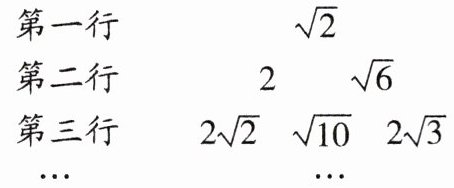
则第八行左起第2个数是
则第八行左起第2个数是
$2\sqrt{15}$
.答案
13. $2\sqrt{15}$ 解析:由题图可知,第一行有 1 个数,第二行共有 2 个数,第三行共有 3 个数,归纳类推得第一行至第七行共有 $1+2+3+4+5+6+7=28$(个)数,则第八行左起第2个数是 $\sqrt{2×(28+2)} = \sqrt{60} = 2 \sqrt{15}$.
14. 计算:
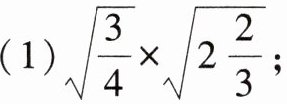
(1)
(2) $(-\sqrt{xy^5}) · \sqrt{x^3 y} · (-\sqrt{\dfrac{1}{y^6}}) (x≥0, y>0)$;
(3) $\sqrt{108a^3 b} · (-\sqrt{6b}) (a≥0, b≥0)$;
(4) $\sqrt{2025^2 - 2023^2}$。
(1)
(2) $(-\sqrt{xy^5}) · \sqrt{x^3 y} · (-\sqrt{\dfrac{1}{y^6}}) (x≥0, y>0)$;
(3) $\sqrt{108a^3 b} · (-\sqrt{6b}) (a≥0, b≥0)$;
(4) $\sqrt{2025^2 - 2023^2}$。
答案
14. (1)原式= $\sqrt{\frac{3}{4}×\frac{8}{3}} = \sqrt{2}$.
(2)原式= $\sqrt{xy^5 · x^3 y · \frac{1}{y^6}} = \sqrt{x^4} = x^2$.
(3)原式= $-\sqrt{108a^3 b} · \sqrt{6b} = -\sqrt{648a^3 b^2} = -18ab \sqrt{2a}$.
(4)原式= $\sqrt{(2025-2023)×(2025+2023)} = \sqrt{2×4048} = 4\sqrt{506}$.
(2)原式= $\sqrt{xy^5 · x^3 y · \frac{1}{y^6}} = \sqrt{x^4} = x^2$.
(3)原式= $-\sqrt{108a^3 b} · \sqrt{6b} = -\sqrt{648a^3 b^2} = -18ab \sqrt{2a}$.
(4)原式= $\sqrt{(2025-2023)×(2025+2023)} = \sqrt{2×4048} = 4\sqrt{506}$.
15. 两个含有二次根式的代数式相乘,如果它们的积不含有二次根式,我们就说这两个代数式互为有理化因式,例如$\sqrt{a}$与$\sqrt{a}$,$\sqrt{2}+1$与$\sqrt{2}-1$.在解形如$\sqrt{24-x}=\sqrt{8-x}+2$的方程时也可以采用类似的策略:由$(\sqrt{24-x}-\sqrt{8-x})·(\sqrt{24-x}+\sqrt{8-x})=(\sqrt{24-x})^2-(\sqrt{8-x})^2=16$,考虑到$\sqrt{24-x}-\sqrt{8-x}=2$,可得$\sqrt{24-x}+\sqrt{8-x}=8$,故可得$\begin{cases}\sqrt{24-x}=5,\\\sqrt{8-x}=3,\end{cases}$将$\sqrt{24-x}=5$两边平方可解得$x=-1$,经检验,$x=-1$是原方程的解.
请根据此方法,解下面的方程:
(1)方程$\sqrt{x+1}=2$的解是
(2)方程$\sqrt{x^2+42}+\sqrt{x^2+10}=16$的解是
(3)解方程$\sqrt{4x^2+6x-5}+\sqrt{4x^2-2x-5}=4x$.
请根据此方法,解下面的方程:
(1)方程$\sqrt{x+1}=2$的解是
$x=3$
;(2)方程$\sqrt{x^2+42}+\sqrt{x^2+10}=16$的解是
$x=\pm\sqrt{39}$
;(3)解方程$\sqrt{4x^2+6x-5}+\sqrt{4x^2-2x-5}=4x$.
答案
15. (1)$x=3$ 解析:$\because \sqrt{x+1}=2$,$\therefore x+1=4$,解得 $x=3$,经检验,$x=3$ 是原方程的解.
(2)$x=\pm\sqrt{39}$ 解析:$\because (\sqrt{x^2+42} + \sqrt{x^2+10}) ( \sqrt{x^2+42} - \sqrt{x^2+10}) = x^2 + 42 - (x^2 + 10) = 32$, 又 $\because \sqrt{x^2+42} + \sqrt{x^2+10} = 16$,$\therefore \sqrt{x^2+42} - \sqrt{x^2+10} = 2$,$\therefore \begin{cases}\sqrt{x^2+42}=9,\\\sqrt{x^2+10}=7,\end{cases}$ $\therefore x^2=39$,$\therefore x=\pm\sqrt{39}$,经检验,$x=\pm\sqrt{39}$是原方程的解.
(3)$\because \sqrt{4x^2+6x-5} + \sqrt{4x^2-2x-5} = 4x$,$\therefore (\sqrt{4x^2+6x-5} + \sqrt{4x^2-2x-5}) ( \sqrt{4x^2+6x-5} - \sqrt{4x^2-2x-5}) = 4x^2 + 6x - 5 - (4x^2 - 2x - 5) = 8x$,$\therefore \sqrt{4x^2+6x-5} - \sqrt{4x^2-2x-5} = 2$, $\therefore \begin{cases}\sqrt{4x^2+6x-5}=2x+1,\\\sqrt{4x^2-2x-5}=2x-1,\end{cases}$ 解得 $x=3$,经检验,$x=3$ 是原方程的解,$\therefore$ 原方程的解为 $x=3$.
