

 登录
登录
一、听录音,选出所听句子中包含的内容。
(
(
(
(
(
(
A
)1. A. do exercise B. do chores C. do well(
C
)2. A. help others B. put things in order C. take notes(
B
)3. A. bad habits B. good habits C. some habits(
A
)4. A. show you around B. show him around C. show me around(
A
)5. A. clean and tidy B. clean and nice C. tidy and bright答案
1~5 A C B A A
二、实验班原创 学习能力 请你在好习惯的图片后打“√”,并用英文描述;在坏习惯的图片后打“×”,并给出合理建议。
| Number | Picture | Good or bad? | Try to describe/Give advice |
| ---- | ---- | ---- | ---- |
| 1 | | (
| 2 |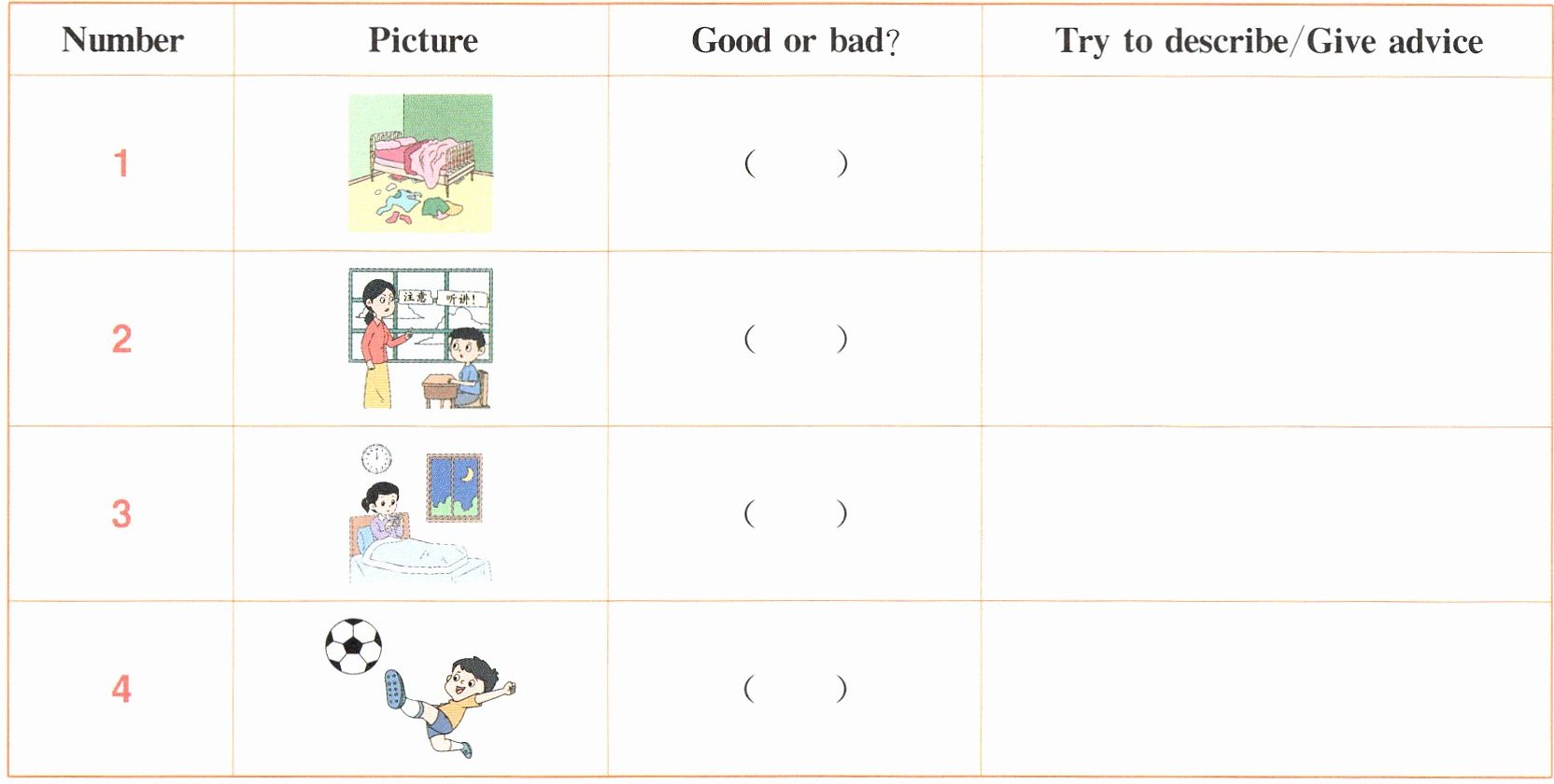 | (
| (
| 3 | | (
| 4 | | (
| Number | Picture | Good or bad? | Try to describe/Give advice |
| ---- | ---- | ---- | ---- |
| 1 | | (
×
) | || 2 |
| (×
) | || 3 | | (
×
) | || 4 | | (
√
) | |答案
1. ×, keep the room tidy
2. ×, listen carefully
3. ×, go to bed early
4. √, do exercise(答案不唯一)
2. ×, listen carefully
3. ×, go to bed early
4. √, do exercise(答案不唯一)
三、用所给单词的适当形式填空。
1. The boy
2.
3. Liu Jiajia
4. Wang Bing
5. Miss Li
1. The boy
keeps
(keep) his room clean.2.
Pick
(pick) one card, please.3. Liu Jiajia
listens
(listen) carefully and takes
(take) notes carefully too.4. Wang Bing
has
(have) many good habits
(habit).5. Miss Li
does
(do) exercise every morning.答案
1. keeps 2. Pick 3. listens,takes
4. has,habits 5. does
1. 主语 The boy 是第三人称单数,句子描述日常行为,用一般现在时,谓语动词需用第三人称单数形式,keep 的第三人称单数形式为 keeps,故填 keeps。
2. 本句是祈使句,用于提出请求,祈使句需以动词原形开头,且首字母要大写,故填 Pick。
3. 主语 Liu Jiajia 是第三人称单数,句子描述日常行为,用一般现在时;and 连接两个并列的谓语动词,都需用第三人称单数形式,listen 的第三人称单数形式为 listens,take 的第三人称单数形式为 takes,故依次填 listens,takes。
4. 第一空:主语 Wang Bing 是第三人称单数,句子描述客观情况,用一般现在时,have 的第三人称单数形式为 has;第二空:many 后接可数名词复数形式,habit 的复数形式为 habits,故依次填 has,habits。
5. 主语 Miss Li 是第三人称单数,every morning 表明句子是一般现在时,do 的第三人称单数形式为 does,故填 does。
4. has,habits 5. does
1. 主语 The boy 是第三人称单数,句子描述日常行为,用一般现在时,谓语动词需用第三人称单数形式,keep 的第三人称单数形式为 keeps,故填 keeps。
2. 本句是祈使句,用于提出请求,祈使句需以动词原形开头,且首字母要大写,故填 Pick。
3. 主语 Liu Jiajia 是第三人称单数,句子描述日常行为,用一般现在时;and 连接两个并列的谓语动词,都需用第三人称单数形式,listen 的第三人称单数形式为 listens,take 的第三人称单数形式为 takes,故依次填 listens,takes。
4. 第一空:主语 Wang Bing 是第三人称单数,句子描述客观情况,用一般现在时,have 的第三人称单数形式为 has;第二空:many 后接可数名词复数形式,habit 的复数形式为 habits,故依次填 has,habits。
5. 主语 Miss Li 是第三人称单数,every morning 表明句子是一般现在时,do 的第三人称单数形式为 does,故填 does。
四、新情境 校园采访 校园小记者在采访学习标兵。从方框中选择合适的选项,补全对话。
A. read some books every night
B. do exercise
C. listen to teachers carefully
D. do well at school
E. watch TV
A: Hi, Lily! You always get good grades(成绩). What's your secret(秘密)?
B: Well, I have some good habits. Every morning, I 1.
A: That's cool! What about in class?
B: I always 2.
A: Do you do homework every day?
B: Yes! And I never 3.
A: That's why you 4.
B: Yes! Also, I 5.
A. read some books every night
B. do exercise
C. listen to teachers carefully
D. do well at school
E. watch TV
A: Hi, Lily! You always get good grades(成绩). What's your secret(秘密)?
B: Well, I have some good habits. Every morning, I 1.
B
before breakfast.A: That's cool! What about in class?
B: I always 2.
C
. That helps me learn well.A: Do you do homework every day?
B: Yes! And I never 3.
E
before I finish it.A: That's why you 4.
D
, right?B: Yes! Also, I 5.
A
and go to bed early. Good habits help me grow smart!答案
1~5 B C E D A
2. 根据问句中"in class"和答句中"helps me learn well"可知,此处应选适合课堂场景的好习惯,C 选项符合语境。
4. 前文介绍了一系列良好的学习和生活习惯,此处是这些习惯带来的正向结果,D 选项符合语境。
5. 根据后文"go to bed early"可知,此处应选睡前的好习惯,A 选项符合语境。
2. 根据问句中"in class"和答句中"helps me learn well"可知,此处应选适合课堂场景的好习惯,C 选项符合语境。
4. 前文介绍了一系列良好的学习和生活习惯,此处是这些习惯带来的正向结果,D 选项符合语境。
5. 根据后文"go to bed early"可知,此处应选睡前的好习惯,A 选项符合语境。
