

 登录
登录
一、词汇运用
A)根据语境,在横线处填写一个适当的词或用括号内所给词的适当形式填空。
1. My partner is very smart and always comes up
2. My school will organize
3. No one knows
4. Everyone knows the importance of environmental
5. When I entered the room, my brother
A)根据语境,在横线处填写一个适当的词或用括号内所给词的适当形式填空。
1. My partner is very smart and always comes up
with
good ideas in group activities.2. My school will organize
an
outdoor trip to let us learn more about wild plants.3. No one knows
if/whether
the famous writer will come to our school to give a talk.4. Everyone knows the importance of environmental
protection
(protect).5. When I entered the room, my brother
buried
(bury) himself in a science fiction novel.答案
1. with
2. an
3. if/whether
4. protection
5. buried
2. an
3. if/whether
4. protection
5. buried
解析
【分析】
本题为英语词汇运用题,需结合固定搭配、冠词用法、宾语从句引导词、词性转换、动词时态等知识点解题。第1题考查固定短语搭配;第2题考查不定冠词用法,需判断单词开头音素;第3题考查宾语从句中表“是否”的引导词;第4题考查词性转换,形容词后接名词;第5题考查一般过去时,结合时间状语从句的时态逻辑判断动词形式。
【解析】
1. 固定搭配:come up with是固定短语,意为“想出(主意等)”,故填with。
2. 冠词用法:outdoor以元音音素开头,表泛指“一次户外旅行”,用不定冠词an,故填an。
3. 宾语从句引导词:此处表示“是否”,引导宾语从句,可用if或whether,故填if/whether。
4. 词性转换:environmental是形容词,后需接名词,protect的名词形式为protection,故填protection。
5. 动词时态:when引导的时间状语从句为一般过去时,主句动作发生在过去,用一般过去时,bury的过去式为buried,故填buried。
【答案】
1. with
2. an
3. if/whether
4. protection
5. buried
【知识点】
固定搭配、冠词用法、词性转换、一般过去时
【点评】
本题为基础英语词汇运用题,侧重考查初中阶段核心的基础知识点,难度适中,主要检验学生对词汇基础用法的掌握情况。
【难度系数】
0.8
本题为英语词汇运用题,需结合固定搭配、冠词用法、宾语从句引导词、词性转换、动词时态等知识点解题。第1题考查固定短语搭配;第2题考查不定冠词用法,需判断单词开头音素;第3题考查宾语从句中表“是否”的引导词;第4题考查词性转换,形容词后接名词;第5题考查一般过去时,结合时间状语从句的时态逻辑判断动词形式。
【解析】
1. 固定搭配:come up with是固定短语,意为“想出(主意等)”,故填with。
2. 冠词用法:outdoor以元音音素开头,表泛指“一次户外旅行”,用不定冠词an,故填an。
3. 宾语从句引导词:此处表示“是否”,引导宾语从句,可用if或whether,故填if/whether。
4. 词性转换:environmental是形容词,后需接名词,protect的名词形式为protection,故填protection。
5. 动词时态:when引导的时间状语从句为一般过去时,主句动作发生在过去,用一般过去时,bury的过去式为buried,故填buried。
【答案】
1. with
2. an
3. if/whether
4. protection
5. buried
【知识点】
固定搭配、冠词用法、词性转换、一般过去时
【点评】
本题为基础英语词汇运用题,侧重考查初中阶段核心的基础知识点,难度适中,主要检验学生对词汇基础用法的掌握情况。
【难度系数】
0.8
B)根据语境,从方框中选择合适的词语并用其适当形式填空。
smog; lamp; wash up; bin; leave behind; generation; well-known
1. Could you please put the plastic bottle in the recycling
2. The
3. All the dirty dishes
4. Mark Twain is a
5. When darkness falls, street
6. It's important to protect natural wonders so that future
7. Many tourists
smog; lamp; wash up; bin; leave behind; generation; well-known
1. Could you please put the plastic bottle in the recycling
bin
?2. The
smog
is harmful to people's health these days.3. All the dirty dishes
were washed up
by her yesterday evening.4. Mark Twain is a
well-known
American writer.5. When darkness falls, street
lamps
light up the quiet street and make it safe for walkers.6. It's important to protect natural wonders so that future
generations
can also enjoy them.7. Many tourists
left behind
lots of waste when they visited the scenic spot last year.答案
1. bin
2. smog
3. were washed up
4. well-known
5. lamps
6. generations
7. left behind
2. smog
3. were washed up
4. well-known
5. lamps
6. generations
7. left behind
解析
【分析】
解题思路:首先通读所有句子,理解每句的语境和所需词义;再结合方框内的词汇,根据句子的语法要求(时态、语态、名词单复数、形容词用法等)选择合适的词并进行适当变形。具体步骤:1. 分析第1句,回收塑料瓶需放进回收箱,选bin;2. 第2句,对健康有害的是雾霾,选smog;3. 第3句,脏盘子被洗,用一般过去时被动语态,wash up的被动形式were washed up;4. 第4句,马克·吐温是著名作家,选well-known;5. 第5句,街道灯照亮街道,lamp用复数lamps;6. 第6句,后代是future generations,generation用复数;7. 第7句,去年留下垃圾,用leave behind的过去式left behind。
【解析】
1. 句意:你能把塑料瓶放进回收箱吗?recycling bin是固定搭配,意为“回收箱”,故填bin。
2. 句意:这些天雾霾对人们的健康有害。smog意为“雾霾”,符合语境,故填smog。
3. 句意:所有脏盘子昨晚被她洗了。主语dirty dishes是动作wash up的承受者,用一般过去时的被动语态(was/were+过去分词),主语为复数,故填were washed up。
4. 句意:马克·吐温是一位著名的美国作家。well-known意为“著名的”,修饰名词writer,故填well-known。
5. 句意:天黑时,街道灯照亮安静的街道,让行人安全。street lamp意为“街道灯”,根据谓语动词light up(原形)可知主语用复数,故填lamps。
6. 句意:保护自然奇观很重要,以便后代也能享受它们。future generations意为“后代”,generation用复数表示一类,故填generations。
7. 句意:去年很多游客在景点留下了很多垃圾。根据时间状语last year可知用一般过去时,leave behind的过去式是left behind,故填left behind。
【答案】
1. bin
2. smog
3. were washed up
4. well-known
5. lamps
6. generations
7. left behind
【知识点】
动词时态与语态、名词单复数、形容词用法
【点评】
本题考查词汇在具体语境中的运用,需结合句意和语法规则选择并变形词汇,是基础题型,注重词汇与语法的综合运用能力。
【难度系数】
0.6
解题思路:首先通读所有句子,理解每句的语境和所需词义;再结合方框内的词汇,根据句子的语法要求(时态、语态、名词单复数、形容词用法等)选择合适的词并进行适当变形。具体步骤:1. 分析第1句,回收塑料瓶需放进回收箱,选bin;2. 第2句,对健康有害的是雾霾,选smog;3. 第3句,脏盘子被洗,用一般过去时被动语态,wash up的被动形式were washed up;4. 第4句,马克·吐温是著名作家,选well-known;5. 第5句,街道灯照亮街道,lamp用复数lamps;6. 第6句,后代是future generations,generation用复数;7. 第7句,去年留下垃圾,用leave behind的过去式left behind。
【解析】
1. 句意:你能把塑料瓶放进回收箱吗?recycling bin是固定搭配,意为“回收箱”,故填bin。
2. 句意:这些天雾霾对人们的健康有害。smog意为“雾霾”,符合语境,故填smog。
3. 句意:所有脏盘子昨晚被她洗了。主语dirty dishes是动作wash up的承受者,用一般过去时的被动语态(was/were+过去分词),主语为复数,故填were washed up。
4. 句意:马克·吐温是一位著名的美国作家。well-known意为“著名的”,修饰名词writer,故填well-known。
5. 句意:天黑时,街道灯照亮安静的街道,让行人安全。street lamp意为“街道灯”,根据谓语动词light up(原形)可知主语用复数,故填lamps。
6. 句意:保护自然奇观很重要,以便后代也能享受它们。future generations意为“后代”,generation用复数表示一类,故填generations。
7. 句意:去年很多游客在景点留下了很多垃圾。根据时间状语last year可知用一般过去时,leave behind的过去式是left behind,故填left behind。
【答案】
1. bin
2. smog
3. were washed up
4. well-known
5. lamps
6. generations
7. left behind
【知识点】
动词时态与语态、名词单复数、形容词用法
【点评】
本题考查词汇在具体语境中的运用,需结合句意和语法规则选择并变形词汇,是基础题型,注重词汇与语法的综合运用能力。
【难度系数】
0.6
二、情境运用
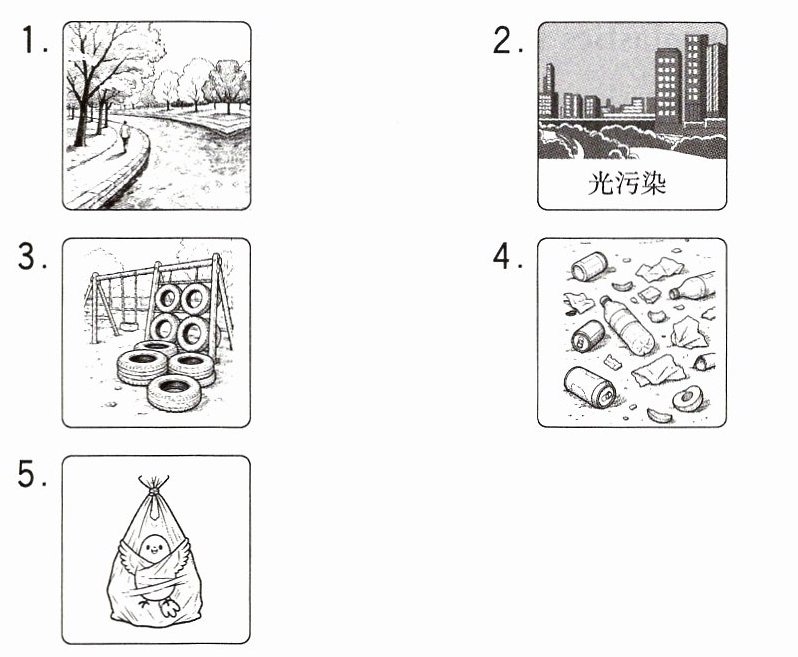
1. A: Where does your father enjoy taking a walk?
B:
2. A:
(运用宾语从句)
B: We should use lights properly, turn off unnecessary lights and choose low-brightness lights to deal with light pollution.
3. A:
B: They can be used for outdoor activities.
4. A: Why is the beach no longer a nice place?
B:
5. A: What happened to the little bird?
B:
1. A: Where does your father enjoy taking a walk?
B:
He enjoys taking a walk by the riverbank
.2. A:
Do you know what we should do to deal with light pollution
?(运用宾语从句)
B: We should use lights properly, turn off unnecessary lights and choose low-brightness lights to deal with light pollution.
3. A:
What can the tyres be used for
?B: They can be used for outdoor activities.
4. A: Why is the beach no longer a nice place?
B:
Because it is covered with/in all kinds of rubbish/waste
.5. A: What happened to the little bird?
B:
It was trapped/got trapped in a plastic bag
.答案
1. He enjoys taking a walk by the riverbank
2. Do you know what we should do to deal with light pollution
3. What can the tyres be used for
4. Because it is covered with/in all kinds of rubbish/waste
5. It was trapped/got trapped in a plastic bag
2. Do you know what we should do to deal with light pollution
3. What can the tyres be used for
4. Because it is covered with/in all kinds of rubbish/waste
5. It was trapped/got trapped in a plastic bag
解析
【分析】本题为情景补全对话,需结合图片信息、问句语境及答语内容,同时注意第2题要求运用宾语从句补全句子。解题时先观察每幅图的核心内容,再匹配对应的问句或答语逻辑:第1题图1是河边小路,对应散步地点;第2题答语是处理光污染的方法,需构造含宾语从句的问句;第3题图3是轮胎,对应用途的问句;第4题图4是垃圾,对应海滩变糟的原因;第5题图5是小鸟被困在袋子里,对应小鸟的状况。
【解析】1. 图1显示河边小路,问句询问散步地点,故答语为He enjoys taking a walk by the riverbank;2. 答语是处理光污染的措施,要求用宾语从句,构造问句Do you know what we should do to deal with light pollution;3. 图3是轮胎,答语说明用途,故问句为What can the tyres be used for;4. 问句询问原因,图4是垃圾,故答语为Because it is covered with/in all kinds of rubbish/waste;5. 图5是小鸟在袋子里,故答语为It was trapped/got trapped in a plastic bag。
【答案】
1. He enjoys taking a walk by the riverbank
2. Do you know what we should do to deal with light pollution
3. What can the tyres be used for
4. Because it is covered with/in all kinds of rubbish/waste
5. It was trapped/got trapped in a plastic bag
【知识点】
补全对话、宾语从句、情景交际
【点评】
本题结合图片与日常交际场景,考查学生的情景交际能力及语法(宾语从句)的运用,其中第2题涉及宾语从句的构造,是稍难点,整体需学生观察图片信息并匹配答语逻辑完成补全。
【难度系数】
0.5
【解析】1. 图1显示河边小路,问句询问散步地点,故答语为He enjoys taking a walk by the riverbank;2. 答语是处理光污染的措施,要求用宾语从句,构造问句Do you know what we should do to deal with light pollution;3. 图3是轮胎,答语说明用途,故问句为What can the tyres be used for;4. 问句询问原因,图4是垃圾,故答语为Because it is covered with/in all kinds of rubbish/waste;5. 图5是小鸟在袋子里,故答语为It was trapped/got trapped in a plastic bag。
【答案】
1. He enjoys taking a walk by the riverbank
2. Do you know what we should do to deal with light pollution
3. What can the tyres be used for
4. Because it is covered with/in all kinds of rubbish/waste
5. It was trapped/got trapped in a plastic bag
【知识点】
补全对话、宾语从句、情景交际
【点评】
本题结合图片与日常交际场景,考查学生的情景交际能力及语法(宾语从句)的运用,其中第2题涉及宾语从句的构造,是稍难点,整体需学生观察图片信息并匹配答语逻辑完成补全。
【难度系数】
0.5
