

 登录
五、任务型阅读:阅读下面短文,根据短文内容完成表格。(每空限填写一个单词。)
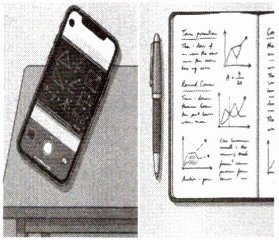
It is often seen that college students take pictures of teachers' blackboard-writing using their smartphones. This starts a discussion on whether taking pictures can replace taking notes.
Among those in the photo-taking camp, some can't read their own handwriting. So it's best to take a picture of teachers' writing so that they can understand the notes. Some take pictures of notes because they know the phone is a safe place to store materials. They may lose paper, but they may not lose their phones. Some take photos because they want to record the exact words that have been written on the blackboard.
It may be convenient to use phones as note takers, but is a picture a replacement for the process of note-taking? Can the two be equally effective?
Taking notes may be an old-fashioned method, but a method which has a long history doesn't mean it's out of date. Taking notes is a traditional way to help make preparations for getting and understanding information. Teachers encourage students to take notes because the act of doing so is more than only recording necessary information—it requires students to ask questions about unknown things. The act of writing information down forces the brain to begin to memorize, establishing the building blocks of learning something new.
I'm not sure which is better. For now, I allow students to take notes as they see fit—handwritten or photographed—because I think that some notes, no matter what method they use, are better than none.
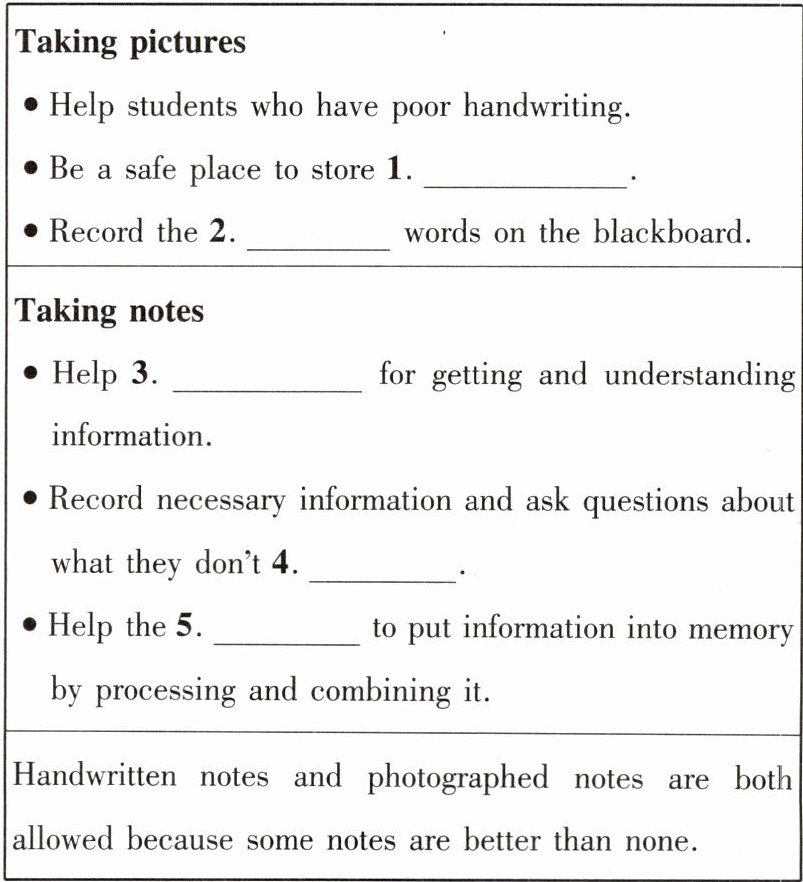
Taking pictures
• Help students who have poor handwriting.
• Be a safe place to store 1.
• Record the 2.
Taking notes
• Help 3.
• Record necessary information and ask questions about what they don't 4.
• Help the 5.
Handwritten notes and photographed notes are both allowed because some notes are better than none.
It is often seen that college students take pictures of teachers' blackboard-writing using their smartphones. This starts a discussion on whether taking pictures can replace taking notes.
Among those in the photo-taking camp, some can't read their own handwriting. So it's best to take a picture of teachers' writing so that they can understand the notes. Some take pictures of notes because they know the phone is a safe place to store materials. They may lose paper, but they may not lose their phones. Some take photos because they want to record the exact words that have been written on the blackboard.
It may be convenient to use phones as note takers, but is a picture a replacement for the process of note-taking? Can the two be equally effective?
Taking notes may be an old-fashioned method, but a method which has a long history doesn't mean it's out of date. Taking notes is a traditional way to help make preparations for getting and understanding information. Teachers encourage students to take notes because the act of doing so is more than only recording necessary information—it requires students to ask questions about unknown things. The act of writing information down forces the brain to begin to memorize, establishing the building blocks of learning something new.
I'm not sure which is better. For now, I allow students to take notes as they see fit—handwritten or photographed—because I think that some notes, no matter what method they use, are better than none.
Taking pictures
• Help students who have poor handwriting.
• Be a safe place to store 1.
materials
.• Record the 2.
exact
words on the blackboard.Taking notes
• Help 3.
prepare
for getting and understanding information.• Record necessary information and ask questions about what they don't 4.
know
.• Help the 5.
brain
to put information into memory by processing and combining it.Handwritten notes and photographed notes are both allowed because some notes are better than none.
答案
1. materials 2. exact 3. prepare 4. know 5. brain
解析
【分析】本题为任务型阅读,要求根据短文内容填写表格,每空限一词。解题思路是:先明确表格的两个分类“拍照记笔记”和“手写记笔记”,再针对每个空的描述关键词,回到短文中对应段落定位相关信息,最后提取匹配的单词填入空格。
【解析】1. 定位短文第二段“Some take pictures of notes because they know the phone is a safe place to store materials.”,可知拍照可作为存储材料的安全场所,故填materials;2. 定位短文第二段最后一句“Some take photos because they want to record the exact words that have been written on the blackboard.”,可知拍照能记录黑板上的准确文字,故填exact;3. 定位短文第四段“Taking notes is a traditional way to help make preparations for getting and understanding information.”,make preparations for对应help prepare for,故填prepare;4. 定位短文第四段“it requires students to ask questions about unknown things.”,unknown things即学生不知道的内容,故填know;5. 定位短文第四段“The act of writing information down forces the brain to begin to memorize...”,可知记笔记能帮助大脑将信息转化为记忆,故填brain。
【答案】1. materials 2. exact 3. prepare 4. know 5. brain
【知识点】任务型阅读,信息定位
【点评】本题考查学生快速定位短文细节信息并转换为合适单词的能力,属于基础任务型阅读题,难度不大。
【难度系数】0.8
