

 登录
登录
Ⅲ.任务型阅读
Robots may seem smart, but they cannot even pick up a chess piece. Let's take a look at some tasks that are easy for kids but not for robots.
Pick things up
Picking things up is not easy. If we drop our pencil on the floor, our brains work hard. First, we must find the pencil. Then we move our hands to it. A robot cannot always move its "hand" to the right place. When we touch the pencil, it might roll(滚动) a little bit. Robots cannot easily understand this either. So, if you drop a pencil on the floor, a robot will probably roll it around the room.
Get around in large space
If someone drops us in a building we've never been to, we might feel a bit lost. But we can look around, find a door and get out quickly. But a robot will look everywhere for a door, even on ceilings(天花板)and floors. This is because it's hard for them to understand space, especially large, blank things such as walls or ceilings.
Understand the world made by people
Common sense is what we don't need to think or talk about. Because of common sense, we do not look for doors on the ceiling. We pick up a coffee cup by its handle(把手). We feel whether it has coffee inside, and whether it is hot.
A robot? It may turn the cup upside down. It may hold the hot part of the cup. Scientists have tried teaching robots common-sense rules. But even huge databases(数据库) don't help much. Maybe they need more time to learn.
阅读短文,回答下面5个问题。
1. What may happen when a robot tries to pick up a pencil?
2. What will a robot do in order to find a door?
3. Who has tried teaching robots common-sense rules?
4. How many tasks are mentioned in the passage?
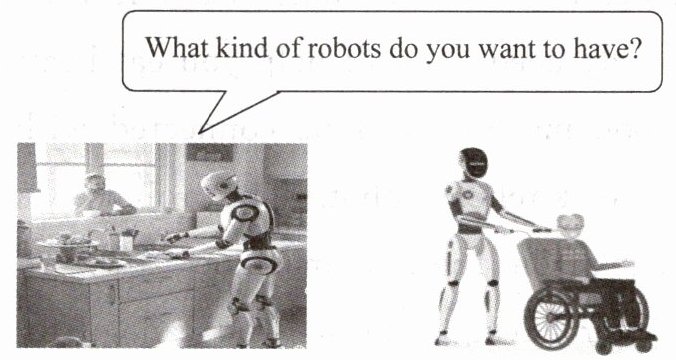
5. [新考法·开放性设问]What kind of robots do you want to have?
阶段巩固,请使用 "单元质量测评(七)"
Robots may seem smart, but they cannot even pick up a chess piece. Let's take a look at some tasks that are easy for kids but not for robots.
Pick things up
Picking things up is not easy. If we drop our pencil on the floor, our brains work hard. First, we must find the pencil. Then we move our hands to it. A robot cannot always move its "hand" to the right place. When we touch the pencil, it might roll(滚动) a little bit. Robots cannot easily understand this either. So, if you drop a pencil on the floor, a robot will probably roll it around the room.
Get around in large space
If someone drops us in a building we've never been to, we might feel a bit lost. But we can look around, find a door and get out quickly. But a robot will look everywhere for a door, even on ceilings(天花板)and floors. This is because it's hard for them to understand space, especially large, blank things such as walls or ceilings.
Understand the world made by people
Common sense is what we don't need to think or talk about. Because of common sense, we do not look for doors on the ceiling. We pick up a coffee cup by its handle(把手). We feel whether it has coffee inside, and whether it is hot.
A robot? It may turn the cup upside down. It may hold the hot part of the cup. Scientists have tried teaching robots common-sense rules. But even huge databases(数据库) don't help much. Maybe they need more time to learn.
阅读短文,回答下面5个问题。
1. What may happen when a robot tries to pick up a pencil?
It may roll the pencil.
2. What will a robot do in order to find a door?
It will search everywhere even the ceilings.
3. Who has tried teaching robots common-sense rules?
Scientists.
4. How many tasks are mentioned in the passage?
Three.
5. [新考法·开放性设问]What kind of robots do you want to have?
I want to own a robot that can help me with my study.(答案不唯一,言之有理即可)
阶段巩固,请使用 "单元质量测评(七)"
答案
1. It may roll the pencil.
2. It will search everywhere even the ceilings.
3. Scientists.
4. Three.
5. I want to own a robot that can help me with my study.(答案不唯一,言之有理即可)
2. It will search everywhere even the ceilings.
3. Scientists.
4. Three.
5. I want to own a robot that can help me with my study.(答案不唯一,言之有理即可)
解析
【分析】做任务型阅读题时,先通读问题,带着问题定位短文对应段落,提取关键信息作答;开放性问题结合短文主题合理表达即可。
【解析】1. 定位短文“Pick things up”部分最后一句,可知机器人可能滚动铅笔,故答案为It may roll the pencil.;2. 定位“Get around in large space”部分,机器人会到处找门甚至天花板,故答案为It will search everywhere even the ceilings.;3. 定位“Understand the world made by people”部分,是科学家尝试教机器人常识,故答案为Scientists.;4. 短文提到了“Pick things up”“Get around in large space”“Understand the world made by people”共3个任务,故答案为Three.;5. 开放性问题,结合短文机器人功能合理作答,如想要帮学习的机器人,答案不唯一。
【答案】1. It may roll the pencil.
2. It will search everywhere even the ceilings.
3. Scientists.
4. Three.
5. I want to own a robot that can help me with my study.(答案不唯一,言之有理即可)
【知识点】任务型阅读、细节理解、开放性问答
【点评】本题为任务型阅读,考查学生提取短文信息的能力,最后一题开放性设问贴近生活,难度适中,适合学生完成。
【难度系数】0.6
【解析】1. 定位短文“Pick things up”部分最后一句,可知机器人可能滚动铅笔,故答案为It may roll the pencil.;2. 定位“Get around in large space”部分,机器人会到处找门甚至天花板,故答案为It will search everywhere even the ceilings.;3. 定位“Understand the world made by people”部分,是科学家尝试教机器人常识,故答案为Scientists.;4. 短文提到了“Pick things up”“Get around in large space”“Understand the world made by people”共3个任务,故答案为Three.;5. 开放性问题,结合短文机器人功能合理作答,如想要帮学习的机器人,答案不唯一。
【答案】1. It may roll the pencil.
2. It will search everywhere even the ceilings.
3. Scientists.
4. Three.
5. I want to own a robot that can help me with my study.(答案不唯一,言之有理即可)
【知识点】任务型阅读、细节理解、开放性问答
【点评】本题为任务型阅读,考查学生提取短文信息的能力,最后一题开放性设问贴近生活,难度适中,适合学生完成。
【难度系数】0.6
