

 登录
登录
一、阅读短文,选择正确的答案。
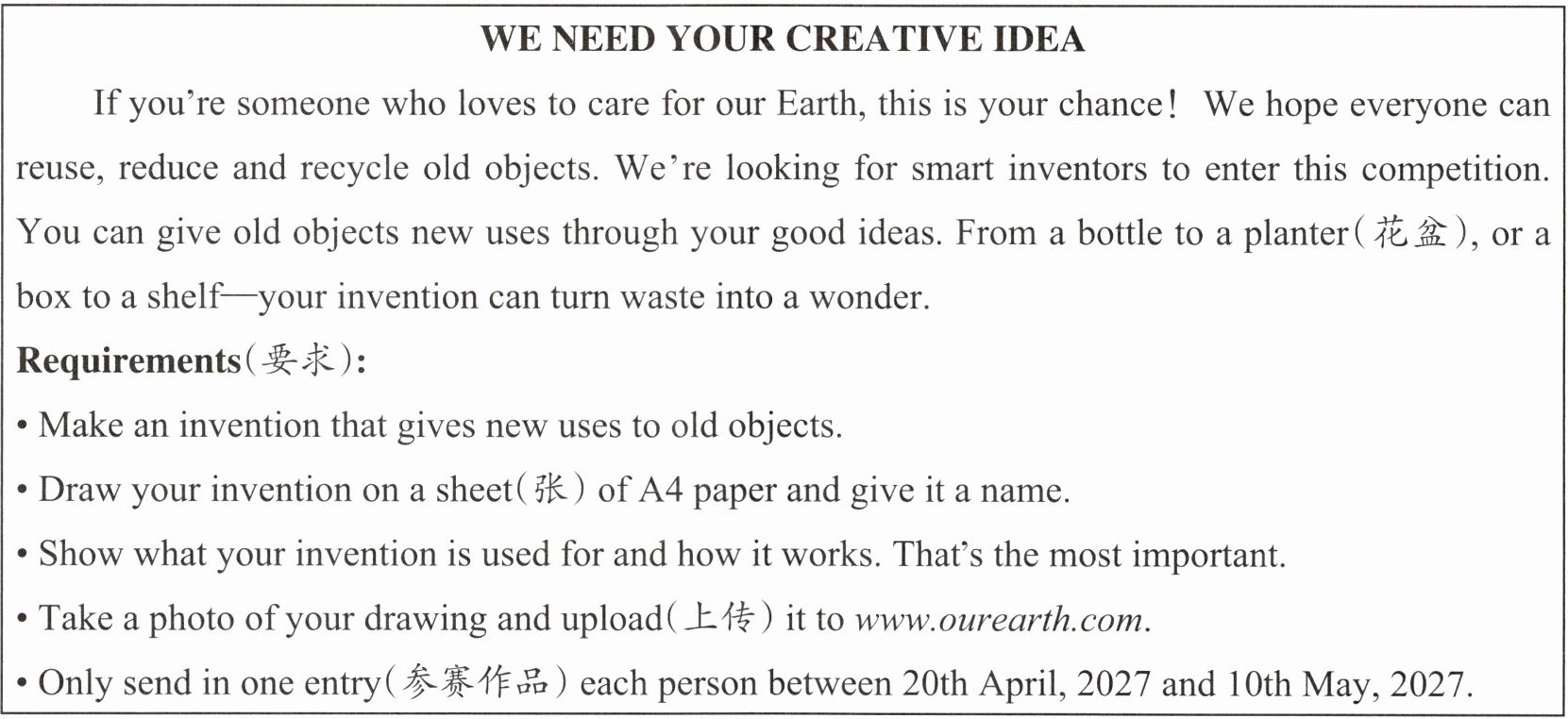
词汇积累 object /'ɒbdʒɪkt/ 物体 smart /smɑːt/ 聪颖的 wonder /'wʌndə(r)/ 奇迹
(
A. To call on people to reuse, reduce and recycle.
B. To teach people how to turn waste into wonders.
C. To tell people the importance of protecting the Earth.
(
A. Drawing the invention on A4 paper and naming it.
B. Describing the invention and introducing how it works.
C. Taking a photo of the drawing and uploading it to the website.
(
A. On 15th April.
B. On 4th May.
C. On 20th May.
(
A. loves to care for the Earth
B. loves to care for animals
C. loves to care for the old people
(
A. You should turn waste into useful things.
B. One person can send in many entries.
C. You don’t need to give your invention a name.
词汇积累 object /'ɒbdʒɪkt/ 物体 smart /smɑːt/ 聪颖的 wonder /'wʌndə(r)/ 奇迹
(
A
) 1. What’s the purpose of the competition?A. To call on people to reuse, reduce and recycle.
B. To teach people how to turn waste into wonders.
C. To tell people the importance of protecting the Earth.
(
B
) 2. What is the most important when you send in your entry?A. Drawing the invention on A4 paper and naming it.
B. Describing the invention and introducing how it works.
C. Taking a photo of the drawing and uploading it to the website.
(
B
) 3. When can you send in your entry?A. On 15th April.
B. On 4th May.
C. On 20th May.
(
A
) 4. The poster is for people who .A. loves to care for the Earth
B. loves to care for animals
C. loves to care for the old people
(
A
) 5. Which of the following is TRUE?A. You should turn waste into useful things.
B. One person can send in many entries.
C. You don’t need to give your invention a name.
答案
1.A 2.B 3.B 4.A 5.A
解析
【分析】
解答这类阅读理解选择题,需根据题干关键词定位原文对应内容,逐一核对选项:
1. 第1题问比赛目的,定位原文第一段中关于比赛期望的表述;
2. 第2题问提交作品最重要的内容,定位Requirements里标注“most important”的句子;
3. 第3题问提交时间,定位Requirements里的时间要求;
4. 第4题问海报面向的人群,定位原文开头的受众描述;
5. 第5题需逐一核对选项与原文是否一致,排除错误选项。
【解析】
1. 解析:根据短文第一段“We hope everyone can reuse, reduce and recycle old objects.”可知,比赛目的是号召人们重复利用、减少和回收旧物,对应选项A,故选A。
2. 解析:根据Requirements中“Show what your invention is used for and how it works. That’s the most important.”可知,提交作品最重要的是说明发明的用途和工作原理,对应选项B,故选B。
3. 解析:根据Requirements中“between 20th April, 2027 and 10th May, 2027”可知,提交时间在2027年4月20日至5月10日之间,选项B(4th May)在此区间内,故选B。
4. 解析:根据原文开头“If you’re someone who loves to care for our Earth”可知,海报面向爱护地球的人,对应选项A,故选A。
5. 解析:A选项对应原文“turn waste into a wonder”(变废为宝),正确;B选项原文要求“Only send in one entry each person”,错误;C选项要求“give it a name”,错误,故选A。
【答案】
1.A 2.B 3.B 4.A 5.A
【知识点】
英语阅读理解,细节信息查找,信息匹配
【点评】
本题为英语阅读理解选择题,侧重考查学生提取原文关键信息的能力,题目多为细节定位类,难度适中,只要仔细阅读原文、找准对应内容即可正确作答。
【难度系数】
0.6
解答这类阅读理解选择题,需根据题干关键词定位原文对应内容,逐一核对选项:
1. 第1题问比赛目的,定位原文第一段中关于比赛期望的表述;
2. 第2题问提交作品最重要的内容,定位Requirements里标注“most important”的句子;
3. 第3题问提交时间,定位Requirements里的时间要求;
4. 第4题问海报面向的人群,定位原文开头的受众描述;
5. 第5题需逐一核对选项与原文是否一致,排除错误选项。
【解析】
1. 解析:根据短文第一段“We hope everyone can reuse, reduce and recycle old objects.”可知,比赛目的是号召人们重复利用、减少和回收旧物,对应选项A,故选A。
2. 解析:根据Requirements中“Show what your invention is used for and how it works. That’s the most important.”可知,提交作品最重要的是说明发明的用途和工作原理,对应选项B,故选B。
3. 解析:根据Requirements中“between 20th April, 2027 and 10th May, 2027”可知,提交时间在2027年4月20日至5月10日之间,选项B(4th May)在此区间内,故选B。
4. 解析:根据原文开头“If you’re someone who loves to care for our Earth”可知,海报面向爱护地球的人,对应选项A,故选A。
5. 解析:A选项对应原文“turn waste into a wonder”(变废为宝),正确;B选项原文要求“Only send in one entry each person”,错误;C选项要求“give it a name”,错误,故选A。
【答案】
1.A 2.B 3.B 4.A 5.A
【知识点】
英语阅读理解,细节信息查找,信息匹配
【点评】
本题为英语阅读理解选择题,侧重考查学生提取原文关键信息的能力,题目多为细节定位类,难度适中,只要仔细阅读原文、找准对应内容即可正确作答。
【难度系数】
0.6
二、[新趋势·学科融合]阅读图文,完成下面的任务。
情境导入:玲玲家刚卖掉一台旧电视,她在想这些旧电器最终都去了哪里,于是她上网查阅了一些资料。
Electronic waste(电子垃圾), also known as "e-waste", is used to describe the waste from useless electrical appliances(电器) such as computers, phones, fridges, washing machines, TVs and so on. Most of these electrical appliances are not always rubbish, but just given up. In 2019, there were 535 million tons of e-waste in the world, and the world's e-waste will reach 747 million tons by 2030.
Last week, we made surveys among 1,000 residents(居民) in Xingfu community. The surveys were mainly(主要地) about different kinds of e-waste and how the residents deal with e-waste. The diagrams(图表) below show the results.
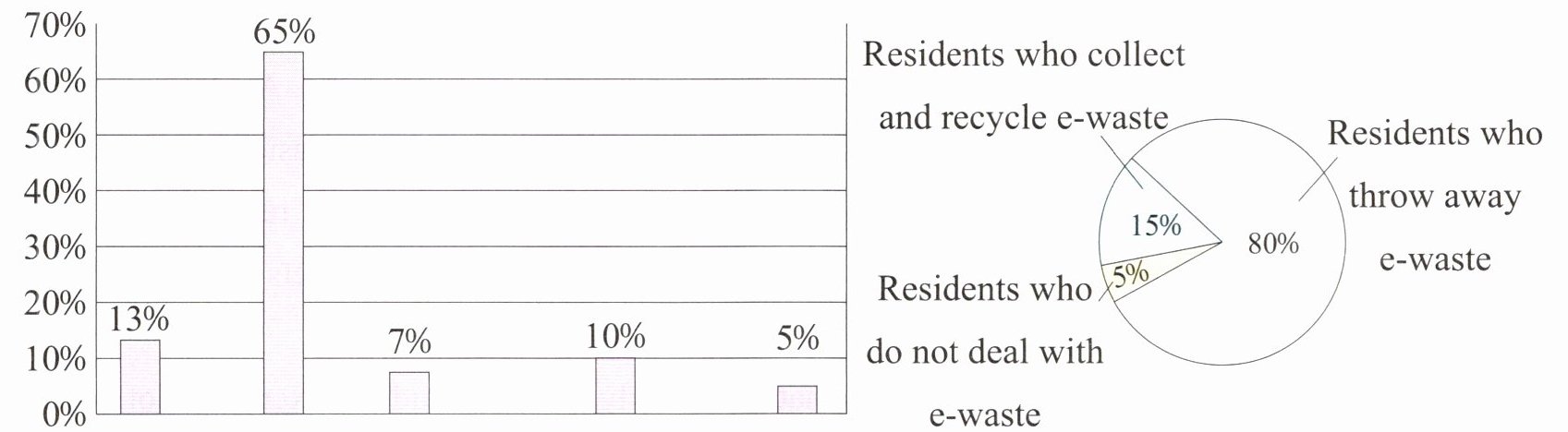
Diagram I Different kinds of e-waste that the residents produce each year
Diagram II How the residents deal with e-waste
E-waste is the world's fastest-growing kind of waste, and only a small part of it is collected and recycled. Some residents think they should recycle e-waste, because e-waste includes many valuable metals(贵金属), such as gold, silver and so on. They try to repair some electrical appliances rather than buy new ones. They also give away their electrical appliances which they don't like any more to people in need.
词汇积累 survey /'sɜːveɪ/ 民意调查 include /ɪn'kluːd/ 包括
任务一:阅读短文,补全表格。

任务二:阅读短文,判断句子正(T)误(F)。
(
(
(
情境导入:玲玲家刚卖掉一台旧电视,她在想这些旧电器最终都去了哪里,于是她上网查阅了一些资料。
Electronic waste(电子垃圾), also known as "e-waste", is used to describe the waste from useless electrical appliances(电器) such as computers, phones, fridges, washing machines, TVs and so on. Most of these electrical appliances are not always rubbish, but just given up. In 2019, there were 535 million tons of e-waste in the world, and the world's e-waste will reach 747 million tons by 2030.
Last week, we made surveys among 1,000 residents(居民) in Xingfu community. The surveys were mainly(主要地) about different kinds of e-waste and how the residents deal with e-waste. The diagrams(图表) below show the results.
Diagram I Different kinds of e-waste that the residents produce each year
Diagram II How the residents deal with e-waste
E-waste is the world's fastest-growing kind of waste, and only a small part of it is collected and recycled. Some residents think they should recycle e-waste, because e-waste includes many valuable metals(贵金属), such as gold, silver and so on. They try to repair some electrical appliances rather than buy new ones. They also give away their electrical appliances which they don't like any more to people in need.
词汇积累 survey /'sɜːveɪ/ 民意调查 include /ɪn'kluːd/ 包括
任务一:阅读短文,补全表格。
任务二:阅读短文,判断句子正(T)误(F)。
(
F
) 4. Electronic waste is useless(无用的). People will never use it again.(
F
) 5. If your TV is broken, you can throw it away.(
T
) 6. Phones are the main(主要的) kind of e-waste according to the survey.答案
任务一:1.50 2.800 3.150
任务二:4.F 5.F 6.T
任务二:4.F 5.F 6.T
解析
【分析】
本题分为任务一和任务二,任务一需根据文中调查的1000名居民的相关数据,结合图表对应的数值(基于总数1000的占比换算)补全表格;任务二需回到原文,找到对应句子的依据,判断正误。具体思路:任务一明确调查总人数为1000,根据图表中各类别占比计算对应数量;任务二逐句核对原文细节:第4题判断电子垃圾是否无用,第5题判断电器损坏后的处理方式,第6题判断手机是否为主要电子垃圾种类。
【解析】
任务一:文中明确调查了1000名居民,结合图表对应的占比,计算得出三个数值分别为50、800、150;
任务二:4. 原文提到电子垃圾包含贵金属可回收,并非无用,故判断为错误(F);5. 原文建议修理电器而非丢弃,故判断为错误(F);6. 根据调查结果,手机是主要的电子垃圾种类,故判断为正确(T)。
【答案】
任务一:1.50 2.800 3.150;任务二:4.F 5.F 6.T
【知识点】
英语阅读理解、信息提取、判断正误
【点评】
本题为学科融合类题目,结合英语阅读与数据分析,考查学生提取文本信息、依据原文判断正误的能力,需仔细核对原文细节,难度适中。
【难度系数】
0.5
本题分为任务一和任务二,任务一需根据文中调查的1000名居民的相关数据,结合图表对应的数值(基于总数1000的占比换算)补全表格;任务二需回到原文,找到对应句子的依据,判断正误。具体思路:任务一明确调查总人数为1000,根据图表中各类别占比计算对应数量;任务二逐句核对原文细节:第4题判断电子垃圾是否无用,第5题判断电器损坏后的处理方式,第6题判断手机是否为主要电子垃圾种类。
【解析】
任务一:文中明确调查了1000名居民,结合图表对应的占比,计算得出三个数值分别为50、800、150;
任务二:4. 原文提到电子垃圾包含贵金属可回收,并非无用,故判断为错误(F);5. 原文建议修理电器而非丢弃,故判断为错误(F);6. 根据调查结果,手机是主要的电子垃圾种类,故判断为正确(T)。
【答案】
任务一:1.50 2.800 3.150;任务二:4.F 5.F 6.T
【知识点】
英语阅读理解、信息提取、判断正误
【点评】
本题为学科融合类题目,结合英语阅读与数据分析,考查学生提取文本信息、依据原文判断正误的能力,需仔细核对原文细节,难度适中。
【难度系数】
0.5
