

 登录
登录
Ⅴ. 阅读还原(有一项多余)
文化意识 文化鉴赏(2026·齐齐哈尔一模)The folk dance “Wuwei Fish Lantern” is a traditional lantern dance in Wuwei City, Anhui Province. Every year, from the 15th day to the end of the first lunar month, villagers dance with colourful fish lanterns. They do this to celebrate the harvest(收获)and hope for good weather. 1

The story of these lanterns goes back to the
Song Dynasty. According to a folk story, after Bao Zheng helped the people in Chenzhou, the imperial court(朝廷) held a big lantern festival to celebrate peace. At that time, the people of Wuwei offered Fish Lanterns, which were highly praised by the imperial court. 2 Because of its long history and great value, this art form was listed as a National Intangible Cultural Heritage in 2011.
3 Workers use local bamboo to build the frame(框架) and paper to cover the surface. Then they colour the lantern and draw beautiful pictures on it. These special designs show people's love for life and their wishes for happiness. However, old traditions can also change with the times. 4 Also, people change the heavy paper into a light modern material. This makes the lanterns easier to carry and brighter to watch.
Wuwei Fish Lantern is not only a treasure of folk art but also an important part of Chinese culture. 5 With these changes, the ancient light of the fish lanterns will continue to shine into the future.
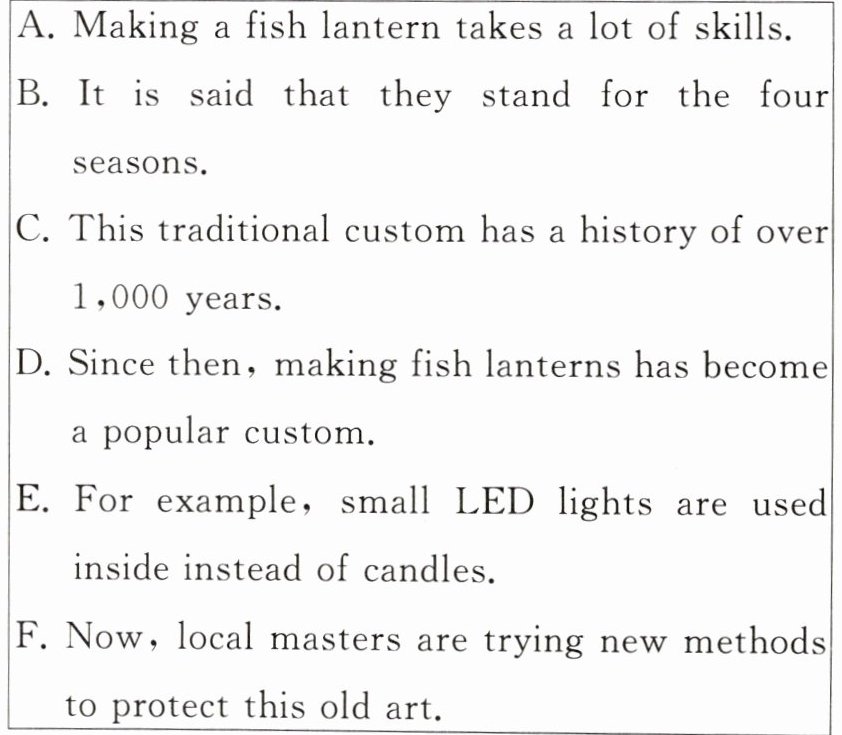
A. Making a fish lantern takes a lot of skills.
B. It is said that they stand for the four seasons.
C. This traditional custom has a history of over 1,000 years.
D. Since then, making fish lanterns has become a popular custom.
E. For example, small LED lights are used inside instead of candles.
F. Now, local masters are trying new methods to protect this old art.
1. 2. 3.
4. 5.
文化意识 文化鉴赏(2026·齐齐哈尔一模)The folk dance “Wuwei Fish Lantern” is a traditional lantern dance in Wuwei City, Anhui Province. Every year, from the 15th day to the end of the first lunar month, villagers dance with colourful fish lanterns. They do this to celebrate the harvest(收获)and hope for good weather. 1
The story of these lanterns goes back to the
Song Dynasty. According to a folk story, after Bao Zheng helped the people in Chenzhou, the imperial court(朝廷) held a big lantern festival to celebrate peace. At that time, the people of Wuwei offered Fish Lanterns, which were highly praised by the imperial court. 2 Because of its long history and great value, this art form was listed as a National Intangible Cultural Heritage in 2011.
3 Workers use local bamboo to build the frame(框架) and paper to cover the surface. Then they colour the lantern and draw beautiful pictures on it. These special designs show people's love for life and their wishes for happiness. However, old traditions can also change with the times. 4 Also, people change the heavy paper into a light modern material. This makes the lanterns easier to carry and brighter to watch.
Wuwei Fish Lantern is not only a treasure of folk art but also an important part of Chinese culture. 5 With these changes, the ancient light of the fish lanterns will continue to shine into the future.
A. Making a fish lantern takes a lot of skills.
B. It is said that they stand for the four seasons.
C. This traditional custom has a history of over 1,000 years.
D. Since then, making fish lanterns has become a popular custom.
E. For example, small LED lights are used inside instead of candles.
F. Now, local masters are trying new methods to protect this old art.
1. 2. 3.
4. 5.
答案
1.C 2.D 3.A 4.E 5.F
【语篇解读】本文是一篇说明文。文章主要介绍了无为鱼灯的历史渊源、制作工艺、文化寓意及其在现代的传承和创新。
1. C 解析:上文“They do this to celebrate the harvest and hope for good weather.”介绍村民舞鱼灯庆祝丰收、祈愿好天气,下文“The story of these lanterns goes back to the Song Dynasty.”介绍无为鱼灯追溯到宋代,C项“这一传统习俗已有1 000多年的历史。”承上启下,说明无为鱼灯历史悠久。故选C。
2. D 解析:上文“the people of Wuwei offered Fish Lanterns, which were highly praised by the imperial court”介绍宋代无为百姓献鱼灯,受到朝廷赞誉,下文“this art form was listed as a National Intangible Cultural Heritage in 2011”介绍无为鱼灯被列为国家级非物质文化遗产,D项“从那时起,制作鱼灯就成了一种流行的习俗。”承上启下,连接历史与当代地位。故选D。
3. A 解析:根据下文“Workers use local bamboo to build the frame and paper to cover the surface...”可知本段介绍无为鱼灯的制作过程,A项“做鱼灯需要很多技巧。”引出下文。故选A。
4. E 解析:根据上文“However, old traditions can also change with the times.”可知传统会随着时代而改变,E项“例如,内部使用小型LED灯而不是蜡烛。”用具体例子说明如何改变。故选E。
5. F 解析:上文“Wuwei Fish Lantern is not only a treasure of folk art but also an important part of Chinese culture.”介绍无为鱼灯是民间艺术瑰宝和中国文化的重要部分,下文“With these changes, the ancient light of the fish lanterns will continue to shine into the future.”介绍鱼灯会随着改变继续传承,F项“现在,当地的大师们正在尝试新的方法来保护这种古老的艺术。”承上启下,说明当地传承人保护无为鱼灯。故选F。
【语篇解读】本文是一篇说明文。文章主要介绍了无为鱼灯的历史渊源、制作工艺、文化寓意及其在现代的传承和创新。
1. C 解析:上文“They do this to celebrate the harvest and hope for good weather.”介绍村民舞鱼灯庆祝丰收、祈愿好天气,下文“The story of these lanterns goes back to the Song Dynasty.”介绍无为鱼灯追溯到宋代,C项“这一传统习俗已有1 000多年的历史。”承上启下,说明无为鱼灯历史悠久。故选C。
2. D 解析:上文“the people of Wuwei offered Fish Lanterns, which were highly praised by the imperial court”介绍宋代无为百姓献鱼灯,受到朝廷赞誉,下文“this art form was listed as a National Intangible Cultural Heritage in 2011”介绍无为鱼灯被列为国家级非物质文化遗产,D项“从那时起,制作鱼灯就成了一种流行的习俗。”承上启下,连接历史与当代地位。故选D。
3. A 解析:根据下文“Workers use local bamboo to build the frame and paper to cover the surface...”可知本段介绍无为鱼灯的制作过程,A项“做鱼灯需要很多技巧。”引出下文。故选A。
4. E 解析:根据上文“However, old traditions can also change with the times.”可知传统会随着时代而改变,E项“例如,内部使用小型LED灯而不是蜡烛。”用具体例子说明如何改变。故选E。
5. F 解析:上文“Wuwei Fish Lantern is not only a treasure of folk art but also an important part of Chinese culture.”介绍无为鱼灯是民间艺术瑰宝和中国文化的重要部分,下文“With these changes, the ancient light of the fish lanterns will continue to shine into the future.”介绍鱼灯会随着改变继续传承,F项“现在,当地的大师们正在尝试新的方法来保护这种古老的艺术。”承上启下,说明当地传承人保护无为鱼灯。故选F。
解析
【分析】
做阅读还原题时,需先通读全文把握文章主旨(本文围绕安徽无为鱼灯的历史、制作工艺、传承创新展开),再分析每个空格前后语句的逻辑关系(如承上启下、举例说明、因果关联等),逐一匹配对应选项,最后通读验证答案是否通顺合理。
【解析】
1. 上文介绍村民舞鱼灯庆祝丰收、祈愿好天气的习俗,下文提及鱼灯历史追溯至宋代,C项“这一传统习俗已有1000多年的历史”承上启下,衔接习俗与历史,故选C;
2. 上文讲述宋代无为百姓献鱼灯获朝廷赞誉,下文说明鱼灯被列为国家级非遗,D项“从那时起,制作鱼灯就成了一种流行的习俗”承接上文历史事件,连接下文当代地位,故选D;
3. 下文详细介绍鱼灯的制作步骤(用竹做框架、用纸贴面等),A项“做鱼灯需要很多技巧”引出制作过程,故选A;
4. 上文提到“传统会随时代变化”,E项“例如,内部使用小型LED灯而不是蜡烛”用具体例子说明传统的变化,故选E;
5. 上文指出无为鱼灯是民间艺术瑰宝和中国文化的重要部分,下文说明鱼灯会随变化继续传承,F项“当地大师正在尝试新方法保护这种古老的艺术”承上启下,衔接文化价值与传承行动,故选F。
【答案】1.C 2.D 3.A 4.E 5.F
【知识点】阅读还原题解题、语篇逻辑推理、传统文化理解
【点评】本题以国家级非遗“无为鱼灯”为话题,考查学生的语篇衔接与逻辑推理能力,渗透文化意识的培养,符合中考英语阅读题的命题特点,难度适中。
【难度系数】0.6
做阅读还原题时,需先通读全文把握文章主旨(本文围绕安徽无为鱼灯的历史、制作工艺、传承创新展开),再分析每个空格前后语句的逻辑关系(如承上启下、举例说明、因果关联等),逐一匹配对应选项,最后通读验证答案是否通顺合理。
【解析】
1. 上文介绍村民舞鱼灯庆祝丰收、祈愿好天气的习俗,下文提及鱼灯历史追溯至宋代,C项“这一传统习俗已有1000多年的历史”承上启下,衔接习俗与历史,故选C;
2. 上文讲述宋代无为百姓献鱼灯获朝廷赞誉,下文说明鱼灯被列为国家级非遗,D项“从那时起,制作鱼灯就成了一种流行的习俗”承接上文历史事件,连接下文当代地位,故选D;
3. 下文详细介绍鱼灯的制作步骤(用竹做框架、用纸贴面等),A项“做鱼灯需要很多技巧”引出制作过程,故选A;
4. 上文提到“传统会随时代变化”,E项“例如,内部使用小型LED灯而不是蜡烛”用具体例子说明传统的变化,故选E;
5. 上文指出无为鱼灯是民间艺术瑰宝和中国文化的重要部分,下文说明鱼灯会随变化继续传承,F项“当地大师正在尝试新方法保护这种古老的艺术”承上启下,衔接文化价值与传承行动,故选F。
【答案】1.C 2.D 3.A 4.E 5.F
【知识点】阅读还原题解题、语篇逻辑推理、传统文化理解
【点评】本题以国家级非遗“无为鱼灯”为话题,考查学生的语篇衔接与逻辑推理能力,渗透文化意识的培养,符合中考英语阅读题的命题特点,难度适中。
【难度系数】0.6
