

 登录
一、【问题解决】学校食堂每天都会扔掉大量食物,造成严重的浪费,我们应该如何减少浪费?阅读材料,完成下列任务。
Studies show that school canteens throw away a lot of food every day. About 30% of the lunch food ends up in the bin. Food waste is bad for our environment( 环境) and it wastes money, too. Our school wants to help everyone save food. Here are some helpful tips for you:
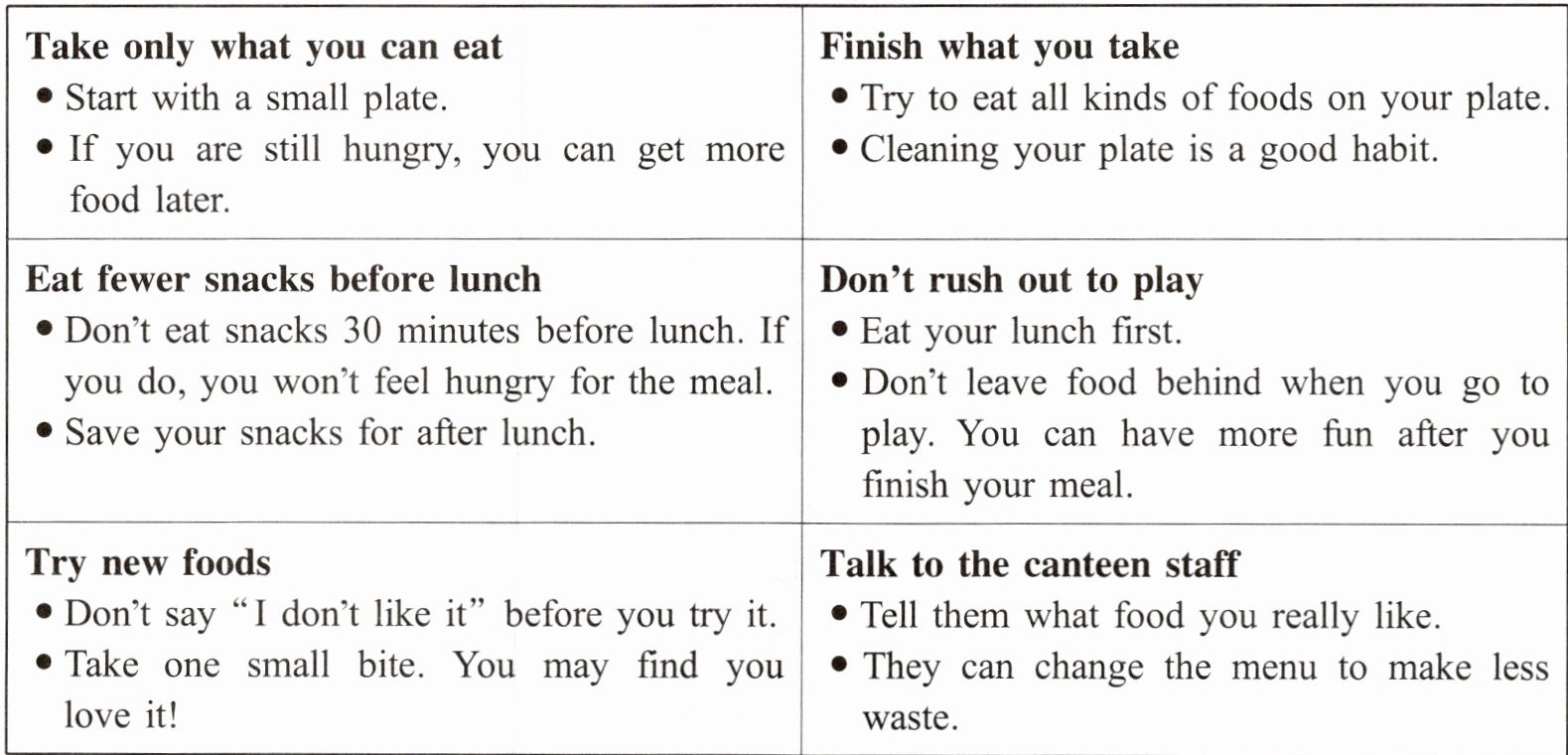
任务一:阅读材料内容,选择最佳答案,把其大写字母编号写在括号内。
(
A. About 10%. B. About 30%. C. About 50%.
(
A. Four. B. Five. C. Six.
(
A. 吃掉 B. 购买 C. 扔掉
(
A. Food waste is not a big problem at school.
B. Food waste is bad for the environment and wastes money.
C. It is OK to waste food sometimes.
(
A. eating snacks before lunch is not healthy
B. we can do many things to reduce food waste at school
C. we can just pick the foods we like to eat
任务二:Tom 想为学校解决食物浪费问题。除了表格列举的建议,你能帮助 Tom 想到其他更好的办法吗?请写出两条建议。
Say No to Food Waste
1.
2.
Studies show that school canteens throw away a lot of food every day. About 30% of the lunch food ends up in the bin. Food waste is bad for our environment( 环境) and it wastes money, too. Our school wants to help everyone save food. Here are some helpful tips for you:
任务一:阅读材料内容,选择最佳答案,把其大写字母编号写在括号内。
(
B
)1. How much lunch food is thrown away every day in many school canteens?A. About 10%. B. About 30%. C. About 50%.
(
C
)2. How many ways can we deal with food waste at school?A. Four. B. Five. C. Six.
(
C
)3. What does the underlined phrase "throw away" mean in Chinese?A. 吃掉 B. 购买 C. 扔掉
(
B
)4. Which of the following is TRUE?A. Food waste is not a big problem at school.
B. Food waste is bad for the environment and wastes money.
C. It is OK to waste food sometimes.
(
B
)5. The passage tells us that B
.A. eating snacks before lunch is not healthy
B. we can do many things to reduce food waste at school
C. we can just pick the foods we like to eat
任务二:Tom 想为学校解决食物浪费问题。除了表格列举的建议,你能帮助 Tom 想到其他更好的办法吗?请写出两条建议。
Say No to Food Waste
1.
Make posters and put them up.
2.
Teach students the importance of saving food.
答案
一、任务一:
1. B
【解析】考查同义理解。根据材料内容“About 30% of the lunch food ends up in the bin.”可知30%的食物最后在桶里,即被扔掉,故选B。
2. C
【解析】考查信息归纳。原文从“Take only what you can eat”到“Talk to the canteen staff”,共列出6条建议(每一条标题即一种方法),故选C。
3. C
【解析】考查词义猜测。材料内容“throw away a lot of food ...”与后文“... ends up in the bin.”对应,意为“扔掉”,故选C。
4. B
【解析】考查细节判断。根据材料内容“Food waste is bad for our environment and it wastes money, too.”可知,厨余垃圾既对环境不好也浪费钱,故选B。
5. B
【解析】考查主旨大意。材料通过“Here are some helpful tips for you: ...”列出多条减少浪费的方法,说明“我”们可以做很多事情来减少学校的食物浪费现象,故选B。
任务二:【示例】
1. Make posters and put them up.
2. Teach students the importance of saving food.
解析
【分析】
首先处理任务一的选择题:1题需定位原文中关于午餐食物浪费的百分比数据,直接匹配选项即可;2题要统计原文列出的减少食物浪费的建议数量,数清后作答;3题通过上下文(食物进垃圾桶的描述)猜测短语含义;4题需核对原文关于食物浪费危害的表述,判断选项正误;5题需把握文章核心主旨,理解内容方向。任务二需结合校园场景,提出合理的减少食物浪费的建议,符合实际即可。
【解析】
任务一:1. 原文明确说明“About 30% of the lunch food ends up in the bin”,即30%的午餐食物被扔掉,故选B;2. 原文从“Take only what you can eat”到“Talk to the canteen staff”共列出6条建议,故选C;3. “throw away”与后文“ends up in the bin”对应,意为“扔掉”,故选C;4. 原文指出“Food waste is bad for our environment and it wastes money, too”,B选项与原文一致,故选B;5. 文章围绕减少学校食物浪费的方法展开,说明可通过多种方式减少浪费,故选B。任务二:结合校园实际,可提出制作宣传海报、教导学生节约粮食的重要性等合理建议,示例为1. Make posters and put them up. 2. Teach students the importance of saving food.
【答案】
任务一:1.B 2.C 3.C 4.B 5.B;任务二:1. Make posters and put them up. 2. Teach students the importance of saving food.
【知识点】
英语阅读理解、词义猜测、细节理解
【点评】
本题为英语基础阅读理解题,考查学生提取信息、猜测词义、理解主旨的能力,任务二结合校园生活考查实际应用能力,贴近学生日常,难度适中。
【难度系数】
0.8
