

 登录
Ⅰ. Read and complete the tasks.
A. Complete the passage with proper words according to the Chinese given.
After learning this unit, three students are talking about the 1.
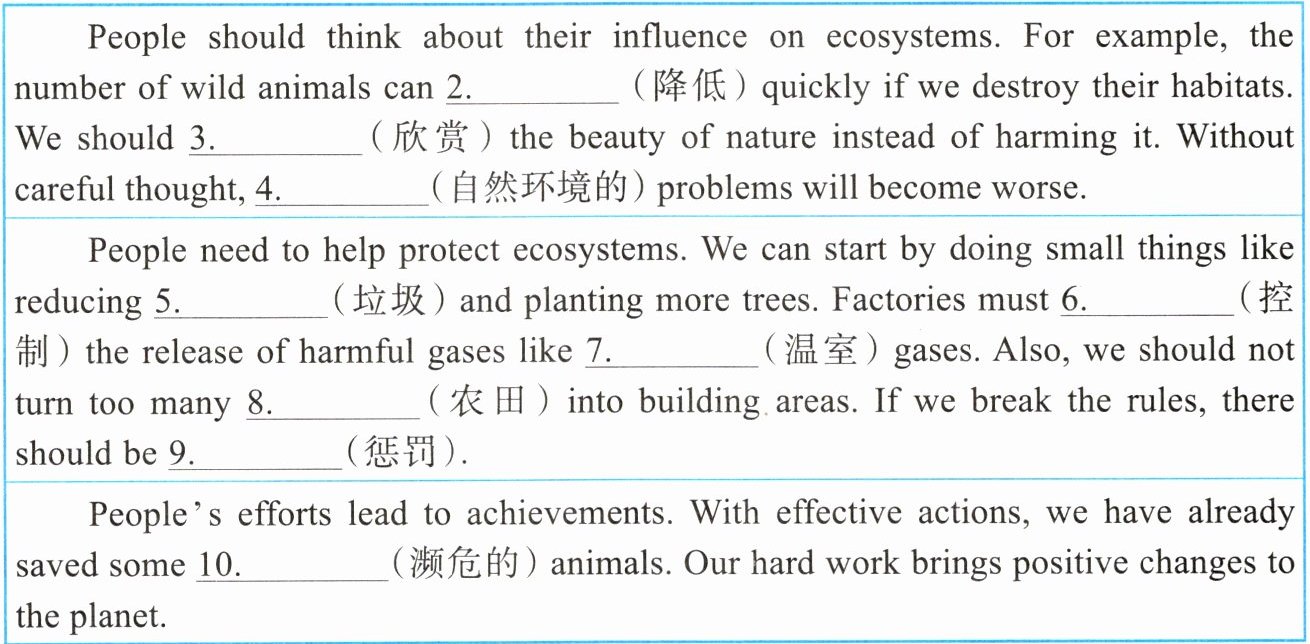
People should think about their influence on ecosystems. For example, the number of wild animals can 2.
People need to help protect ecosystems. We can start by doing small things like reducing 5.
People’s efforts lead to achievements. With effective actions, we have already saved some 10.
B. Use attributive clauses with that or which to answer the question.
What can you do in your daily life to help protect the balance between people and nature?
A. Complete the passage with proper words according to the Chinese given.
After learning this unit, three students are talking about the 1.
balance
(平衡)between people and nature.People should think about their influence on ecosystems. For example, the number of wild animals can 2.
drop
(降低)quickly if we destroy their habitats. We should 3. admire
(欣赏)the beauty of nature instead of harming it. Without careful thought, 4. environmental
(自然环境的)problems will become worse.People need to help protect ecosystems. We can start by doing small things like reducing 5.
rubbish
(垃圾)and planting more trees. Factories must 6. control
(控制)the release of harmful gases like 7. greenhouse
(温室)gases. Also, we should not turn too many 8. farmlands
(农田)into building areas. If we break the rules, there should be 9. punishment(s)
(惩罚).People’s efforts lead to achievements. With effective actions, we have already saved some 10.
endangered
(濒危的)animals. Our hard work brings positive changes to the planet.B. Use attributive clauses with that or which to answer the question.
What can you do in your daily life to help protect the balance between people and nature?
One possible version: I can avoid buying products that have too much packaging.
答案
A. 1. balance 2. drop 3. admire 4. environmental 5. rubbish 6. control 7. greenhouse 8. farmlands 9. punishment(s) 10. endangered
B. One possible version: I can avoid buying products that have too much packaging.
B. One possible version: I can avoid buying products that have too much packaging.
解析
【分析】
本题分为A、B两部分,A部分需根据中文提示填写合适单词,要结合句子结构(如情态动词后接动词原形、形容词修饰名词、名词复数等)确定单词的词性和形式;B部分要求用that/which引导的定语从句回答日常保护人与自然平衡的做法,需掌握定语从句的基本结构(先行词+that/which+从句)。
【解析】
A部分:
1. 中文提示“平衡”,对应名词balance,此处作宾语用原形。
2. 情态动词can后接动词原形,“降低”对应drop,符合语境。
3. 情态动词should后接动词原形,“欣赏”对应admire。
4. 需形容词修饰名词problems,“自然环境的”对应environmental。
5. “垃圾”对应不可数名词rubbish,符合语境。
6. 情态动词must后接动词原形,“控制”对应control。
7. “温室”作定语修饰gases,对应greenhouse,构成固定搭配greenhouse gases(温室气体)。
8. many后接可数名词复数,“农田”对应farmlands。
9. “惩罚”对应punishment,可作可数或不可数名词,故填punishment(s)。
10. 需形容词修饰名词animals,“濒危的”对应endangered。
B部分:用that/which引导定语从句,先行词为products,从句修饰先行词,示例答案符合要求。
【答案】
A. 1. balance 2. drop 3. admire 4. environmental 5. rubbish 6. control 7. greenhouse 8. farmlands 9. punishment(s) 10. endangered
B. I can avoid buying products that have too much packaging.
【知识点】
词汇运用;定语从句(that/which)
【点评】
本题围绕“人与自然平衡”主题,考查单元核心词汇运用及定语从句基础用法,题型贴合单元学习内容,难度适中,能有效检验学生的词汇掌握和语法运用能力。
【难度系数】
0.6
Ⅱ. Read and complete the cloze test.
Once a deer lived in the forest with her son, whom she loved very much. She wanted her son to be 1
The next day, Mr Wise started 4
7
One day, the little deer dropped into a snare (陷阱). He tried to climb out, but he 8
A week later, his mother knew about her son’s 12
From the story we know that as students, we 15
(
(
(
(
(
(
(
(
(
(
(
(
(
(
(
Once a deer lived in the forest with her son, whom she loved very much. She wanted her son to be 1
A
all the time, so she brought him to a wise teacher. The deer said to the teacher, “Please teach my son some tricks to 2B
himself from danger.” The teacher, Mr Wise, 3C
to help make the little deer stronger.The next day, Mr Wise started 4
B
the little deer. But the little deer was only 5D
playing so that he didn’t know anything about the tricks. He was even absent from some of the 6A
. Mr Wise wanted to help the little deer,7
B
he could do nothing.One day, the little deer dropped into a snare (陷阱). He tried to climb out, but he 8
B
. He regretted not learning from his teacher. He shouted for help 9D
, but nobody heard him. He stayed in the snare for a few 10A
. He was very 11A
because he couldn’t find any food. In the end, he died.A week later, his mother knew about her son’s 12
D
. She cried and cried. She went up to the teacher to find the reason. Mr Wise said to her, “I am sorry for what happened to your son. He was not willing to 13C
although I have tried to teach him. As a teacher I can do 14C
if the student is not willing to learn. I’m so sorry!”From the story we know that as students, we 15
A
try our best to learn everything we should learn with our teachers’ help.(
A
)1. A. safe B. lucky C. healthy D. happy(
B
)2. A. help B. save C. hurt D. change(
C
)3. A. refused B. learnt C. agreed D. failed(
B
)4. A. warning B. teaching C. controlling D. encouraging(
D
)5. A. clever at B. careful of C. surprised at D. interested in(
A
)6. A. classes B. meetings C. meals D. actions(
B
)7. A. and B. but C. or D. so(
B
)8. A. stopped B. failed C. passed D. caught(
D
)9. A. slowly B. politely C. quietly D. loudly(
A
)10. A. days B. hours C. minutes D. weeks(
A
)11. A. hungry B. relaxed C. happy D. tired(
D
)12. A. accident B. illness C. injury D. death(
C
)13. A. play B. climb C. learn D. say(
C
)14. A. something B. anything C. nothing D. everything(
A
)15. A. should B. could C. may D. will答案
1. A 2. B 3. C 4. B 5. D 6. A 7. B 8. B 9. D 10. A 11. A 12. D 13. C 14. C 15. A
解析
【分析】
这是一篇寓意类完形填空,解题思路为:首先通读全文把握故事主旨(鹿妈妈送儿子向老师学习避险技巧,小鹿贪玩不学习最终丧命,点明要努力学习的道理);然后结合上下文语境、词义辨析、固定搭配及语法知识,逐个分析每个空的选项,排除不符合语境的答案,选出最恰当的一项。
【解析】
1. 结合语境,鹿妈妈想让儿子一直安全,故选A(safe)。
2. 固定搭配save oneself from...意为“保护自己免受……”,此处指学习避险技巧,故选B(save)。
3. 老师同意帮助小鹿变强,agreed符合语境,故选C(agreed)。
4. 老师开始教小鹿技巧,teaching符合语境,故选B(teaching)。
5. 小鹿只对玩感兴趣,be interested in是固定搭配,故选D(interested in)。
6. 小鹿缺席的是课程,classes符合语境,故选A(classes)。
7. 前句说老师想帮忙,后句说老师无能为力,是转折关系,用but,故选B(but)。
8. 小鹿尝试爬出来但失败了,failed符合语境,故选B(failed)。
9. 呼救需要大声,loudly符合语境,故选D(loudly)。
10. 小鹿在陷阱里待了几天,days符合常理,故选A(days)。
11. 找不到食物所以饿,hungry符合语境,故选A(hungry)。
12. 小鹿死了,death符合语境,故选D(death)。
13. 小鹿不愿意学习,learn符合语境,故选C(learn)。
14. 学生不愿学,老师无能为力,do nothing符合语境,故选C(nothing)。
15. 作为学生应该努力学习,should符合语境,故选A(should)。
【答案】
1.A 2.B 3.C 4.B 5.D 6.A 7.B 8.B 9.D 10.A 11.A 12.D 13.C 14.C 15.A
【知识点】
完形填空解题技巧,词义辨析,固定搭配
【点评】
本文是一篇富有教育意义的完形填空,通过小鹿的故事传达了珍惜学习机会、努力学习的道理,考查学生对词汇、语境的理解及运用能力,难度适中。
【难度系数】
0.6
