

 登录
登录
一、连词成句。
1. visit, friends, our, Let's, old (.)
2. want, make, bookmarks, I, to, some (.)
3. up, a, tree, He, study, a, mantis, goes, to (.)
4. you, What, like, doing, do (?)
1. visit, friends, our, Let's, old (.)
2. want, make, bookmarks, I, to, some (.)
3. up, a, tree, He, study, a, mantis, goes, to (.)
4. you, What, like, doing, do (?)
答案
1. Let's visit our old friends.
2. I want to make some bookmarks.
3. He goes up a tree to study a mantis.
4. What do you like doing?
2. I want to make some bookmarks.
3. He goes up a tree to study a mantis.
4. What do you like doing?
解析
1. 本题是Let's引导的祈使句,遵循"Let's + 动词原形 + 其余内容"的结构,Let's后接动词visit,"our old friends"是固定搭配,意思是我们的老朋友,组合后语句通顺。
2. 句子主语为I,用到固定搭配want to do sth(想要做某事),"make some bookmarks"意思是做一些书签,按照主谓的顺序排列即可。
3. 句子主语为He,用到固定搭配go up a tree(爬上树),不定式to后接动词study,"study a mantis"表示观察螳螂,用来表目的,组合成通顺的陈述句。
4. 本题是特殊疑问句,疑问词What放在句首,之后接助动词do,再接主语you,最后搭配like doing的常用结构,组成询问爱好的问句。
2. 句子主语为I,用到固定搭配want to do sth(想要做某事),"make some bookmarks"意思是做一些书签,按照主谓的顺序排列即可。
3. 句子主语为He,用到固定搭配go up a tree(爬上树),不定式to后接动词study,"study a mantis"表示观察螳螂,用来表目的,组合成通顺的陈述句。
4. 本题是特殊疑问句,疑问词What放在句首,之后接助动词do,再接主语you,最后搭配like doing的常用结构,组成询问爱好的问句。
二、读一读,给下列句子排序。
()I can make dumplings and noodles.
()Cooking is fun. I often cook at weekends.
()Hello, I'm Tom. Do you know my hobby? Let me tell you.
()And I can make a birthday cake.
()I like cooking food.
()I can make dumplings and noodles.
()Cooking is fun. I often cook at weekends.
()Hello, I'm Tom. Do you know my hobby? Let me tell you.
()And I can make a birthday cake.
()I like cooking food.
答案
3 5 1 4 2
解析
我们可以按照叙事的逻辑顺序来排序:1. 首先以自我介绍、引出自己的爱好作为开头,对应句子“Hello, I'm Tom. Do you know my hobby? Let me tell you.”;2. 接着点明自己的爱好是做饭,对应句子“I like cooking food.”;3. 之后介绍自己会做的食物,先说会包饺子和面条,对应句子“I can make dumplings and noodles.”;4. 再用And补充说明自己还会做生日蛋糕,对应句子“And I can make a birthday cake.”;5. 最后表达做饭很有趣,说明自己经常在周末做饭,对应句子“Cooking is fun. I often cook at weekends.”,这样整个语句逻辑通顺连贯。
三、Li Lei 要参加学校的“时间规划大赛”,请根据表格信息补全他的日程。
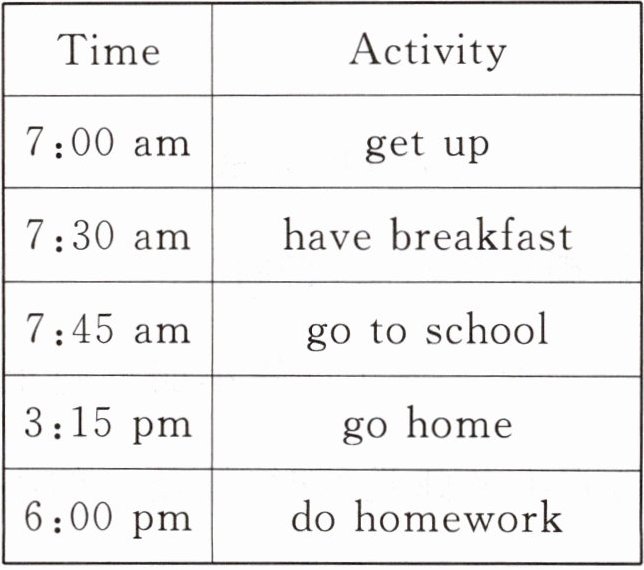
Hi, I’m Li Lei. I 1. at seven o’clock. I have breakfast at 2. . I 3. at seven forty-five.
In the afternoon, I 4. at three fifteen. I 5. at six o’clock.
Hi, I’m Li Lei. I 1. at seven o’clock. I have breakfast at 2. . I 3. at seven forty-five.
In the afternoon, I 4. at three fifteen. I 5. at six o’clock.
答案
1. get up
2. seven thirty/7:30 am
3. go to school
4. go home
5. do homework
2. seven thirty/7:30 am
3. go to school
4. go home
5. do homework
解析
我们对照表格中给出的时间和对应活动信息来补全句子:
1. 表格显示早上7点的活动是起床,因此此处填get up;
2. 表格显示吃早餐的时间是早上7点30分,因此此处填seven thirty/7:30 am;
3. 表格显示早上7点45分的活动是去上学,因此此处填go to school;
4. 表格显示下午3点15分的活动是回家,因此此处填go home;
5. 表格显示下午6点的活动是做作业,因此此处填do homework。
1. 表格显示早上7点的活动是起床,因此此处填get up;
2. 表格显示吃早餐的时间是早上7点30分,因此此处填seven thirty/7:30 am;
3. 表格显示早上7点45分的活动是去上学,因此此处填go to school;
4. 表格显示下午3点15分的活动是回家,因此此处填go home;
5. 表格显示下午6点的活动是做作业,因此此处填do homework。
