

 登录
登录
五、完成句子
1. these, may, qualities, remain, same, your, life, all, the (.) (连词成句)
2. 一些文化精神由我们的祖先传递给我们。(汉译英)
Some cultural spirits
3. 多年的努力终于在他成功实现梦想之时得到了回报。(汉译英)
Years of hard work finally
4. 研究表明,良好的沟通能让学生很好地相互合作。(汉译英)
1. these, may, qualities, remain, same, your, life, all, the (.) (连词成句)
These qualities may remain the same all your life.
2. 一些文化精神由我们的祖先传递给我们。(汉译英)
Some cultural spirits
are
passed
on
to
us by our ancestors.3. 多年的努力终于在他成功实现梦想之时得到了回报。(汉译英)
Years of hard work finally
paid
off
when he succeeded
in
achieving
his dream.4. 研究表明,良好的沟通能让学生很好地相互合作。(汉译英)
Studies
show that good communication allows students to
cooperate
well
with
each other.答案
1. These qualities may remain the same all your life.
2. are passed on to 3. paid off; succeeded in achieving
4. Studies; to cooperate well with
2. are passed on to 3. paid off; succeeded in achieving
4. Studies; to cooperate well with
解析
【分析】
1. 连词成句:先确定主语为These qualities,情态动词may后接动词原形remain,搭配固定短语remain the same,最后补充时间状语all your life,按英语陈述句语序排列即可。
2. 汉译英:“由...传递给”需用被动语态,结构为be+过去分词,“传递”对应pass on,搭配介词to表对象,主语为复数用一般现在时。
3. 汉译英:“得到回报”对应固定短语pay off,结合语境用一般过去时;“成功实现”用固定结构succeed in doing sth,“实现梦想”用achieve。
4. 汉译英:“研究”此处泛指用复数Studies;固定搭配allow sb to do sth,“很好地相互合作”对应cooperate well with。
【解析】
1. 连词成句:按“主语+情态动词+动词原形+表语+时间状语”的英语陈述句结构排列所给词汇,得到正确句子:These qualities may remain the same all your life。
2. 汉译英:被动语态结构为“be+passed on+to”,主语Some cultural spirits为复数,一般现在时,故填are passed on to。
3. 汉译英:“得到回报”用pay off的过去式paid off;“成功实现”用succeed in achieving,结合语境用一般过去时,故填paid off; succeeded in achieving。
4. 汉译英:“研究”泛指用复数Studies;固定搭配allow students to do sth,“很好地相互合作”为cooperate well with,故填Studies; to cooperate well with。
【答案】
1. These qualities may remain the same all your life.
2. are passed on to
3. paid off; succeeded in achieving
4. Studies; to cooperate well with
【知识点】
连词成句、被动语态、固定短语搭配
【点评】
本题为基础英语练习题,涵盖连词成句和汉译英题型,主要考察学生对英语基本句型、被动语态结构及常用固定搭配的掌握,难度适中,适合巩固英语基础。
【难度系数】
0.6
1. 连词成句:先确定主语为These qualities,情态动词may后接动词原形remain,搭配固定短语remain the same,最后补充时间状语all your life,按英语陈述句语序排列即可。
2. 汉译英:“由...传递给”需用被动语态,结构为be+过去分词,“传递”对应pass on,搭配介词to表对象,主语为复数用一般现在时。
3. 汉译英:“得到回报”对应固定短语pay off,结合语境用一般过去时;“成功实现”用固定结构succeed in doing sth,“实现梦想”用achieve。
4. 汉译英:“研究”此处泛指用复数Studies;固定搭配allow sb to do sth,“很好地相互合作”对应cooperate well with。
【解析】
1. 连词成句:按“主语+情态动词+动词原形+表语+时间状语”的英语陈述句结构排列所给词汇,得到正确句子:These qualities may remain the same all your life。
2. 汉译英:被动语态结构为“be+passed on+to”,主语Some cultural spirits为复数,一般现在时,故填are passed on to。
3. 汉译英:“得到回报”用pay off的过去式paid off;“成功实现”用succeed in achieving,结合语境用一般过去时,故填paid off; succeeded in achieving。
4. 汉译英:“研究”泛指用复数Studies;固定搭配allow students to do sth,“很好地相互合作”为cooperate well with,故填Studies; to cooperate well with。
【答案】
1. These qualities may remain the same all your life.
2. are passed on to
3. paid off; succeeded in achieving
4. Studies; to cooperate well with
【知识点】
连词成句、被动语态、固定短语搭配
【点评】
本题为基础英语练习题,涵盖连词成句和汉译英题型,主要考察学生对英语基本句型、被动语态结构及常用固定搭配的掌握,难度适中,适合巩固英语基础。
【难度系数】
0.6
六、南京期中 完形填空 主题:人与自我——自我认知 学科素养:思维品质 词数:约160 建议用时:4分钟
“Know yourself” is the first step to wisdom, yet it is an easy task. We often doubt we truly understand ourselves. Are we the creative type who likes to invent, or the organized one who prefers ? Are we naturally about new things, or more energetic in taking action? Sometimes we even wonder if we are the so-called “black sheep” in the family, feeling a little different from others.
To know yourself better, should you pay attention to your own feelings and habits, listen to feedback from people you trust. You may need to some habits that hold you back and learn to manage difficulties calmly. Taking it step by step can make it much to manage this process. There is no doubt that this journey will help you become a more valuable person—both to yourself and to others.
______ starting this meaningful journey today? Remember, self-awareness is like a light that helps you see your true colors. Let’s begin now!
(
(
(
(
(
(
(
(
“Know yourself” is the first step to wisdom, yet it is an easy task. We often doubt we truly understand ourselves. Are we the creative type who likes to invent, or the organized one who prefers ? Are we naturally about new things, or more energetic in taking action? Sometimes we even wonder if we are the so-called “black sheep” in the family, feeling a little different from others.
To know yourself better, should you pay attention to your own feelings and habits, listen to feedback from people you trust. You may need to some habits that hold you back and learn to manage difficulties calmly. Taking it step by step can make it much to manage this process. There is no doubt that this journey will help you become a more valuable person—both to yourself and to others.
______ starting this meaningful journey today? Remember, self-awareness is like a light that helps you see your true colors. Let’s begin now!
(
C
) 1. A. nearly B. easily C. hardly D. quickly(
A
) 2. A. whether B. how C. when D. that(
B
) 3. A. rules B. order C. results D. methods(
C
) 4. A. modest B. patient C. curious D. confident(
C
) 5. A. neither; nor B. either; or C. not only; but also D. both; and(
D
) 6. A. give in B. give out C. give away D. give up(
B
) 7. A. harder B. easier C. quicker D. slower(
B
) 8. A. Why don’t you B. How about C. Would you like D. Why not答案
答案速查 1.C 2.A 3.B 4.C 5.C 6.D 7.B 8.B
【主旨大意】本文主要围绕“认识自我”这一主题,阐述了认识自我的重要性、认识自我时的常见困惑,给出了更好认识自我的方法,并呼吁人们从当下开始踏上认识自我的旅程。
1. C【点拨】根据“yet”可知,前后句语义转折,前半句说认识自我是通往智慧的第一步,后半句应强调其“不容易”,hardly符合“绝非容易”的语义。
2. A【点拨】“doubt”后接宾语从句时,若表示“不确定是否……”,需用whether引导,本句强调对“是否真正了解自己”的怀疑。
3. B【点拨】根据“organized”,有条理的,可知,此处指“更喜欢秩序”。
4. C【点拨】根据“about new things”可知,be curious about“对……好奇”是固定短语,符合“对新事物的态度”这一语境。
5. C【点拨】本句中“关注自身”和“倾听他人”是递进关系,需用not only; but also。
6. D【点拨】根据“habits that hold you back”可知,需“放弃”这些习惯。
7. B【点拨】此处是指一步一步来会让这个过程的管理容易得多。
8. B【点拨】Why don’t you后接动词原形;How about后接动名词;Would you like后接动词不定式;Why not后接动词原形。空格后是starting,需用How about。
【主旨大意】本文主要围绕“认识自我”这一主题,阐述了认识自我的重要性、认识自我时的常见困惑,给出了更好认识自我的方法,并呼吁人们从当下开始踏上认识自我的旅程。
1. C【点拨】根据“yet”可知,前后句语义转折,前半句说认识自我是通往智慧的第一步,后半句应强调其“不容易”,hardly符合“绝非容易”的语义。
2. A【点拨】“doubt”后接宾语从句时,若表示“不确定是否……”,需用whether引导,本句强调对“是否真正了解自己”的怀疑。
3. B【点拨】根据“organized”,有条理的,可知,此处指“更喜欢秩序”。
4. C【点拨】根据“about new things”可知,be curious about“对……好奇”是固定短语,符合“对新事物的态度”这一语境。
5. C【点拨】本句中“关注自身”和“倾听他人”是递进关系,需用not only; but also。
6. D【点拨】根据“habits that hold you back”可知,需“放弃”这些习惯。
7. B【点拨】此处是指一步一步来会让这个过程的管理容易得多。
8. B【点拨】Why don’t you后接动词原形;How about后接动名词;Would you like后接动词不定式;Why not后接动词原形。空格后是starting,需用How about。
解析
【分析】解答本题需遵循完形填空的解题步骤:首先通读全文,把握本文“认识自我”的核心主题;其次,针对每个空格,结合上下文语境、逻辑关系、固定搭配逐一分析选项:1. 根据转折连词yet判断前后语义相反,需选表否定的副词;2. doubt后接宾语从句表不确定时,用whether引导;3. 结合前文organized(有条理的)的语境,选对应名词;4. 利用固定搭配be curious about解题;5. 判断前后分句为递进关系,选对应连词;6. 根据“阻碍你的习惯”选表“放弃”的短语;7. 结合“一步一步来”的语境,选表“更容易”的比较级;8. 根据空格后动名词starting,选对应结构的短语。
【解析】1. 选C:句意为“‘认识你自己’是通往智慧的第一步,但绝非易事”,yet表转折,hardly(几乎不)符合“绝非容易”的语义,其余选项nearly(几乎)、easily(容易地)、quickly(快速地)均不符合。2. 选A:doubt后接宾语从句,表“不确定是否……”时需用whether引导,that用于肯定句宾语从句,how、when不符合语境。3. 选B:由organized(有条理的)可知,此处指“更喜欢秩序”,order(秩序)符合语境,rules(规则)、results(结果)、methods(方法)不符合。4. 选C:be curious about是固定短语,意为“对……好奇”,符合“对新事物的态度”语境,modest(谦虚的)、patient(耐心的)、confident(自信的)不符合。5. 选C:此处“关注自身感受习惯”和“倾听信任的人的反馈”是递进关系,not only...but also(不仅……而且……)表递进,其余选项neither...nor(既不……也不)、either...or(要么……要么)、both...and(两者都)不符合逻辑。6. 选D:hold you back意为“阻碍你”,需放弃这些习惯,give up(放弃)符合,give in(屈服)、give out(分发)、give away(赠送)不符合。7. 选B:句意为“一步一步来会让这个过程更容易管理”,easier(更容易的)符合语境,harder(更难的)、quicker(更快的)、slower(更慢的)不符合。8. 选B:How about后接动名词,空格后是starting,符合结构;Why don’t you、Why not后接动词原形,Would you like后接不定式,均不符合。
【答案】1.C 2.A 3.B 4.C 5.C 6.D 7.B 8.B
【知识点】完形填空、固定搭配、语境推理
【点评】本题围绕“自我认知”主题设置,考查学生的语境理解、词汇辨析及固定搭配运用能力,贴合初中英语期中测试要求,兼具知识性与思想引导性。
【难度系数】0.6
【解析】1. 选C:句意为“‘认识你自己’是通往智慧的第一步,但绝非易事”,yet表转折,hardly(几乎不)符合“绝非容易”的语义,其余选项nearly(几乎)、easily(容易地)、quickly(快速地)均不符合。2. 选A:doubt后接宾语从句,表“不确定是否……”时需用whether引导,that用于肯定句宾语从句,how、when不符合语境。3. 选B:由organized(有条理的)可知,此处指“更喜欢秩序”,order(秩序)符合语境,rules(规则)、results(结果)、methods(方法)不符合。4. 选C:be curious about是固定短语,意为“对……好奇”,符合“对新事物的态度”语境,modest(谦虚的)、patient(耐心的)、confident(自信的)不符合。5. 选C:此处“关注自身感受习惯”和“倾听信任的人的反馈”是递进关系,not only...but also(不仅……而且……)表递进,其余选项neither...nor(既不……也不)、either...or(要么……要么)、both...and(两者都)不符合逻辑。6. 选D:hold you back意为“阻碍你”,需放弃这些习惯,give up(放弃)符合,give in(屈服)、give out(分发)、give away(赠送)不符合。7. 选B:句意为“一步一步来会让这个过程更容易管理”,easier(更容易的)符合语境,harder(更难的)、quicker(更快的)、slower(更慢的)不符合。8. 选B:How about后接动名词,空格后是starting,符合结构;Why don’t you、Why not后接动词原形,Would you like后接不定式,均不符合。
【答案】1.C 2.A 3.B 4.C 5.C 6.D 7.B 8.B
【知识点】完形填空、固定搭配、语境推理
【点评】本题围绕“自我认知”主题设置,考查学生的语境理解、词汇辨析及固定搭配运用能力,贴合初中英语期中测试要求,兼具知识性与思想引导性。
【难度系数】0.6
七、 跨学科+心理学 阅读理解 主题:人与自我——性格与成长 学科素养:思维品质 词数:约370 建议用时:10分钟
Personality describes certain ways of thinking, feelings, and behaviors that tell apart a person from others. The word “personality” comes from the Latin word “persona”, which refers to a mask worn by performers in the theatre to play roles, or to disguise who the person is. Although there are many meanings of personality, most focus on the way of behaviors and characteristics that can help predict and explain a person’s behavior. Explanations for personality can focus on lots of influences, from genetic (基因的) effects to the role of the environment and experience in shaping a person’s personality.

mask
Types of Personality
There is popular general knowledge of personality types such as the Myers-Briggs theory. The Myers-Briggs Personality Type Indicator (MBTI 人格类型量表) recognizes a personality based on four aspects: introversion-extraversion (内倾—外倾), sensing-intuition (实感—直觉), thinking-feeling, and judging-perceiving (判断—感知). After taking a Myers-Briggs personality test, you are considered one of 16 personality types. Here are some examples of these personality types:
◇ ISTJ: Introverted, sensing, thinking, and judging. People with this personality type are logical, organized, detail-oriented and practical.
◇ INFP: Introverted, intuitive, feeling, and perceiving. They tend to be idealistic and sensitive to their feelings.
◇ ESFJ: Extroverted, sensing, feeling, and judging. They are outgoing, kind, loyal and sensitive.
◇ ENFJ: Extroverted, intuitive, feeling, and judging. They are known as “givers” for being warm-hearted and they are practical.
▲
Research on personality can offer deep understanding about how personality develops and changes over the course of a lifetime. Some tests give people deep understanding about how their personality affects many areas of their lives, including careers, relationships, personal growth, and more. Understanding your personality type can help you find out what career you might enjoy, how well you might perform in certain job roles, or how effective a kind of psychological treatment could be for you. Personality type can also have an influence on your health, including how often you visit the doctor and how you deal with stress.
Understanding the psychology (心理学) of personality is much more than mere general knowledge. The findings from personality research can have important applications in medicine, health, business, economics, technology and other fields. By building a better understanding of how personality works, we can look for new ways to improve both personal and public health.
(
A. To question. B. To hide. C. To discuss. D. To guess.
(
A. Logical and loyal. B. Detail-oriented and practical.
C. Outgoing and kind. D. Humorous and self-confident.
(
A. The Influence of Personality B. The Forms of Personality
C. The Changes in Personality D. The Studies on Personality
(
A. people’s living environment is decided by personality
B. a personality test is a must when hiring employees
C. deep understanding of how personality works matters a lot
D. learning psychology can greatly improve one’s personality
Personality describes certain ways of thinking, feelings, and behaviors that tell apart a person from others. The word “personality” comes from the Latin word “persona”, which refers to a mask worn by performers in the theatre to play roles, or to disguise who the person is. Although there are many meanings of personality, most focus on the way of behaviors and characteristics that can help predict and explain a person’s behavior. Explanations for personality can focus on lots of influences, from genetic (基因的) effects to the role of the environment and experience in shaping a person’s personality.
mask
Types of Personality
There is popular general knowledge of personality types such as the Myers-Briggs theory. The Myers-Briggs Personality Type Indicator (MBTI 人格类型量表) recognizes a personality based on four aspects: introversion-extraversion (内倾—外倾), sensing-intuition (实感—直觉), thinking-feeling, and judging-perceiving (判断—感知). After taking a Myers-Briggs personality test, you are considered one of 16 personality types. Here are some examples of these personality types:
◇ ISTJ: Introverted, sensing, thinking, and judging. People with this personality type are logical, organized, detail-oriented and practical.
◇ INFP: Introverted, intuitive, feeling, and perceiving. They tend to be idealistic and sensitive to their feelings.
◇ ESFJ: Extroverted, sensing, feeling, and judging. They are outgoing, kind, loyal and sensitive.
◇ ENFJ: Extroverted, intuitive, feeling, and judging. They are known as “givers” for being warm-hearted and they are practical.
▲
Research on personality can offer deep understanding about how personality develops and changes over the course of a lifetime. Some tests give people deep understanding about how their personality affects many areas of their lives, including careers, relationships, personal growth, and more. Understanding your personality type can help you find out what career you might enjoy, how well you might perform in certain job roles, or how effective a kind of psychological treatment could be for you. Personality type can also have an influence on your health, including how often you visit the doctor and how you deal with stress.
Understanding the psychology (心理学) of personality is much more than mere general knowledge. The findings from personality research can have important applications in medicine, health, business, economics, technology and other fields. By building a better understanding of how personality works, we can look for new ways to improve both personal and public health.
(
B
)1. What does the word “disguise” probably mean in Paragraph 1?A. To question. B. To hide. C. To discuss. D. To guess.
(
B
)2. What might be the strengths of an ISTJ?A. Logical and loyal. B. Detail-oriented and practical.
C. Outgoing and kind. D. Humorous and self-confident.
(
A
)3. Which of the following would be the best heading for Paragraph 3?A. The Influence of Personality B. The Forms of Personality
C. The Changes in Personality D. The Studies on Personality
(
C
)4. The writer probably agrees that .A. people’s living environment is decided by personality
B. a personality test is a must when hiring employees
C. deep understanding of how personality works matters a lot
D. learning psychology can greatly improve one’s personality
答案
答案速查 1.B 2.B 3.A 4.C
【主旨大意】本文首先介绍了人格的定义与词源,接着以MBTI人格分类理论为例介绍了不同的人格类型,随后阐述了人格对人们生活各方面的影响,最后说明了人格研究的重要应用价值。
1. B【点拨】根据第一段语境可知,disguise用来解释拉丁语“persona”,该词指戏剧演员表演时佩戴的面具,面具的作用是隐藏佩戴者的真实身份,结合选项,只有To hide符合该词义。
2. B【点拨】根据文中描述“◇ ISTJ: Introverted, sensing, thinking, and... practical.”可知,ISTJ型人格的特点是:逻辑性强、有条理、关注细节、务实。
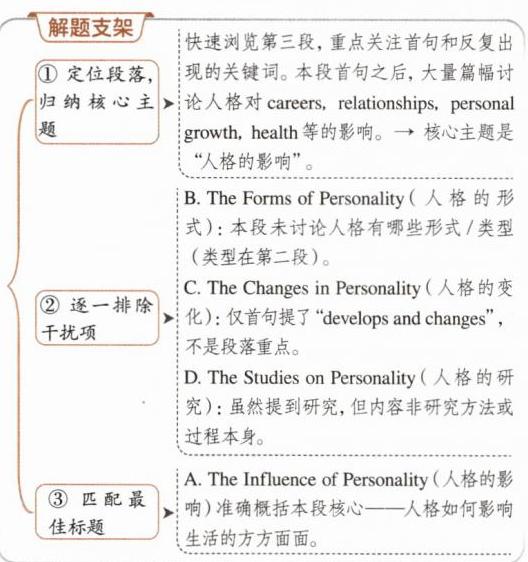
3. A
4. C【点拨】根据文章最后一段“By building a better... public health.”可知,作者认同深入理解人格的运作机制有十分重要的意义。
解析
【分析】
1. 第1题是词义猜测题:先定位到第一段中“disguise”所在的句子,结合前文“persona”指戏剧演员佩戴的面具,面具的作用是隐藏真实身份,据此推测词义。
2. 第2题是细节理解题:根据题干关键词“ISTJ”,快速定位到“Types of Personality”板块中ISTJ的描述,提取对应特点匹配选项。
3. 第3题是段落主旨题:定位第三段,梳理段落核心内容,明确其围绕“人格对生活各方面的影响”展开,排除干扰项后确定最佳标题。
4. 第4题是推理判断题:定位到文章最后一段,分析作者观点,对比选项选出符合作者态度的内容。
【解析】
1. 第1题:词义猜测题。根据第一段“the Latin word 'persona', which refers to a mask worn by performers in the theatre to play roles, or to disguise who the person is”可知,面具的作用是隐藏佩戴者的真实身份,“disguise”意为“隐藏”,对应选项B。
2. 第2题:细节理解题。根据文中“◇ ISTJ: ... logical, organized, detail-oriented and practical.”可知,ISTJ型人格的优势是注重细节和务实,对应选项B。
3. 第3题:段落主旨题。第三段主要讨论人格对职业、人际关系、个人成长、健康等方面的影响,核心主题是“人格的影响”;选项B(人格形式)对应第二段,选项C(人格变化)仅首句提及非重点,选项D(人格研究)未涉及研究过程,均排除,故选A。
4. 第4题:推理判断题。根据最后一段“By building a better understanding of how personality works, we can look for new ways to improve both personal and public health.”可知,作者认为深入理解人格的运作机制非常重要,对应选项C;选项A(环境决定人格)与原文“基因和环境均影响人格”不符,选项B(人格测试是招聘必需)原文未提及,选项D(学习心理学改善人格)与原文不符,故选C。
【答案】1.B 2.B 3.A 4.C
【知识点】词义猜测题,细节理解题,段落主旨题
【点评】本题为跨学科阅读理解题,结合心理学知识,考查学生的词义猜测、细节查找、主旨归纳和推理判断能力,题型常规,难度适中,适合巩固阅读理解技巧。
【难度系数】0.6
1. 第1题是词义猜测题:先定位到第一段中“disguise”所在的句子,结合前文“persona”指戏剧演员佩戴的面具,面具的作用是隐藏真实身份,据此推测词义。
2. 第2题是细节理解题:根据题干关键词“ISTJ”,快速定位到“Types of Personality”板块中ISTJ的描述,提取对应特点匹配选项。
3. 第3题是段落主旨题:定位第三段,梳理段落核心内容,明确其围绕“人格对生活各方面的影响”展开,排除干扰项后确定最佳标题。
4. 第4题是推理判断题:定位到文章最后一段,分析作者观点,对比选项选出符合作者态度的内容。
【解析】
1. 第1题:词义猜测题。根据第一段“the Latin word 'persona', which refers to a mask worn by performers in the theatre to play roles, or to disguise who the person is”可知,面具的作用是隐藏佩戴者的真实身份,“disguise”意为“隐藏”,对应选项B。
2. 第2题:细节理解题。根据文中“◇ ISTJ: ... logical, organized, detail-oriented and practical.”可知,ISTJ型人格的优势是注重细节和务实,对应选项B。
3. 第3题:段落主旨题。第三段主要讨论人格对职业、人际关系、个人成长、健康等方面的影响,核心主题是“人格的影响”;选项B(人格形式)对应第二段,选项C(人格变化)仅首句提及非重点,选项D(人格研究)未涉及研究过程,均排除,故选A。
4. 第4题:推理判断题。根据最后一段“By building a better understanding of how personality works, we can look for new ways to improve both personal and public health.”可知,作者认为深入理解人格的运作机制非常重要,对应选项C;选项A(环境决定人格)与原文“基因和环境均影响人格”不符,选项B(人格测试是招聘必需)原文未提及,选项D(学习心理学改善人格)与原文不符,故选C。
【答案】1.B 2.B 3.A 4.C
【知识点】词义猜测题,细节理解题,段落主旨题
【点评】本题为跨学科阅读理解题,结合心理学知识,考查学生的词义猜测、细节查找、主旨归纳和推理判断能力,题型常规,难度适中,适合巩固阅读理解技巧。
【难度系数】0.6
