

 登录
登录
A Listen and order(听录音,给下列图片排序)
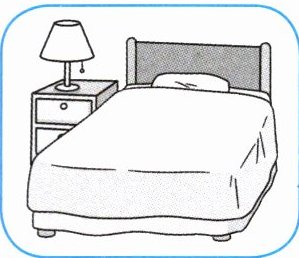
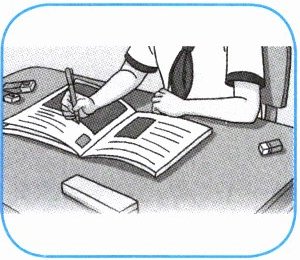
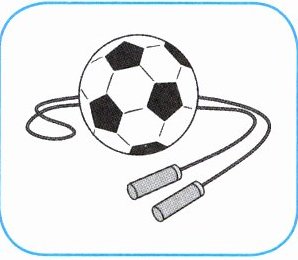
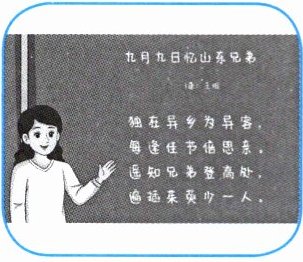
(
(
2
) (3
) (4
) (1
)答案
2 3 4 1
B Look and say(看一看,说一说)
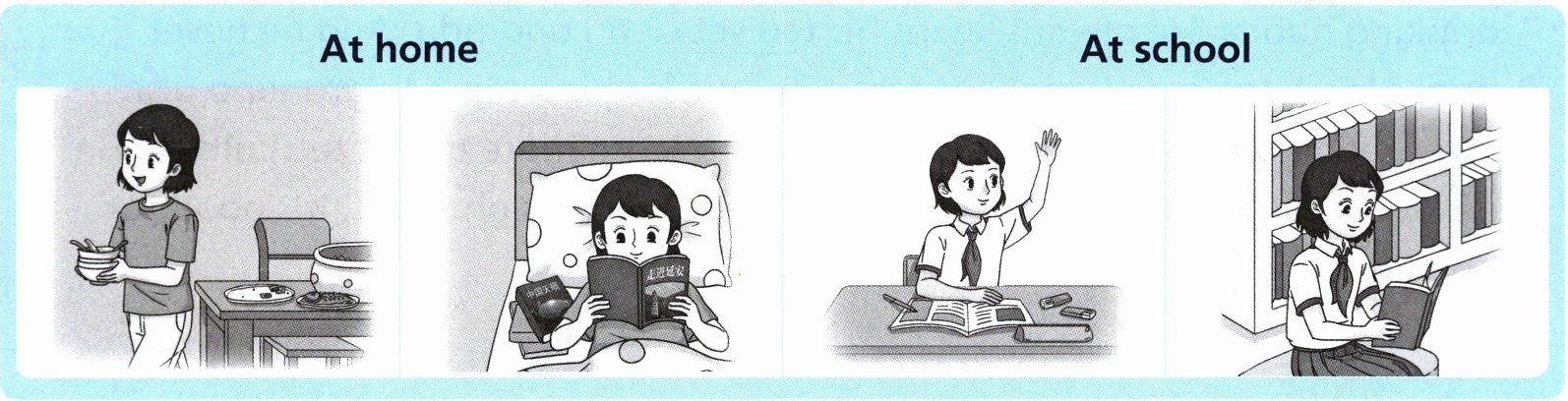
参考句型:Yang Ling has some good habits. She ... She has a bad habit too. She ...
参考句型:Yang Ling has some good habits. She ... She has a bad habit too. She ...
答案
Yang Ling has some good habits. She helps her parents clear the table after meals at home. She listens carefully in class and always puts up her hand to answer questions. She also reads books quietly in the school library. She has a bad habit too. She sometimes reads books in bed.
解析
【分析】首先观察图片,分为“在家”和“在学校”两个场景:在家时,Yang Ling饭后收拾餐桌是好习惯,躺在床上看书是坏习惯;在学校时,课堂上举手回答问题、在图书馆安静看书是好习惯。结合参考句型“Yang Ling has some good habits. She ... She has a bad habit too. She ...”,先描述好习惯,再描述坏习惯,组织成通顺的英语句子。
【解析】先识别图片中的对应行为:1. 在家饭后收拾餐桌(好习惯);2. 在家躺在床上看书(坏习惯);3. 学校课堂举手回答问题(好习惯);4. 学校图书馆看书(好习惯)。按照参考句型结构,依次列举好习惯,再说明坏习惯,用正确的英语表达这些行为。
【答案】Yang Ling has some good habits. She helps her parents clear the table after meals at home. She listens carefully in class and always puts up her hand to answer questions. She also reads books quietly in the school library. She has a bad habit too. She sometimes reads books in bed.
【知识点】看图说话、英语句型运用、日常习惯表达
【点评】本题通过图片考查学生的观察能力和英语表达日常习惯的能力,参考句型降低了表达难度,适合基础阶段学生练习。
【难度系数】0.6
【解析】先识别图片中的对应行为:1. 在家饭后收拾餐桌(好习惯);2. 在家躺在床上看书(坏习惯);3. 学校课堂举手回答问题(好习惯);4. 学校图书馆看书(好习惯)。按照参考句型结构,依次列举好习惯,再说明坏习惯,用正确的英语表达这些行为。
【答案】Yang Ling has some good habits. She helps her parents clear the table after meals at home. She listens carefully in class and always puts up her hand to answer questions. She also reads books quietly in the school library. She has a bad habit too. She sometimes reads books in bed.
【知识点】看图说话、英语句型运用、日常习惯表达
【点评】本题通过图片考查学生的观察能力和英语表达日常习惯的能力,参考句型降低了表达难度,适合基础阶段学生练习。
【难度系数】0.6
C Read and complete(根据课文内容完成表格)
does exercise takes notes does chores
in bed listens to goes to bed
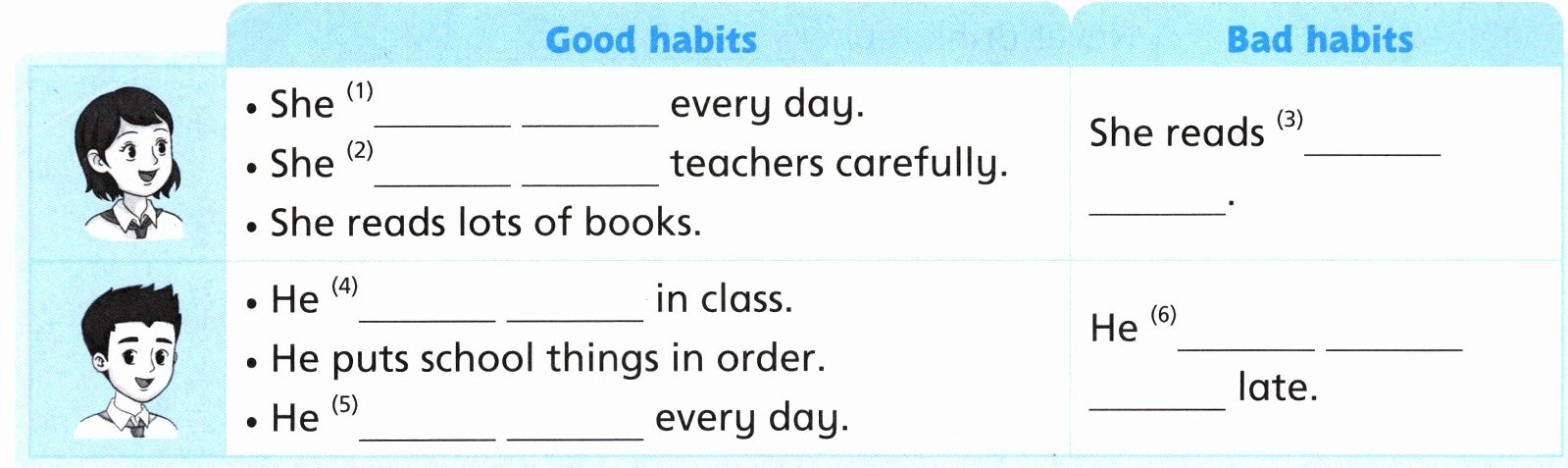
does exercise takes notes does chores
in bed listens to goes to bed
答案
1. does chores 2. listens to
3. in bed 4. takes notes
5. does exercise 6. goes to bed
3. in bed 4. takes notes
5. does exercise 6. goes to bed
解析
【分析】首先明确题目要求:根据给出的动词短语,结合表格中“好习惯/坏习惯”的分类,以及主语(she/he)的人称和一般现在时的时态特点完成填空。先整理给出的词汇:does exercise(做运动)、takes notes(记笔记)、does chores(做家务)、in bed(在床上)、listens to(听)、goes to bed(睡觉)。再逐个分析每个空的语境:
1. 空在“She ___ every day”(好习惯),需选日常好习惯的短语,对应does chores;
2. 空在“She ___ teachers carefully”,需选“听老师”的表达,对应listens to;
3. 空在“She reads ___”(坏习惯),需选“在床上看书”的坏习惯表达,对应in bed;
4. 空在“He ___ in class”(好习惯),需选“课堂上记笔记”的好习惯表达,对应takes notes;
5. 空在“He ___ every day”(好习惯),需选“日常做运动”的好习惯表达,对应does exercise;
6. 空在“He ___ late”(坏习惯),需选“晚睡”的坏习惯表达,对应goes to bed。
【解析】1. 主语she是第三人称单数,一般现在时,结合“every day”和好习惯分类,does chores(做家务)符合语境;2. “listen to teachers carefully”是固定表达,意为认真听老师讲课,属于好习惯;3. “read in bed”意为在床上看书,是坏习惯,符合Bad habits分类;4. “take notes in class”意为课堂上记笔记,属于好习惯,符合Good habits分类;5. “do exercise every day”意为每天做运动,是好习惯;6. “go to bed late”意为晚睡,是坏习惯,符合分类要求。
【答案】1. does chores 2. listens to 3. in bed 4. takes notes 5. does exercise 6. goes to bed
【知识点】一般现在时、动词短语、习惯表达
【点评】本题考查常用动词短语的运用,结合“好习惯/坏习惯”的语境和一般现在时的用法,题型基础,贴近日常英语表达。
【难度系数】0.6
1. 空在“She ___ every day”(好习惯),需选日常好习惯的短语,对应does chores;
2. 空在“She ___ teachers carefully”,需选“听老师”的表达,对应listens to;
3. 空在“She reads ___”(坏习惯),需选“在床上看书”的坏习惯表达,对应in bed;
4. 空在“He ___ in class”(好习惯),需选“课堂上记笔记”的好习惯表达,对应takes notes;
5. 空在“He ___ every day”(好习惯),需选“日常做运动”的好习惯表达,对应does exercise;
6. 空在“He ___ late”(坏习惯),需选“晚睡”的坏习惯表达,对应goes to bed。
【解析】1. 主语she是第三人称单数,一般现在时,结合“every day”和好习惯分类,does chores(做家务)符合语境;2. “listen to teachers carefully”是固定表达,意为认真听老师讲课,属于好习惯;3. “read in bed”意为在床上看书,是坏习惯,符合Bad habits分类;4. “take notes in class”意为课堂上记笔记,属于好习惯,符合Good habits分类;5. “do exercise every day”意为每天做运动,是好习惯;6. “go to bed late”意为晚睡,是坏习惯,符合分类要求。
【答案】1. does chores 2. listens to 3. in bed 4. takes notes 5. does exercise 6. goes to bed
【知识点】一般现在时、动词短语、习惯表达
【点评】本题考查常用动词短语的运用,结合“好习惯/坏习惯”的语境和一般现在时的用法,题型基础,贴近日常英语表达。
【难度系数】0.6
