

 登录
登录
七、完形填空。
A grasshopper ( 蚱蜢 ) sits on the grass on a sunny summer day. “What a 1 day! I can make music and 2 here. How happy I am!” he says to himself.
The grasshopper has a good time and then he 3 a little ant. The ant tries to take some 4 home. The grasshopper says to the ant, “Hello, little ant! Why do you work so hard? Aren’t you 5?” The ant says, “Yes. I’m tired, but I have to get the food for 6. When it’s cold, I can stay at home and have food. You 7 find some food for the cold winter too.” The grasshopper does not listen to the ant. He plays and dances.
Winter comes. It is cold. The ant sleeps and plays in his home. He eats the food and feels 8. One day, someone knocks on his door. He 9 the door and sees the grasshopper. “Please help me, my friend,” the grasshopper says. “I’m very cold and 10. I don’t have any food to eat.” The ant gives the grasshopper some food to eat.
(
(
(
(
(
(
(
(
(
(
A grasshopper ( 蚱蜢 ) sits on the grass on a sunny summer day. “What a 1 day! I can make music and 2 here. How happy I am!” he says to himself.
The grasshopper has a good time and then he 3 a little ant. The ant tries to take some 4 home. The grasshopper says to the ant, “Hello, little ant! Why do you work so hard? Aren’t you 5?” The ant says, “Yes. I’m tired, but I have to get the food for 6. When it’s cold, I can stay at home and have food. You 7 find some food for the cold winter too.” The grasshopper does not listen to the ant. He plays and dances.
Winter comes. It is cold. The ant sleeps and plays in his home. He eats the food and feels 8. One day, someone knocks on his door. He 9 the door and sees the grasshopper. “Please help me, my friend,” the grasshopper says. “I’m very cold and 10. I don’t have any food to eat.” The ant gives the grasshopper some food to eat.
(
B
) 1. A. bad B. fine C. hot D. cold(
C
) 2. A. walk B. jump C. dance D. sleep(
B
) 3. A. gets B. sees C. hears D. moves(
D
) 4. A. water B. clothes C. grass D. food(
D
) 5. A. nice B. hot C. right D. tired(
A
) 6. A. winter B. fun C. supper D. people(
D
) 7. A. don’t B. shouldn’t C. do D. should(
B
) 8. A. sad B. happy C. thirsty D. ill(
D
) 9. A. finds B. knocks C. gets D. opens(
A
) 10. A. hungry B. heavy C. nice D. afraid答案
1. B 2. C 3. B 4. D 5. D 6. A 7. D 8. B 9. D 10. A
解析
【分析】做完形填空需先通读全文,把握文章主旨(本文为蚱蜢与蚂蚁的寓言故事,讲述夏日享乐与冬日储备食物的对比),再结合上下文语境、词汇含义及逻辑关系逐一分析每个空,排除不符合语境的选项,选出最恰当的答案。
【解析】1. 由前文“sunny summer day”可知是好天气,选B(fine);2. 后文提到蚱蜢“plays and dances”,此处对应跳舞,选C(dance);3. 蚱蜢玩耍时看到蚂蚁,选B(sees);4. 蚂蚁储备的是食物,对应后文“get the food”,选D(food);5. 蚂蚁自述“tired”,此处问是否累,选D(tired);6. 蚂蚁要为冬天储备食物,对应后文“cold winter”,选A(winter);7. 蚂蚁建议蚱蜢也该为冬天找食物,选D(should);8. 蚂蚁在家有食物,感觉开心,选B(happy);9. 有人敲门,蚂蚁开门,选D(opens);10. 蚱蜢没食物,饥饿,选A(hungry)。
【答案】1.B 2.C 3.B 4.D 5.D 6.A 7.D 8.B 9.D 10.A
【知识点】完形填空、语境理解、词汇运用
【点评】本文是经典寓言类完形填空,通过蚱蜢与蚂蚁的对比传递道理,重点考查学生对上下文语境的把握和基础词汇的运用,是巩固完形解题能力的典型题目。
【难度系数】0.6
【解析】1. 由前文“sunny summer day”可知是好天气,选B(fine);2. 后文提到蚱蜢“plays and dances”,此处对应跳舞,选C(dance);3. 蚱蜢玩耍时看到蚂蚁,选B(sees);4. 蚂蚁储备的是食物,对应后文“get the food”,选D(food);5. 蚂蚁自述“tired”,此处问是否累,选D(tired);6. 蚂蚁要为冬天储备食物,对应后文“cold winter”,选A(winter);7. 蚂蚁建议蚱蜢也该为冬天找食物,选D(should);8. 蚂蚁在家有食物,感觉开心,选B(happy);9. 有人敲门,蚂蚁开门,选D(opens);10. 蚱蜢没食物,饥饿,选A(hungry)。
【答案】1.B 2.C 3.B 4.D 5.D 6.A 7.D 8.B 9.D 10.A
【知识点】完形填空、语境理解、词汇运用
【点评】本文是经典寓言类完形填空,通过蚱蜢与蚂蚁的对比传递道理,重点考查学生对上下文语境的把握和基础词汇的运用,是巩固完形解题能力的典型题目。
【难度系数】0.6
八、短文仿写。
下面的饼图和短文展示了赵悦是如何使用她的零花钱的。仔细阅读范文,然后在空白的饼图上展示你的零花钱使用方式,并写一段话,不少于8句。
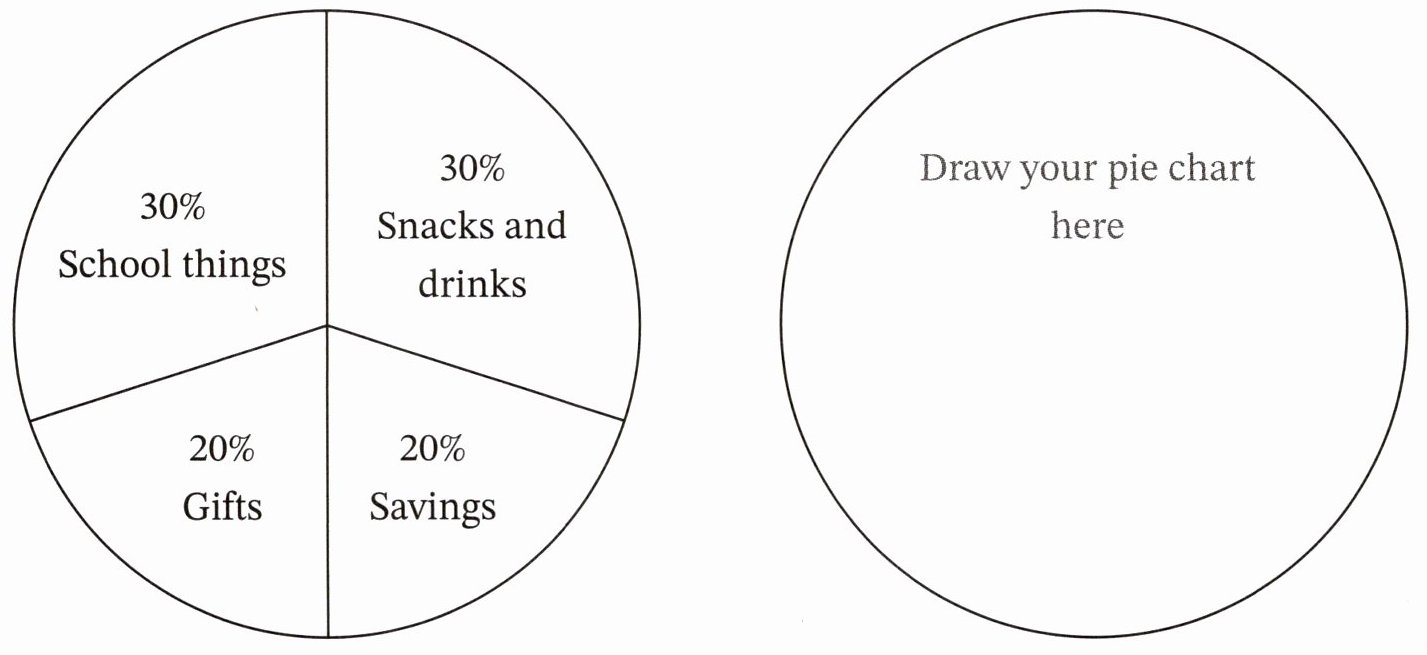
I’m Zhao Yue. I get 25 yuan from my parents every week. How do I spend my pocket money? Look at the pie chart.
I spend 30% of my pocket money on school things like pens and pencils. I spend 30% on snacks and drinks. I usually buy some biscuits (饼干) and juice.
I also spend 20% on gifts for my family or friends. I save (存) 20% of my pocket money.
This is my pocket money plan. It helps me have good spending habits and learn how to use money well.
下面的饼图和短文展示了赵悦是如何使用她的零花钱的。仔细阅读范文,然后在空白的饼图上展示你的零花钱使用方式,并写一段话,不少于8句。
I’m Zhao Yue. I get 25 yuan from my parents every week. How do I spend my pocket money? Look at the pie chart.
I spend 30% of my pocket money on school things like pens and pencils. I spend 30% on snacks and drinks. I usually buy some biscuits (饼干) and juice.
I also spend 20% on gifts for my family or friends. I save (存) 20% of my pocket money.
This is my pocket money plan. It helps me have good spending habits and learn how to use money well.
答案
饼图绘制参考:将空白圆划分为4块,分别标注40% Books、25% School things、20% Savings、15% Snacks。
参考短文:
I'm Li Ming. I get 20 yuan from my parents every week. How do I spend my pocket money? Look at my pie chart.
I spend 40% of my pocket money on different books. I love reading storybooks and science books very much. I spend 25% on school things, such as notebooks and erasers. I spend 15% on snacks, and I usually buy small candies and fresh milk. I also save 20% of my pocket money every month. This is my pocket money plan. It helps me form a good reading habit and learn to use money in a reasonable way.
参考短文:
I'm Li Ming. I get 20 yuan from my parents every week. How do I spend my pocket money? Look at my pie chart.
I spend 40% of my pocket money on different books. I love reading storybooks and science books very much. I spend 25% on school things, such as notebooks and erasers. I spend 15% on snacks, and I usually buy small candies and fresh milk. I also save 20% of my pocket money every month. This is my pocket money plan. It helps me form a good reading habit and learn to use money in a reasonable way.
解析
【分析】本题为英语短文仿写题,解题思路如下:① 先模仿范文结构,介绍自己的身份、零花钱来源;② 参考饼图(或设定合理的零花钱分配比例),用英语清晰表达各部分的用途及占比;③ 最后总结零花钱计划的好处,确保短文不少于8句,语句通顺。
【解析】按照范文的句式逻辑:首先确定自己的身份(如Li Ming)、每周零花钱金额(如20元);接着设定各部分的百分比(如40%用于买书、25%用于学习用品、15%用于零食、20%用于储蓄),使用“主语+spend+百分比+on+具体物品”的句式描述;最后说明该零花钱计划的作用,保证短文连贯、符合英语表达习惯,满足字数要求。
【答案】I'm Li Ming. I get 20 yuan from my parents every week. How do I spend my pocket money? Look at my pie chart.
I spend 40% of my pocket money on different books. I love reading storybooks and science books very much. I spend 25% on school things, such as notebooks and erasers. I spend 15% on snacks, and I usually buy small candies and fresh milk. I also save 20% of my pocket money every month. This is my pocket money plan. It helps me form a good reading habit and learn to use money in a reasonable way.
【知识点】英语短文仿写、百分比表达、话题写作
【点评】本题结合图表考查英语写作能力,要求学生模仿范文结构合理分配零花钱用途,兼顾语言运用与理财意识培养,难度适中。
【难度系数】0.5
【解析】按照范文的句式逻辑:首先确定自己的身份(如Li Ming)、每周零花钱金额(如20元);接着设定各部分的百分比(如40%用于买书、25%用于学习用品、15%用于零食、20%用于储蓄),使用“主语+spend+百分比+on+具体物品”的句式描述;最后说明该零花钱计划的作用,保证短文连贯、符合英语表达习惯,满足字数要求。
【答案】I'm Li Ming. I get 20 yuan from my parents every week. How do I spend my pocket money? Look at my pie chart.
I spend 40% of my pocket money on different books. I love reading storybooks and science books very much. I spend 25% on school things, such as notebooks and erasers. I spend 15% on snacks, and I usually buy small candies and fresh milk. I also save 20% of my pocket money every month. This is my pocket money plan. It helps me form a good reading habit and learn to use money in a reasonable way.
【知识点】英语短文仿写、百分比表达、话题写作
【点评】本题结合图表考查英语写作能力,要求学生模仿范文结构合理分配零花钱用途,兼顾语言运用与理财意识培养,难度适中。
【难度系数】0.5
