

 登录
登录
B
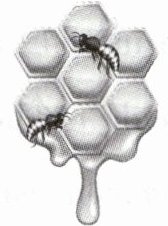
honeycomb
Have you ever looked at a honeycomb and wondered why it's made of perfect six-sided shapes? Or why the seeds in a sunflower form such beautiful patterns? The answer lies not only in nature but also in maths. Maths is more than just numbers—it's like a hidden rule waiting to be found all around us in nature.
Let's take bees as an example. These small insects are very good at using maths. When they build their honeycombs, they need to use as little material as possible to store the most honey. After a long time of evolution(演变), they found the best shape: the hexagon(六边形). If we compare this shape to others like squares or triangles, we find that the hexagon uses the least wax to hold the most honey. This shows us how maths helps solve real-life problems in nature.
Another interesting example is the Fibonacci sequence(斐波那契数列). It's a special number pattern where each number is the sum of the two numbers before it: 0, 1, 1, 2, 3, 5, 8, 13, and so on. We can see this pattern in many places in nature such as sunflowers and pineapples. It allows the seeds to be put closely together while still giving them enough space to grow.
From the shape of a snail's shell to the way planets move in space, maths helps explain many things in the natural world. So the next time you study maths in school, remember that you're not just learning for tests. You're actually discovering the hidden rules that help us organize our world.
() 4. How does the author start the article?
A. By explaining a maths rule.
B. By telling a story.
C. By describing a picture.
D. By asking questions.
() 5. What can we learn about the Fibonacci sequence in paragraph 3?
A. It often shows up in nature.
B. It is used in honeycombs.
C. It helps plants grow quickly.
D. It is only found in sunflowers.
() 6. Why should we learn maths according to the last paragraph?
A. To get good grades in school.
B. To solve problems like bees do.
C. To find number patterns in nature.
D. To understand the world's hidden rules.
honeycomb
Have you ever looked at a honeycomb and wondered why it's made of perfect six-sided shapes? Or why the seeds in a sunflower form such beautiful patterns? The answer lies not only in nature but also in maths. Maths is more than just numbers—it's like a hidden rule waiting to be found all around us in nature.
Let's take bees as an example. These small insects are very good at using maths. When they build their honeycombs, they need to use as little material as possible to store the most honey. After a long time of evolution(演变), they found the best shape: the hexagon(六边形). If we compare this shape to others like squares or triangles, we find that the hexagon uses the least wax to hold the most honey. This shows us how maths helps solve real-life problems in nature.
Another interesting example is the Fibonacci sequence(斐波那契数列). It's a special number pattern where each number is the sum of the two numbers before it: 0, 1, 1, 2, 3, 5, 8, 13, and so on. We can see this pattern in many places in nature such as sunflowers and pineapples. It allows the seeds to be put closely together while still giving them enough space to grow.
From the shape of a snail's shell to the way planets move in space, maths helps explain many things in the natural world. So the next time you study maths in school, remember that you're not just learning for tests. You're actually discovering the hidden rules that help us organize our world.
() 4. How does the author start the article?
A. By explaining a maths rule.
B. By telling a story.
C. By describing a picture.
D. By asking questions.
() 5. What can we learn about the Fibonacci sequence in paragraph 3?
A. It often shows up in nature.
B. It is used in honeycombs.
C. It helps plants grow quickly.
D. It is only found in sunflowers.
() 6. Why should we learn maths according to the last paragraph?
A. To get good grades in school.
B. To solve problems like bees do.
C. To find number patterns in nature.
D. To understand the world's hidden rules.
答案
4. D 5. A 6. D
解析
4. 文章开篇连续抛出两个相关问题,引出“自然界中藏着数学规律”的核心话题,作者是通过提问的方式开启全文的。
5. 第三段明确提到斐波那契数列可以在向日葵、菠萝等自然界的很多地方被发现,说明它经常出现在自然界中;B选项蜂巢对应的是六边形的相关例子,和斐波那契数列无关;C选项文中没有提到它能帮助植物快速生长;D选项“只在向日葵中存在”和原文表述矛盾。
6. 文章最后一段点明,我们学习数学不只是为了应付考试,本质上是在发现、理解构建我们世界的隐藏规律。
5. 第三段明确提到斐波那契数列可以在向日葵、菠萝等自然界的很多地方被发现,说明它经常出现在自然界中;B选项蜂巢对应的是六边形的相关例子,和斐波那契数列无关;C选项文中没有提到它能帮助植物快速生长;D选项“只在向日葵中存在”和原文表述矛盾。
6. 文章最后一段点明,我们学习数学不只是为了应付考试,本质上是在发现、理解构建我们世界的隐藏规律。
