

 登录
第二节(共5小题,每小题2分,满分10分)
阅读短文,从所列选项中,选出最佳选项填入对应空白处,使短文通顺、连贯。(选项中有一项多余)
In the hot summer, the temperature sometimes can go up to $40° \mathrm{C}$. 31.
Drink Enough Water
In hot weather, our bodies lose water and salt quickly through sweat(出汗). So it is necessary to drink more water with some salt or choose sports drinks. Try to drink at least 1,500~2,000 ml of water every day and take small sips(小口喝). 32.
Eat Well and Rest Enough
Summer diet should be light. Eat more fruit and vegetables that are rich in water. Do not eat too much oily or heavy food. It will make your body work too hard. 33.
Take Fewer Trips Outside
34.
Take Care of Your Health
If you have a headache, and you feel very tired and thirsty, or sweat a lot, you may have heatstroke(中暑). 35.
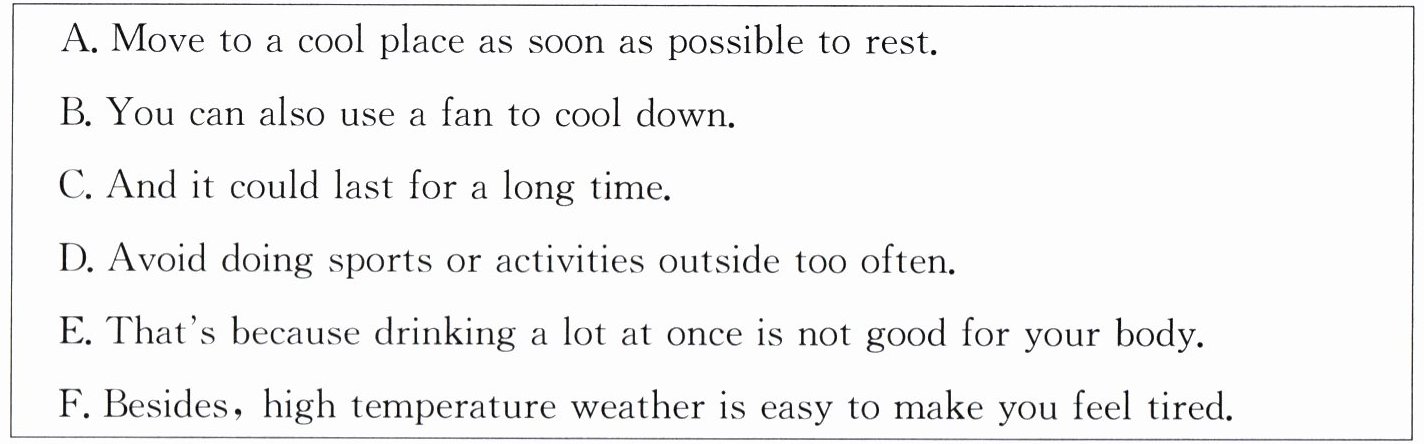
阅读短文,从所列选项中,选出最佳选项填入对应空白处,使短文通顺、连贯。(选项中有一项多余)
In the hot summer, the temperature sometimes can go up to $40° \mathrm{C}$. 31.
C
Then you may wonder what you should do.Drink Enough Water
In hot weather, our bodies lose water and salt quickly through sweat(出汗). So it is necessary to drink more water with some salt or choose sports drinks. Try to drink at least 1,500~2,000 ml of water every day and take small sips(小口喝). 32.
E
Eat Well and Rest Enough
Summer diet should be light. Eat more fruit and vegetables that are rich in water. Do not eat too much oily or heavy food. It will make your body work too hard. 33.
F
So it's important to rest well and get enough sleep.Take Fewer Trips Outside
34.
D
If you need to go out, try to avoid going out during high temperatures. Also, try to stay outside for a short time. Another thing is to wear lightweight, light-coloured clothing when going outside.Take Care of Your Health
If you have a headache, and you feel very tired and thirsty, or sweat a lot, you may have heatstroke(中暑). 35.
A
If you still feel bad, see a doctor quickly.答案
31. C
32. E
33. F
34. D
35. A
32. E
33. F
34. D
35. A
解析
【分析】
本题为英语阅读理解七选五题型,需结合上下文语境、句子间的逻辑关系(如因果、承接、解释等)选择合适选项。解题思路为:先通读全文把握段落主题,再逐一分析空白处前后文内容,匹配符合逻辑衔接的句子,同时排除多余选项。
【解析】
1. 第31空:前文提到夏季气温可达40℃,后文说“然后你可能会想该做什么”,选项C中“it”指代前文的高温,说明高温持续时间长,才引发后续疑问,故31选C。
2. 第32空:前文建议“小口喝水”,选项E解释了要小口喝水的原因,与前文形成因果关系,故32选E。
3. 第33空:前文提到“不要吃太油的食物会让身体太累”,后文说“休息好很重要”,选项F承接前文的“身体累”,说明高温易让人疲劳,引出休息的必要性,故33选F。
4. 第34空:本段小标题为“少外出”,选项D“避免频繁进行户外体育活动”符合少外出的主题,故34选D。
5. 第35空:前文提到中暑症状,后文说“仍不舒服要尽快看医生”,选项A“尽快转移到凉爽的地方休息”是中暑后的紧急处理措施,符合语境,故35选A。
【答案】
31. C 32. E 33. F 34. D 35. A
【知识点】
英语阅读理解,七选五题型,上下文逻辑衔接
【点评】
本题考查学生对语篇逻辑和上下文衔接的理解能力,需结合段落主题、句子间逻辑关系推理判断,难度适中。
【难度系数】
0.6
三、短文填空(共10小题,每小题1分,满分10分)
阅读短文,从方框中选出恰当的单词并用其适当形式填空,使短文通顺、意义完整。每空仅填一词,每词仅用一次。
allow in easily fast warmth after hero impossible reach speed
The film The Litchi Road tells a story from the Tang Dynasty:Li Shande tried his best to send lychees from Lingnan to Chang'an. 36.
But today, things are very different. Lychees picked in Zhanjiang can 37.
Long ago, China had smart delivery(智能配送)ideas. During the Spring and Autumn Period, there was a “transfer station(中转站)”. By the Tang Dynasty, there were over a thousand post stations across the country. This system 40.
Today, delivery workers are 41.
With technology, people can get their things much more 43.
From horses to robots, China's delivery has grown for thousands of years. This is not just 45.
阅读短文,从方框中选出恰当的单词并用其适当形式填空,使短文通顺、意义完整。每空仅填一词,每词仅用一次。
allow in easily fast warmth after hero impossible reach speed
The film The Litchi Road tells a story from the Tang Dynasty:Li Shande tried his best to send lychees from Lingnan to Chang'an. 36.
After
travelling 2,300 km to Chang'an in 11 days, fresh lychees were brought to the emperor. It was very hard work!But today, things are very different. Lychees picked in Zhanjiang can 37.
reach
Xi'an in 5 hours by high-speed train. What's more, 38. in
just 48 hours, they can be sent to the whole world. It was once a(n) 39. impossible
task. But it is now a simple click on a smartphone.Long ago, China had smart delivery(智能配送)ideas. During the Spring and Autumn Period, there was a “transfer station(中转站)”. By the Tang Dynasty, there were over a thousand post stations across the country. This system 40.
allowed
messages to travel from the border to the capital in just a day or two days.Today, delivery workers are 41.
heroes
. They go through the streets and make sure every package is sent on time. What truly touches people's hearts about delivery is never the speed, but the 42. warmth
hidden inside the packages(包裹).With technology, people can get their things much more 43.
easily
. In 2020, Zhejiang University used delivery robots first in the world. It is not only 44. faster
but also good for the environment.From horses to robots, China's delivery has grown for thousands of years. This is not just 45.
speed
. It is a nation's pride in solving hard tasks with wisdom, hard work and technology.答案
36. After
37. reach
38. in
39. impossible
40. allowed
41. heroes
42. warmth
43. easily
44. faster
45. speed
37. reach
38. in
39. impossible
40. allowed
41. heroes
42. warmth
43. easily
44. faster
45. speed
解析
【分析】首先通读短文,理解文章主旨是介绍中国配送业从古代到现代的发展历程,体现国家的进步。解题思路为:1. 明确方框内单词的含义及词性;2. 结合每个空格的前后语境、语法结构(如介词搭配、情态动词后接原形、时态、单复数等),选择恰当的单词并调整适当形式;3. 验证所填单词是否使短文通顺、符合逻辑。
【解析】
36. 空格后是动名词travelling,结合语境“在11天旅行到长安之后”,需用介词after构成“after doing sth”结构,故填After。
37. 情态动词can后接动词原形,根据“到达西安”的语境,选动词reach,故填reach。
38. 表示“在48小时内”,用“in + 时间段”结构,符合语境,故填in。
39. 后文提到现在是简单的操作,可知过去是“不可能的”任务,选形容词impossible,故填impossible。
40. 句子描述古代驿站系统的作用,时态为一般过去时,动词allow的过去式为allowed,意为“允许”,符合语境,故填allowed。
41. 主语delivery workers是复数,需用名词hero的复数形式heroes,意为“英雄们”,故填heroes。
42. 句意为“触动人心的是包裹里的温暖”,需用名词warmth,故填warmth。
43. 修饰动词get需用副词,选副词easily,意为“容易地”,符合语境,故填easily。
44. 与过去对比,现在的配送更快,用fast的比较级faster,故填faster。
45. 结合语境“这不仅仅是速度”,选名词speed,故填speed。
【答案】36. After 37. reach 38. in 39. impossible 40. allowed 41. heroes 42. warmth 43. easily 44. faster 45. speed
【知识点】介词用法、动词形式变化、语境词义辨析
【点评】本题为短文填空题型,考查词汇在具体语境中的运用,要求学生既能理解文章大意,又能掌握词汇的词性、形式变化及语法搭配,注重语境理解与语言运用能力的结合。
【难度系数】0.7
