

 登录
C
Can you imagine a paralysed (瘫痪的) patient controlling a power wheelchair only with his thoughts? And can you imagine him directing a robotic dog to pick up food deliveries? This is not a scene from a sci-fi film. It is a huge step forward that comes from Chinese scientists’ recent clinical trials of an invasive brain-computer interface (BCI) (侵入式脑机接口).
The patient became paralysed after a fall in 2022. In June 2025, he got a BCI system. This system was made by the Centre for Excellence in Brain Science and Intelligence Technology under the CAS. After a few weeks of training, he could control a computer cursor (光标) and a tablet (平板电脑) without difficulty.
To help the patient interact (互动) with the world better, the researchers added new technologies. They successfully made the BCI system work not only on a 2D screen but also in the real 3D world. For example, the patient could use his thoughts to control a wheelchair and a robotic dog rather than only moving a cursor on a computer screen. This was a new step in technological progress. It helped the brain signals move beyond a 2D screen and interact directly with the real 3D world.
An invasive BCI system has two parts: a front-end sensor and a back-end processor. The front-end sensor is a very thin thread. It is only $\frac{1}{100}$ as thick as a human hair. 5 to 8 millimetres of it is put into the brain. The back-end processor is as big as a coin. It is placed in a small hollow in the skull (颅骨). Experts say the front-end sensor is like a network cable, connecting the brain to the outside world to send and receive information. The back-end processor turns the brain’s weak signals into computer instructions. In this way, paralysed patients can use their thoughts to control external devices and live better lives.
The BCI system used in this trial was developed completely by Chinese researchers and partners. It shows China’s growing strength in high technology. We believe China will continue to lead the world in technology development.
( ) 28. Why does the writer mention the scene at the beginning of the passage?
A. To show the purpose of BCI.
B. To lead into the topic of BCI.
C. To explain the patient’s thoughts.
D. To describe a sci-fi film scene.
(
A. Click an icon on the smartphone.
B. Type English words on a tablet.
C. Move a cursor on a computer screen.
D. Pour water from a cup and drink it.
(
A. How the invasive brain-computer interface works.
B. How the invasive brain-computer interface improves.
C. How the invasive brain-computer interface is tested.
D. How the invasive brain-computer interface is created.
(
D
Can you imagine a paralysed (瘫痪的) patient controlling a power wheelchair only with his thoughts? And can you imagine him directing a robotic dog to pick up food deliveries? This is not a scene from a sci-fi film. It is a huge step forward that comes from Chinese scientists’ recent clinical trials of an invasive brain-computer interface (BCI) (侵入式脑机接口).
The patient became paralysed after a fall in 2022. In June 2025, he got a BCI system. This system was made by the Centre for Excellence in Brain Science and Intelligence Technology under the CAS. After a few weeks of training, he could control a computer cursor (光标) and a tablet (平板电脑) without difficulty.
To help the patient interact (互动) with the world better, the researchers added new technologies. They successfully made the BCI system work not only on a 2D screen but also in the real 3D world. For example, the patient could use his thoughts to control a wheelchair and a robotic dog rather than only moving a cursor on a computer screen. This was a new step in technological progress. It helped the brain signals move beyond a 2D screen and interact directly with the real 3D world.
An invasive BCI system has two parts: a front-end sensor and a back-end processor. The front-end sensor is a very thin thread. It is only $\frac{1}{100}$ as thick as a human hair. 5 to 8 millimetres of it is put into the brain. The back-end processor is as big as a coin. It is placed in a small hollow in the skull (颅骨). Experts say the front-end sensor is like a network cable, connecting the brain to the outside world to send and receive information. The back-end processor turns the brain’s weak signals into computer instructions. In this way, paralysed patients can use their thoughts to control external devices and live better lives.
The BCI system used in this trial was developed completely by Chinese researchers and partners. It shows China’s growing strength in high technology. We believe China will continue to lead the world in technology development.
( ) 28. Why does the writer mention the scene at the beginning of the passage?
A. To show the purpose of BCI.
B. To lead into the topic of BCI.
C. To explain the patient’s thoughts.
D. To describe a sci-fi film scene.
(
D
) 29. Which of the following activities is an example of 3D interaction with the world?A. Click an icon on the smartphone.
B. Type English words on a tablet.
C. Move a cursor on a computer screen.
D. Pour water from a cup and drink it.
(
A
) 30. What does paragraph 4 mainly talk about?A. How the invasive brain-computer interface works.
B. How the invasive brain-computer interface improves.
C. How the invasive brain-computer interface is tested.
D. How the invasive brain-computer interface is created.
(
B
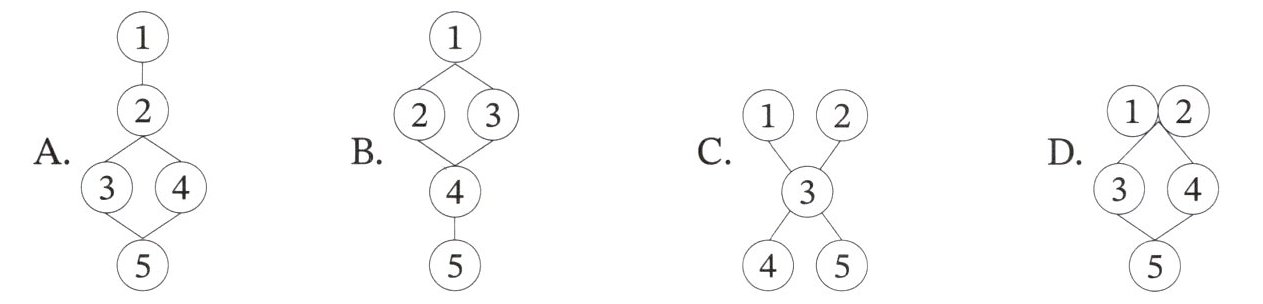
) 31. Which of the following best shows the structure of the passage?D
答案
28. B 29. D 30. A 31. B
解析
【分析】
本题为科技类阅读理解题,需结合文章内容逐一分析各题:
1. 第28题:考查开头场景的写作意图,英语阅读中开头的具体场景通常用于引出文章核心话题,需排除干扰选项;
2. 第29题:考查细节理解,需定位文章中“3D世界互动”的描述,区分2D屏幕操作与真实3D动作;
3. 第30题:考查段落主旨,需梳理第四段的核心内容,判断其是否围绕BCI的工作原理展开;
4. 第31题:考查文章结构,需分析各段落的逻辑关系,匹配对应的结构选项。
【解析】
1. 第28题:文章开头用瘫痪病人用脑控轮椅、机器狗的场景,目的是引出下文关于侵入式脑机接口(BCI)的临床试验这一核心话题,A选项“展示BCI的目的”、C选项“解释病人的想法”、D选项“描述科幻场景”均不符合,故选B。
2. 第29题:根据第三段“不仅在2D屏幕,还在真实3D世界”的描述,A(点击图标)、B(平板打字)、C(移动光标)均为2D屏幕上的操作,D(倒水喝)是真实3D世界的互动动作,故选D。
3. 第30题:第四段介绍侵入式BCI的两个组成部分(前端传感器、后端处理器),以及二者如何将脑信号转化为外部设备指令,核心是说明BCI的工作原理,B(改进)、C(测试)、D(创造)均不符合,故选A。
4. 第31题:文章结构为:①段引出BCI话题;②段介绍病人与BCI的基本情况;③段说明3D互动的进展;④段讲解BCI的工作原理;⑤段总结中国科技实力,对应选项B的结构,故选B。
【答案】
28.B 29.D 30.A 31.B
【知识点】
阅读理解,细节理解,主旨大意
【点评】
本文为科技说明文,围绕侵入式脑机接口展开,考查学生对文章细节、写作意图、段落主旨及整体结构的理解,需学生具备快速定位信息、梳理逻辑的能力,难度适中。
【难度系数】
0.6
