

 登录
登录
Ⅳ.选择恰当的句子补全短文,其中有一项多余。
Lots of people learn English by watching movies. 1.
Step 1: Watch a movie with subtitles(字幕) for the first time. 2.
Step 2: 3.
Step 3: 4.
5.
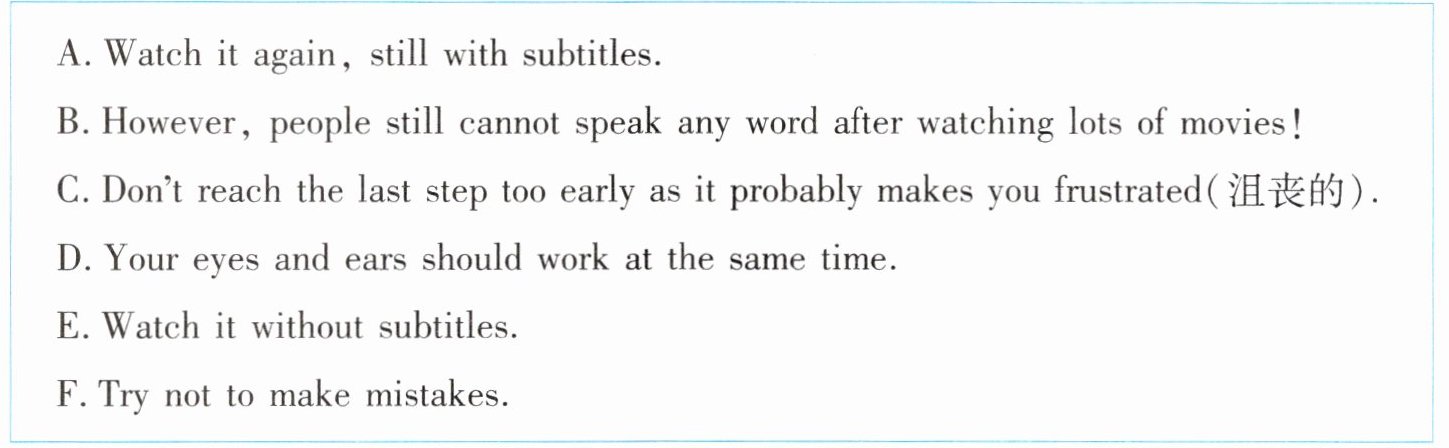
Lots of people learn English by watching movies. 1.
B
The point is that they haven't watched movies in the right ways. If you want to learn English by watching movies, you'd better follow the following steps, or you may waste your time and learn nothing.Step 1: Watch a movie with subtitles(字幕) for the first time. 2.
D
And try to remember the main idea of the movie.Step 2: 3.
A
But try your best to see the subtitles less often, and listen as much as you can. Look at the subtitles quickly only when you really don't understand.Step 3: 4.
E
It sounds difficult. But believe me, after enough practice during the first two steps, you will find it easier.5.
C
However, if you reach it when you are ready, you may find that English is just a piece of cake for you.答案
1. B 2. D 3. A 4. E 5. C
解析
【分析】本题为英语补全短文题,需结合上下文语境、逻辑关系及段落结构选择合适句子。首先通读全文,明确大意:很多人尝试通过看电影学英语却没效果,原因是方法不当,文章给出了三个学习步骤。第1空需承接前文“很多人看电影学英语”并转折引出“方法不对”的原因;第2空对应第一步带字幕看电影的状态;第3空对应第二步的操作;第4空对应第三步的要求;第5空需引出最后一步的注意事项。
【解析】1. 第1空:前文提到很多人通过看电影学英语,后文指出他们没选对方法,B选项“然而,人们看了很多电影还是不会说任何单词”符合转折逻辑,故选B;2. 第2空:第一步是带字幕看电影,D选项“你的眼睛和耳朵应该同时工作”契合带字幕观看时视听结合的状态,故选D;3. 第3空:第二步要求少看字幕,A选项“再看一次,还是带字幕”符合步骤递进(从第一次带字幕到第二次仍带字幕但减少看字幕频率),故选A;4. 第4空:第三步应是脱离字幕练习,E选项“不带字幕看”符合要求,故选E;5. 第5空:后文提到“准备好再到最后一步”,C选项“不要太早到最后一步,因为可能会让你沮丧”与之呼应,故选C。
【答案】1.B 2.D 3.A 4.E 5.C
【知识点】英语补全短文、语境理解
【点评】本题考查英语阅读理解中的句子还原能力,需梳理段落逻辑和步骤顺序,结合上下文匹配句子,难度适中,是常见的英语题型。
【难度系数】0.5
【解析】1. 第1空:前文提到很多人通过看电影学英语,后文指出他们没选对方法,B选项“然而,人们看了很多电影还是不会说任何单词”符合转折逻辑,故选B;2. 第2空:第一步是带字幕看电影,D选项“你的眼睛和耳朵应该同时工作”契合带字幕观看时视听结合的状态,故选D;3. 第3空:第二步要求少看字幕,A选项“再看一次,还是带字幕”符合步骤递进(从第一次带字幕到第二次仍带字幕但减少看字幕频率),故选A;4. 第4空:第三步应是脱离字幕练习,E选项“不带字幕看”符合要求,故选E;5. 第5空:后文提到“准备好再到最后一步”,C选项“不要太早到最后一步,因为可能会让你沮丧”与之呼应,故选C。
【答案】1.B 2.D 3.A 4.E 5.C
【知识点】英语补全短文、语境理解
【点评】本题考查英语阅读理解中的句子还原能力,需梳理段落逻辑和步骤顺序,结合上下文匹配句子,难度适中,是常见的英语题型。
【难度系数】0.5
Ⅴ. 阅读理解。
Everyone is born with the ability to learn. But whether or not you can do this well depends on your learning habits. Research shows that successful learners have some good habits in common.
Creating an interest in what they learn
Studies show that if you are interested in something, your brain is more active and it is also easier for you to pay attention to it for a long time. Good learners often connect what they need to learn with something they are interested in. For example, if they need to learn English and they like music or sport, they can listen to English songs or watch sports programmes in English. This way they will not get bored.
Practising and learning from mistakes
Good learners think about what they are good at and what they need to practise more. Remember, “Use it or lose it!” Even if you learn something well, you will forget it unless you use it. Practice makes perfect. Good learners are also not afraid of making mistakes. Alexander Graham
Bell did not invent the telephone overnight. He succeeded by trying many times and learning from his mistakes.
Developing their study skills
It is not enough to just study hard. You have to know how to study. Good learners find out the best ways to learn well. For example, they may take notes by writing down key words or by drawing mind maps. Good learners also look for ways to review what they have learned. They may do this by reading their notes every day or by explaining the information to another student.
Asking questions
Good learners often ask questions during or after class. They even ask each other and try to find out the answers. Knowledge comes from questioning.
Learning is a lifelong journey because every day brings something new. Everything that you learn becomes a part of you and changes you, so learn wisely and learn well.
(
A. Three. B. Four.
C. Two. D. Six.
(
A. By listing numbers.
B. By giving examples.
C. By answering questions.
D. By comparing different interests.
(
A. Good learners don’t need to study hard.
B. If you have learnt something, you will never forget it.
C. Good learners are not afraid of making mistakes.
D. Good learners use the same ways to gain knowledge.
(
A. Good Habits of Successful Learners
B. Developing an Interest in What You Learn
C. The Importance of Asking Questions
D. Some Important Study Skills
Everyone is born with the ability to learn. But whether or not you can do this well depends on your learning habits. Research shows that successful learners have some good habits in common.
Creating an interest in what they learn
Studies show that if you are interested in something, your brain is more active and it is also easier for you to pay attention to it for a long time. Good learners often connect what they need to learn with something they are interested in. For example, if they need to learn English and they like music or sport, they can listen to English songs or watch sports programmes in English. This way they will not get bored.
Practising and learning from mistakes
Good learners think about what they are good at and what they need to practise more. Remember, “Use it or lose it!” Even if you learn something well, you will forget it unless you use it. Practice makes perfect. Good learners are also not afraid of making mistakes. Alexander Graham
Bell did not invent the telephone overnight. He succeeded by trying many times and learning from his mistakes.
Developing their study skills
It is not enough to just study hard. You have to know how to study. Good learners find out the best ways to learn well. For example, they may take notes by writing down key words or by drawing mind maps. Good learners also look for ways to review what they have learned. They may do this by reading their notes every day or by explaining the information to another student.
Asking questions
Good learners often ask questions during or after class. They even ask each other and try to find out the answers. Knowledge comes from questioning.
Learning is a lifelong journey because every day brings something new. Everything that you learn becomes a part of you and changes you, so learn wisely and learn well.
(
B
)1. How many good habits are mentioned in the passage?A. Three. B. Four.
C. Two. D. Six.
(
B
)2. How does the writer explain that successful learners create an interest in what they learn?A. By listing numbers.
B. By giving examples.
C. By answering questions.
D. By comparing different interests.
(
C
)3. Which of the following statements is right according to the passage?A. Good learners don’t need to study hard.
B. If you have learnt something, you will never forget it.
C. Good learners are not afraid of making mistakes.
D. Good learners use the same ways to gain knowledge.
(
A
)4. What’s the best title for this passage?A. Good Habits of Successful Learners
B. Developing an Interest in What You Learn
C. The Importance of Asking Questions
D. Some Important Study Skills
答案
1. B 2. B 3. C 4. A
解析
【分析】
首先通读全文,明确文章核心是介绍成功学习者的4个共同好习惯。针对每道题,需定位原文对应内容:
1. 题1问提到的好习惯数量,需查找文中列出的习惯段落,统计数量后匹配选项;
2. 题2问作者解释培养兴趣的方法,需定位对应段落,分析论证方式;
3. 题3问判断正确陈述,需逐一核对选项与原文细节,排除错误项;
4. 题4问选最佳标题,需把握全文主旨,匹配核心内容。
【解析】
1. 题1:文中依次提到“培养学习兴趣”“练习并从错误中学习”“发展学习技能”“提问”共4个好习惯,故选B。
2. 题2:作者在阐述培养兴趣时,举例“学英语时结合音乐或运动(听英文歌、看英文体育节目)”论证,采用举例子的方法,故选B。
3. 题3:A项与原文“仅努力学习不够”矛盾;B项与原文“不用就会遗忘”矛盾;C项与原文“好学习者不怕犯错”一致;D项与原文“好学习者找最优学习方法”矛盾,故选C。
4. 题4:全文围绕“成功学习者的共同好习惯”展开,分4个习惯详细说明,A项贴合主旨;B、C仅为单段内容,D项表述片面,故选A。
【答案】
1. B 2. B 3. C 4. A
【知识点】
英语阅读理解、细节理解题、主旨大意题
【点评】
本题为英语阅读理解题,主要考查学生对文章细节信息的查找、判断及主旨归纳能力,题目难度适中,学生认真阅读原文、定位对应内容即可得出答案。
【难度系数】
0.7
首先通读全文,明确文章核心是介绍成功学习者的4个共同好习惯。针对每道题,需定位原文对应内容:
1. 题1问提到的好习惯数量,需查找文中列出的习惯段落,统计数量后匹配选项;
2. 题2问作者解释培养兴趣的方法,需定位对应段落,分析论证方式;
3. 题3问判断正确陈述,需逐一核对选项与原文细节,排除错误项;
4. 题4问选最佳标题,需把握全文主旨,匹配核心内容。
【解析】
1. 题1:文中依次提到“培养学习兴趣”“练习并从错误中学习”“发展学习技能”“提问”共4个好习惯,故选B。
2. 题2:作者在阐述培养兴趣时,举例“学英语时结合音乐或运动(听英文歌、看英文体育节目)”论证,采用举例子的方法,故选B。
3. 题3:A项与原文“仅努力学习不够”矛盾;B项与原文“不用就会遗忘”矛盾;C项与原文“好学习者不怕犯错”一致;D项与原文“好学习者找最优学习方法”矛盾,故选C。
4. 题4:全文围绕“成功学习者的共同好习惯”展开,分4个习惯详细说明,A项贴合主旨;B、C仅为单段内容,D项表述片面,故选A。
【答案】
1. B 2. B 3. C 4. A
【知识点】
英语阅读理解、细节理解题、主旨大意题
【点评】
本题为英语阅读理解题,主要考查学生对文章细节信息的查找、判断及主旨归纳能力,题目难度适中,学生认真阅读原文、定位对应内容即可得出答案。
【难度系数】
0.7
