

 登录
登录
二、读一读,从方框中选择合适的单词或短语补全对话。
pocket money spend twenty save crayons share plan buy money
A: How much 1.
B: I get 2.
A: What do you do with your pocket money?
B: I 3.
A: That's great! 8.
B: Yes! I think we should make a good 9.
pocket money spend twenty save crayons share plan buy money
A: How much 1.
pocket money
do you get every week?B: I get 2.
twenty
yuan every week.A: What do you do with your pocket money?
B: I 3.
spend
some to 4. buy
food and 5. crayons
. I 6. save
some in my piggy bank. And I 7. share
some with people in need.A: That's great! 8.
Money
isn't everything, but it can help others.B: Yes! I think we should make a good 9.
plan
for our money.答案
1. pocket money
2. twenty
3. spend
4. buy
5. crayons
6. save
7. share
8. Money
9. plan
2. twenty
3. spend
4. buy
5. crayons
6. save
7. share
8. Money
9. plan
解析
【分析】
这是一道选词补全对话题,需围绕“零花钱使用”的话题,结合句子语义、语法规则及固定搭配,从方框给定的单词/短语中选择合适内容填空。先通读对话明确核心话题,再逐个分析每个空的语境,匹配对应词汇。
【解析】
1. 问句中“How much”修饰不可数名词,结合答句的“pocket money”,可知问的是每周的零花钱,故填pocket money;
2. 此处需回答数量,方框中“twenty”符合语境,故填twenty;
3. 问句询问零花钱的用途,此处表示“花费”的动作,故填spend;
4. “spend...to do sth”是固定结构,此处表示买食物,故填buy;
5. 与“food”并列的物品,方框中“crayons”符合语境,故填crayons;
6. “in my piggy bank”对应“储蓄”的动作,故填save;
7. “share sth with sb”是固定搭配,意为“和某人分享某物”,符合语境,故填share;
8. 句子表达“钱不是一切”,故填Money;
9. “make a plan”是固定短语,意为“做计划”,故填plan。
【答案】
1. pocket money 2. twenty 3. spend 4. buy 5. crayons 6. save 7. share 8. Money 9. plan
【知识点】
英语选词填空、词汇运用、固定搭配
【点评】
本题围绕日常零花钱的话题,考查学生对词汇在语境中的理解与运用,题型基础贴近生活,有助于学生掌握日常话题的英语表达。
【难度系数】
0.6
这是一道选词补全对话题,需围绕“零花钱使用”的话题,结合句子语义、语法规则及固定搭配,从方框给定的单词/短语中选择合适内容填空。先通读对话明确核心话题,再逐个分析每个空的语境,匹配对应词汇。
【解析】
1. 问句中“How much”修饰不可数名词,结合答句的“pocket money”,可知问的是每周的零花钱,故填pocket money;
2. 此处需回答数量,方框中“twenty”符合语境,故填twenty;
3. 问句询问零花钱的用途,此处表示“花费”的动作,故填spend;
4. “spend...to do sth”是固定结构,此处表示买食物,故填buy;
5. 与“food”并列的物品,方框中“crayons”符合语境,故填crayons;
6. “in my piggy bank”对应“储蓄”的动作,故填save;
7. “share sth with sb”是固定搭配,意为“和某人分享某物”,符合语境,故填share;
8. 句子表达“钱不是一切”,故填Money;
9. “make a plan”是固定短语,意为“做计划”,故填plan。
【答案】
1. pocket money 2. twenty 3. spend 4. buy 5. crayons 6. save 7. share 8. Money 9. plan
【知识点】
英语选词填空、词汇运用、固定搭配
【点评】
本题围绕日常零花钱的话题,考查学生对词汇在语境中的理解与运用,题型基础贴近生活,有助于学生掌握日常话题的英语表达。
【难度系数】
0.6
三、读一读,完成练习。
(一)读一读,选出正确答案。
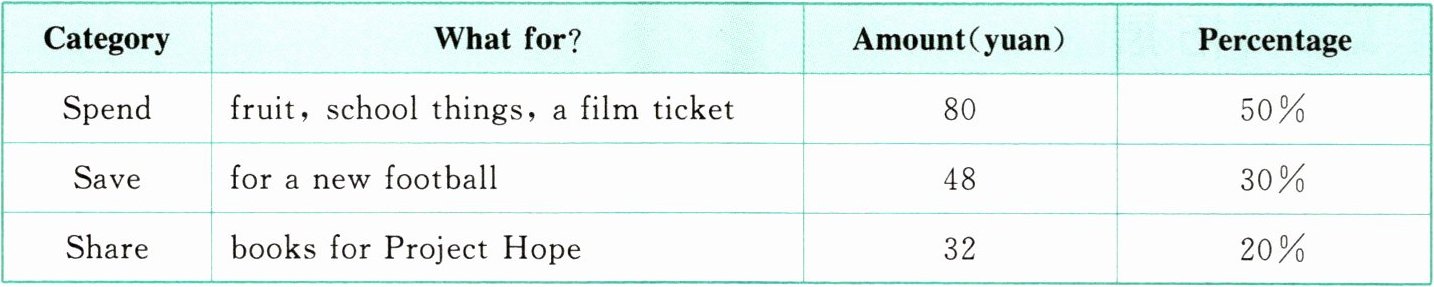
Lily’s monthly pocket money plan
(
A. 80 yuan. B. 160 yuan. C. 200 yuan.
(
A. 20%. B. 30%. C. 50%.
(
A. 32 yuan. B. 48 yuan. C. 80 yuan.
(
A. Fruit. B. A film ticket. C. Video games.
(
A. help poor children
B. buy a football
C. buy some fruit
(二)读一读,判断句子正(√)误(×)。
In China, people use renminbi (RMB) in daily life. There are two kinds: coins and paper money. We have 1-jiao, 5-jiao and 1-yuan coins. For paper money, there are 5-yuan, 10-yuan, 20-yuan, 50-yuan and 100-yuan notes. Renminbi helps us buy food, books and many other things.
Now, with the development of technology, we also have electronic money(电子货币). We don’t need to take cash(现金) with us. We can use our phones to pay for things, like WeChat Pay and Alipay. They are fast and convenient(方便的). Renminbi is still important, but electronic money makes our life easier.
(
(
(
(
(
(一)读一读,选出正确答案。
Lily’s monthly pocket money plan
(
B
)1. How much pocket money does Lily get every month?A. 80 yuan. B. 160 yuan. C. 200 yuan.
(
B
)2. What percentage of her money does Lily save?A. 20%. B. 30%. C. 50%.
(
A
)3. How much money does Lily use for sharing?A. 32 yuan. B. 48 yuan. C. 80 yuan.
(
C
)4. What does Lily NOT spend her money on?A. Fruit. B. A film ticket. C. Video games.
(
A
)5. Lily shares money to .A. help poor children
B. buy a football
C. buy some fruit
(二)读一读,判断句子正(√)误(×)。
In China, people use renminbi (RMB) in daily life. There are two kinds: coins and paper money. We have 1-jiao, 5-jiao and 1-yuan coins. For paper money, there are 5-yuan, 10-yuan, 20-yuan, 50-yuan and 100-yuan notes. Renminbi helps us buy food, books and many other things.
Now, with the development of technology, we also have electronic money(电子货币). We don’t need to take cash(现金) with us. We can use our phones to pay for things, like WeChat Pay and Alipay. They are fast and convenient(方便的). Renminbi is still important, but electronic money makes our life easier.
(
×
)1. People in China only use coins and paper money now.(
√
)2. We have 5-yuan, 10-yuan, 20-yuan, 50-yuan and 100-yuan notes.(
×
)3. When we use WeChat Pay, we need to take cash.(
×
)4. Electronic money makes our life more difficult.(
√
)5. The passage mainly tells us about renminbi and electronic payment.答案
(一)1. B
2. B
3. A
4. C
5. A
(二)1. ×
2. √
3. ×
4. ×
5. √
2. B
3. A
4. C
5. A
(二)1. ×
2. √
3. ×
4. ×
5. √
解析
【分析】
本题分为两部分,第一部分是选择题,需结合表格中的金额和百分比信息,通过计算或直接提取对应数据完成选择;第二部分是判断题,需仔细阅读短文内容,对比题目描述判断正误。解题时要找准表格和短文中的关键信息,避免混淆不同类别对应的内容。
【解析】
(一)选择题:
1. 已知Lily花费的金额为80元,占总零花钱的50%,总零花钱=80÷50%=160元,故选B。
2. 表格中“Save”对应的百分比为30%,即Lily储蓄的钱占总钱数的30%,故选B。
3. 表格中“Share”对应的金额为32元,即Lily用于分享的钱是32元,故选A。
4. 表格中“Spend”的用途是fruit、school things、a film ticket,未提及video games,故选C。
5. 表格中“Share”的用途是books for Project Hope,Project Hope是帮助贫困孩子的项目,故选A。
(二)判断题:
1. 短文提到现在有电子货币,并非只使用硬币和纸币,故打×。
2. 短文明确说明纸币有5-yuan、10-yuan、20-yuan、50-yuan和100-yuan notes,故打√。
3. 短文提到使用微信支付不需要带现金,故打×。
4. 短文提到电子货币让生活更方便,而非更困难,故打×。
5. 短文前半部分讲人民币,后半部分讲电子货币,主要内容是人民币和电子支付,故打√。
【答案】
(一)1.B 2.B 3.A 4.C 5.A
(二)1.× 2.√ 3.× 4.× 5.√
【知识点】
英语阅读理解、信息提取、数据计算
【点评】
本题结合表格和短文考察英语阅读的信息处理能力,第一部分侧重数据计算和信息匹配,第二部分侧重细节判断,整体难度适中,需要学生仔细核对原文信息。
【难度系数】
0.6
本题分为两部分,第一部分是选择题,需结合表格中的金额和百分比信息,通过计算或直接提取对应数据完成选择;第二部分是判断题,需仔细阅读短文内容,对比题目描述判断正误。解题时要找准表格和短文中的关键信息,避免混淆不同类别对应的内容。
【解析】
(一)选择题:
1. 已知Lily花费的金额为80元,占总零花钱的50%,总零花钱=80÷50%=160元,故选B。
2. 表格中“Save”对应的百分比为30%,即Lily储蓄的钱占总钱数的30%,故选B。
3. 表格中“Share”对应的金额为32元,即Lily用于分享的钱是32元,故选A。
4. 表格中“Spend”的用途是fruit、school things、a film ticket,未提及video games,故选C。
5. 表格中“Share”的用途是books for Project Hope,Project Hope是帮助贫困孩子的项目,故选A。
(二)判断题:
1. 短文提到现在有电子货币,并非只使用硬币和纸币,故打×。
2. 短文明确说明纸币有5-yuan、10-yuan、20-yuan、50-yuan和100-yuan notes,故打√。
3. 短文提到使用微信支付不需要带现金,故打×。
4. 短文提到电子货币让生活更方便,而非更困难,故打×。
5. 短文前半部分讲人民币,后半部分讲电子货币,主要内容是人民币和电子支付,故打√。
【答案】
(一)1.B 2.B 3.A 4.C 5.A
(二)1.× 2.√ 3.× 4.× 5.√
【知识点】
英语阅读理解、信息提取、数据计算
【点评】
本题结合表格和短文考察英语阅读的信息处理能力,第一部分侧重数据计算和信息匹配,第二部分侧重细节判断,整体难度适中,需要学生仔细核对原文信息。
【难度系数】
0.6
