

 登录
[2025 海南中考]
Chinglish takes flight
“You swan, he frog.” This sentence might sound funny in English. But it is lively! Both Chinese and foreigners can understand and enjoy it. It is an example of Chinglish.
So, what is Chinglish? It is a mix of Chinese and English. Now, it is quite popular outside China. It all started when a foreign girl put a sad photo online. It seemed that her boyfriend had made her cry. Some nice Chinese people created some funny Chinglish, such as “You swan, he frog” to cheer her up. The expression(表达) comes from a famous old Chinese story. It’s about a beautiful swan and an ugly toad(癞蛤蟆).
Many foreigners found it cool. They shared it a lot online and made funny pictures with it. Some of them got interested in the Chinese stories behind Chinglish.
“It’s great that more Chinese culture is being shared with the rest of the world,” said Cody, a young man from New Zealand. “It helps a lot to understand Chinese culture better.”
More and more people are finding the fun in Chinglish. This is great! But for young English learners like us, it’s still important to use proper English, especially in tests and at formal events(正式场合). Standard English helps people understand each other more clearly. Different situations call for different ways.
Chinglish serves as a fun bridge connecting two cultures, but we must know when to cross the bridge and when to stay in the “main road” of standard English. After all, being able to use Chinglish properly and also communicate well in standard English makes you a true language user!
Task Ⅰ: Finish the chart according to the article. Fill in each blank with no more than 3 words.
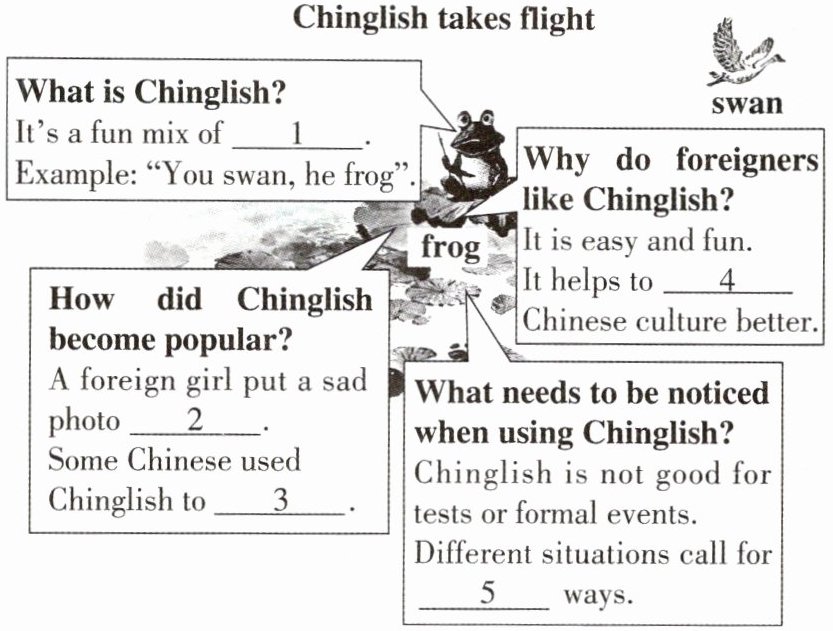
1.
2.
3.
4.
5.
Task Ⅱ: Answer the following questions.
6. Where does the expression “You swan, he frog” come from?
7. According to the passage, what makes you a true language user?
8. Will you use Chinglish if you talk online with an English friend about your summer plan? Explain your reason(s) in about 20 words.
Chinglish takes flight
“You swan, he frog.” This sentence might sound funny in English. But it is lively! Both Chinese and foreigners can understand and enjoy it. It is an example of Chinglish.
So, what is Chinglish? It is a mix of Chinese and English. Now, it is quite popular outside China. It all started when a foreign girl put a sad photo online. It seemed that her boyfriend had made her cry. Some nice Chinese people created some funny Chinglish, such as “You swan, he frog” to cheer her up. The expression(表达) comes from a famous old Chinese story. It’s about a beautiful swan and an ugly toad(癞蛤蟆).
Many foreigners found it cool. They shared it a lot online and made funny pictures with it. Some of them got interested in the Chinese stories behind Chinglish.
“It’s great that more Chinese culture is being shared with the rest of the world,” said Cody, a young man from New Zealand. “It helps a lot to understand Chinese culture better.”
More and more people are finding the fun in Chinglish. This is great! But for young English learners like us, it’s still important to use proper English, especially in tests and at formal events(正式场合). Standard English helps people understand each other more clearly. Different situations call for different ways.
Chinglish serves as a fun bridge connecting two cultures, but we must know when to cross the bridge and when to stay in the “main road” of standard English. After all, being able to use Chinglish properly and also communicate well in standard English makes you a true language user!
Task Ⅰ: Finish the chart according to the article. Fill in each blank with no more than 3 words.
1.
Chinese and English
2.
online
3.
cheer her up
4.
understand
5.
different
Task Ⅱ: Answer the following questions.
6. Where does the expression “You swan, he frog” come from?
It comes from a famous old Chinese story.
7. According to the passage, what makes you a true language user?
Being able to use Chinglish properly and also communicate well in standard English.
8. Will you use Chinglish if you talk online with an English friend about your summer plan? Explain your reason(s) in about 20 words.
Yes. Because it can be fun and help share Chinese culture, as long as the friend understands.
答案
1. Chinese and English 根据“It is a mix of Chinese and English.”可知答案。
2. online 根据“It all started when a foreign girl put a sad photo online.”可知,一个外国女孩把悲伤的照片放到了网上。
3. cheer her up 根据“Some nice Chinese people created some funny Chinglish, such as ‘You swan, he frog’ to cheer her up.”可知,一些中国人用中式英语让她振作起来。
温馨提示
patient 作名词时意为“病人”;作形容词意为“有耐心的”,此时其名词形式为patience,意为“耐心”。
知识拓展
be covered with 被……覆盖
4. understand 根据“It helps a lot to understand Chinese culture better.”可知,它有助于更好地理解中国文化。
5. different 根据“Different situations call for different ways.”可知,不同情况需要不同的方式。
6. It comes from a famous old Chinese story. 根据“The expression comes from a famous old Chinese story.”可知,这一表达来自一个著名的中国古老故事。
7. Being able to use Chinglish properly and also communicate well in standard English. 根据“After all, being able to use Chinglish properly and also communicate well in standard English makes you a true language user!”可知,能正确使用中式英语且能用标准英语良好交流的人是真正的语言使用者。
8. Yes. Because it can be fun and help share Chinese culture, as long as the friend understands. 开放性试题,言之有理且无语法错误即可。
