

 登录
[2026 天津期中]A curious mind is like a key that can open the door to new knowledge and opportunities. It is the
When we are curious, we are eager to learn
Take Thomas Edison as an example. His curious mind made him interested
However, curiosity is not just about being interested in something. It also
In our daily lives, we should
(
(
(
(
(
(
(
(
(
(
情境2 B展区介绍了玛丽·居里等伟大的科学家的生平和成就。
任务二 阅读理解A(10分)
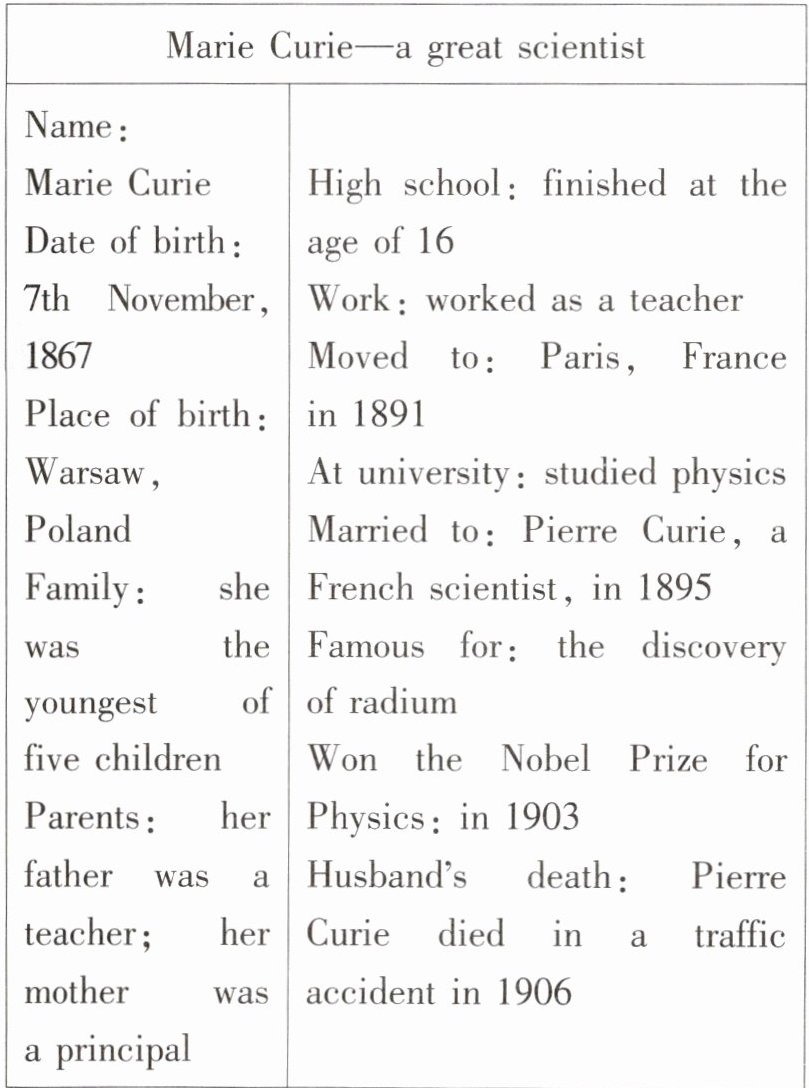
Won the Nobel Prize for Chemistry: in 1911
Date of death: 4th July, 1934, aged 67
(
A. In 1883. B. In 1891. C. In 1895.
(
A. 24. B. 25. C. 26.
(
A. One. B. Two. C. Three.
(
A. A science professor.
B. A French scientist.
C. The discovery of radium.
(
A. Tourism & Economy.
B. History & Society.
C. Health & Medicine.
情境3 C展区给我们展示了北京大学研究人员开发的一种名为 ThermoFace 的新型工具,该工具通过分析人脸不同部位的温度来评估人的年龄和健康状况。
A
1 that drives people to explore the unknown, ask questions, and seek answers.When we are curious, we are eager to learn
C
2 about the things that interest us. This curiosity can lead us to read books, A
3 experiments, or have discussions with others. It makes learning interesting and D
4.Take Thomas Edison as an example. His curious mind made him interested
B
5 everything around him. He asked questions like “Why does this work?” and “How can I make it better?” These questions A
6 him to invent many important things, such as the light bulb.However, curiosity is not just about being interested in something. It also
A
7 having the courage to take risks and try new things. Sometimes, the answers we seek (寻求) may not be easy to find, and we may A
8 many difficulties. But with a curious mind, we will not give up easily.In our daily lives, we should
A
9 our curiosity. We can start D
10 asking more questions, being open-minded, and taking on new experiences. A curious mind can bring us a more colourful and meaningful life.(
A
)1. A. power B. fear C. invention D. failure(
C
)2. A. little B. less C. more D. few(
A
)3. A. do B. look C. take D. carry(
D
)4. A. tiring B. boring C. surprising D. exciting(
B
)5. A. to B. in C. of D. for(
A
)6. A. led B. made C. let D. had(
A
)7. A. means B. shows C. tells D. says(
A
)8. A. face B. avoid C. create D. solve(
A
)9. A. develop B. grow C. burn D. rise(
D
)10. A. within B. at C. of D. by情境2 B展区介绍了玛丽·居里等伟大的科学家的生平和成就。
任务二 阅读理解A(10分)
Won the Nobel Prize for Chemistry: in 1911
Date of death: 4th July, 1934, aged 67
(
A
)11. When did Marie Curie finish high school?A. In 1883. B. In 1891. C. In 1895.
(
A
)12. How old was Marie Curie when she travelled to Paris?A. 24. B. 25. C. 26.
(
B
)13. How many Nobel Prizes did Marie Curie get in her whole life?A. One. B. Two. C. Three.
(
C
)14. What is Marie Curie famous for?A. A science professor.
B. A French scientist.
C. The discovery of radium.
(
B
)15. 新考法 文章出处 In which part of a newspaper can we find the passage?A. Tourism & Economy.
B. History & Society.
C. Health & Medicine.
情境3 C展区给我们展示了北京大学研究人员开发的一种名为 ThermoFace 的新型工具,该工具通过分析人脸不同部位的温度来评估人的年龄和健康状况。
答案
1. A 句意为:它是推动人们探索未知、提出问题并寻求答案的力量。power 意为“力量”,fear 意为“害怕”;invention 意为“发明”;failure 意为“失败”。根据语境,故选 A 项。
2. C 句意为:当我们有好奇心时,就会渴望了解更多让我们感兴趣的事物。little 意为“少量”;less 意为“更少”;more 意为“更多”;few 意为“很少”。根据语境可知,当我们好奇时,会渴望了解更多。故选 C 项。
3. A 句意为:这种好奇心会引导我们看书、做实验或与他人讨论。do 意为“做”;look 意为“看”;take 意为“拿走”;carry 意为“携带”。根据 experiments 可知,此处指“做实验”。故选 A 项。
4. D 句意为:它使学习(变得)有趣和令人兴奋。tiring 意为“令人疲惫的”;boring 意为“令人厌倦的”;surprising 意为“令人惊讶的”;exciting 意为“令人兴奋的”。根据句意和 interesting 可知选 D 项。
5. B 句意为:他的好奇心让他对周围的一切都充满了兴趣。“interested in...”意为“对……感兴趣”。故选 B 项。
6. A lead 意为“促使;导致”;make 意为“制作”;let 意为“让”;have 意为“有”。根据语境可知,这些问题促使他发明了许多重要的东西,lead sb to do sth 意为“促使某人做某事”,故选 A 项。
7. A mean 意为“意味着”;show 意为“展示”;tell 意为“告诉”;say 意为“说”。此处表示这也意味着要有勇气去冒险和尝试新事物。mean doing sth 意为“意味着做某事”,故选 A 项。
8. A 句意为:有时,我们寻求的答案可能并不容易找到,我们可能会面临许多困难。face 意为“面临”;avoid 意为“避免”;create 意为“创造”;solve 意为“解决”。根据“we may ... many difficulties”可知,此处表示我们可能面临许多困难。故选 A 项。
9. A 句意为:在日常生活中,我们应该培养自己的好奇心。develop 意为“培养”;grow 意为“成长”;burn 意为“燃烧”;rise 意为“上升”。根据“we should... our curiosity”可知,此处表示我们应培养好奇心。故选 A 项。
10. D 句意为:我们可以通过多问问题、开放心态和接受新体验开始。根据句意可知此处表示“通过”。故选 D 项。
11. A 细节理解题。根据“Date of birth: 7th November, 1867”以及“High school: finished at the age of 16”可知,她出生于 1867 年,16 岁中学毕业,即 1883 年。
12. A 细节理解题。根据“Date of birth: 7 November, 1867”以及“Moved to: Paris, France in 1891”可知,她出生于 1867 年,1891 年搬到了巴黎,当时 24 岁。
13. B 细节理解题。根据“Won the Nobel Prize for Physics: in 1903”以及“Won the Nobel Prize for Chemistry: in 1911”可知,她获得了两次诺贝尔奖。
14. C 细节理解题。根据“Famous for: the discovery of radium”,可知,她因为镭的发现而闻名。
15. B 推理判断题。本文主要介绍了一位伟大的科学家,故可能在报纸的“历史和社会”版块出现。
