

 登录
18. 如图,在$△ ABC$中,$∠ C=90°$,$AC=6\ \mathrm{cm}$,$BC=8\ \mathrm{cm}$,点$D$从点$C$开始沿边$CA$运动,速度为$1\ \mathrm{cm/s}$. 与此同时,点$E$从点$B$开始沿边$BC$运动,速度为$2\ \mathrm{cm/s}$. 当点$E$到达点$C$时,点$D$,$E$同时停止运动. 连接$AE$,$DE$,设运动时间为$t\ \mathrm{s}$.
(1) $CD=$
(2) 当$CD$为何值时,$S_{△ ADE}=\frac{5}{8}S_{△ ABC}$?
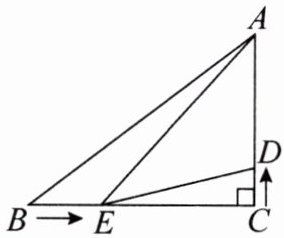
(1) $CD=$
$t$
$\mathrm{cm}$,$CE=$$8-2t$
$\mathrm{cm}$. (用含$t$的代数式表示)(2) 当$CD$为何值时,$S_{△ ADE}=\frac{5}{8}S_{△ ABC}$?
答案
18. 解:(1)$t$ $(8-2t)$
(2)$\because S_{△ ABC}=\frac{1}{2}×6×8=24(\mathrm{cm}^2)$,
$\therefore S_{△ ADE}=\frac{5}{8}S_{△ ABC}=15(\mathrm{cm}^2)$.
$\therefore \frac{1}{2}(6-t)(8-2t)=15$.
解方程,得 $t_1=1$,$t_2=9$.
$\because 0≤ t≤4$,$\therefore t=1$.
$\therefore$当$CD=1\ \mathrm{cm}$时,$S_{△ ADE}=\frac{5}{8}S_{△ ABC}$.
(2)$\because S_{△ ABC}=\frac{1}{2}×6×8=24(\mathrm{cm}^2)$,
$\therefore S_{△ ADE}=\frac{5}{8}S_{△ ABC}=15(\mathrm{cm}^2)$.
$\therefore \frac{1}{2}(6-t)(8-2t)=15$.
解方程,得 $t_1=1$,$t_2=9$.
$\because 0≤ t≤4$,$\therefore t=1$.
$\therefore$当$CD=1\ \mathrm{cm}$时,$S_{△ ADE}=\frac{5}{8}S_{△ ABC}$.
解析
【分析】
(1) 动点问题中线段长度可通过“路程=速度×时间”推导:点D从C出发速度为1cm/s,运动时间为t,故CD长度为速度乘时间即t cm;点E从B出发速度为2cm/s,故BE=2t cm,CE为BC总长度减去BE的长度,即(8-2t)cm,同时注意E到达C时运动停止,因此t的取值范围为0≤t≤4。
(2) 先计算△ABC的面积,再根据面积比例求出△ADE的面积;△ADE的底AD=AC-CD=(6-t)cm,由于∠C=90°,BC⊥AC,因此AD边上的高等于CE的长度,结合三角形面积公式列方程求解,最后根据t的取值范围舍去不符合实际的解即可得到CD的长度。
【解析】
(1) 点D运动速度为1cm/s,运动时间为t s,因此$CD = 1×t = t\ \mathrm{cm}$;
点E运动速度为2cm/s,运动时间为t s,因此$BE = 2t\ \mathrm{cm}$,$CE = BC - BE = (8 - 2t)\ \mathrm{cm}$。
(2) 计算$△ ABC$的面积:
$\because ∠ C=90°, AC=6\ \mathrm{cm}, BC=8\ \mathrm{cm}$
$\therefore S_{△ ABC}=\frac{1}{2}×AC×BC=\frac{1}{2}×6×8=24(\mathrm{cm}^2)$
结合题意得$S_{△ ADE}=\frac{5}{8}S_{△ ABC}=\frac{5}{8}×24=15(\mathrm{cm}^2)$
又$AD = AC - CD = (6 - t)\ \mathrm{cm}$,AD边上的高等于CE的长度,因此:
$\frac{1}{2}(6-t)(8-2t)=15$
整理得$t^2-10t+9=0$,解得$t_1=1$,$t_2=9$
$\because$点E到达C时运动停止,$2t≤8$即$0≤t≤4$,$\therefore t=9$舍去,得$t=1$,即$CD=1\ \mathrm{cm}$。
【答案】
(1) $t$;$8-2t$
(2) $1\ \mathrm{cm}$
【知识点】
动点线段表示,三角形面积计算,一元二次方程应用
【点评】
本题是动点与面积结合的基础综合题,解题核心是用运动时间正确表示相关线段长度,建立面积方程求解,同时要注意结合动点的运动范围对方程的解进行合理性检验。
【难度系数】
0.7
