

 登录
Roasted Stuffed Buns (烤包子)
This type of bun looks like a small, golden, square-shaped pillow (枕头), and there's mutton in it. The food shows the traditional lifestyle of Xinjiang people. They stay outside with their cattle and sheep all year, and they often take a knife with them. During lunch time, they would cut up mutton for making buns, and then cook them over a fire. Now, they start using clay ovens to cook the food.
1. How many pieces do people usually cut a lamb into?
2. Why do people use hands to eat Hand-grasped Mutton?
3. What's inside Roasted Stuffed Buns?
4. What does the Roasted Stuffed Bun show?
5. Do you think it's important for teenagers to learn how to make traditional foods? Why or why not?
This type of bun looks like a small, golden, square-shaped pillow (枕头), and there's mutton in it. The food shows the traditional lifestyle of Xinjiang people. They stay outside with their cattle and sheep all year, and they often take a knife with them. During lunch time, they would cut up mutton for making buns, and then cook them over a fire. Now, they start using clay ovens to cook the food.
1. How many pieces do people usually cut a lamb into?
12/Twelve.
2. Why do people use hands to eat Hand-grasped Mutton?
Because the pieces of meat are too big for them to hold by chopsticks.
3. What's inside Roasted Stuffed Buns?
There's mutton in it.
4. What does the Roasted Stuffed Bun show?
The food shows the traditional lifestyle of Xinjiang people.
5. Do you think it's important for teenagers to learn how to make traditional foods? Why or why not?
示例: Yes. Because they can learn about the traditional lifestyles of different places. / Because they will remember the history and tradition of their culture.
答案
1. 12/Twelve. 2. Because the pieces of meat are too big for them to hold by chopsticks. 3. There's mutton in it. 4. The food shows the traditional lifestyle of Xinjiang people. 5. 示例: Yes. Because they can learn about the traditional lifestyles of different places. / Because they will remember the history and tradition of their culture.
解析
【分析】
本题为英语阅读理解题,包含细节理解题与开放性试题。解题时,针对1-4题的细节题,需回到原文定位问题对应的关键信息,准确提取答案;第5题需结合自身认知,围绕学习传统食物制作的意义作答,言之有理即可。
【解析】
1. 对应细节题,结合相关常识及参考答案,答案为12/Twelve;
2. 结合文本背景与参考答案,原因是肉块太大无法用筷子夹住;
3. 从原文“This type of bun... there's mutton in it.”提取信息,答案为There's mutton in it;
4. 从原文“The food shows the traditional lifestyle of Xinjiang people.”直接提取;
5. 为开放性试题,可从了解传统文化、传承传统等角度作答,示例答案合理即可。
【答案】
1. 12/Twelve. 2. Because the pieces of meat are too big for them to hold by chopsticks. 3. There's mutton in it. 4. The food shows the traditional lifestyle of Xinjiang people. 5. 示例: Yes. Because they can learn about the traditional lifestyles of different places. / Because they will remember the history and tradition of their culture.
【知识点】
英语阅读理解,细节理解题,开放性试题
【点评】
本题考查学生的英语阅读细节提取能力与语言表达能力,话题贴近生活,难度适中,适合学生作答。
【难度系数】
0.7
Ⅵ. 写作指导
请以“My Favourite Dish”为题,介绍你最喜欢的一道菜肴,内容包括:
1. What's your favourite dish?
2. Why do you like this dish?
请以“My Favourite Dish”为题,介绍你最喜欢的一道菜肴,内容包括:
1. What's your favourite dish?
2. Why do you like this dish?
答案
My Favourite Dish
My favourite dish is scrambled eggs with tomatoes. It is a very popular home-style dish in China.
I love this dish so much for two main reasons. First, it tastes really great. The soft eggs and fresh sweet-sour tomatoes go well together, and its nice smell always makes me feel hungry. Second, my mother often cooks this dish for me at dinner. Every time I eat it, I can feel her warm love. This dish is also easy to make and full of nutrition, it is good for our health. I hope I can learn to cook this dish by myself one day.
解析
【分析】
本题为英语命题写作题,要求以“My Favourite Dish”为题,需涵盖两个核心要点:一是明确最喜欢的菜肴,二是说明喜欢该菜肴的原因。解题时需先确定具体菜肴(如常见的家常菜),再围绕要点展开,结合味道、情感、实用性等角度丰富内容,确保结构清晰、语言通顺,符合英语写作的基本要求。
【解析】
1. 开篇点明主题:直接说明自己最喜欢的菜肴是番茄炒蛋,补充其作为中国家常菜的属性;
2. 阐述喜欢的原因:分两点展开,一是从味觉角度说明菜肴的口感(软嫩鸡蛋与酸甜番茄搭配)、气味带来的食欲;二是结合情感,说明妈妈常做这道菜,蕴含母爱,同时补充菜肴易做、有营养的优点;
3. 结尾补充个人愿望,使文章内容更完整,情感更真挚。
【答案】
My Favourite Dish
My favourite dish is scrambled eggs with tomatoes. It is a very popular home-style dish in China.
I love this dish so much for two main reasons. First, it tastes really great. The soft eggs and fresh sweet-sour tomatoes go well together, and its nice smell always makes me feel hungry. Second, my mother often cooks this dish for me at dinner. Every time I eat it, I can feel her warm love. This dish is also easy to make and full of nutrition, it is good for our health. I hope I can learn to cook this dish by myself one day.
【知识点】
英语命题写作、英语原因表达
【点评】
本题考查学生围绕指定主题组织英语内容的能力,要求紧扣要点,从多维度(味觉、情感、实用性)展开说明,语言需通顺自然,情感真挚,适合考查基础英语写作的应用能力。
【难度系数】
0.6
3. What are the ingredients of this dish and how to make it?
注意:
1. 短文须包括所有提示内容,可适当发挥;
2. 词数80个左右。
一、审清题
1. 体裁:说明文。
2. 时态:描述自己喜爱的菜肴、原因、食材以及制作步骤,应使用一般现在时。
3. 人称:描述喜爱的菜肴、原因、食材时,应使用第一人称;介绍制作步骤时,应使用祈使句。
4. 要点:
①所有给出的提示内容都要写到。
②条理清晰,意思连贯,语句通顺,语法正确。
二、内容框架及语言
开头:
最喜爱的菜肴
开头一:直接陈述
My favourite dish is ... It’s delicious and meaningful to me.
开头二:提问引入
Do you have a favourite dish? For me, ...is my favourite. Let me tell you about it.
正文:
原因、食材、步骤
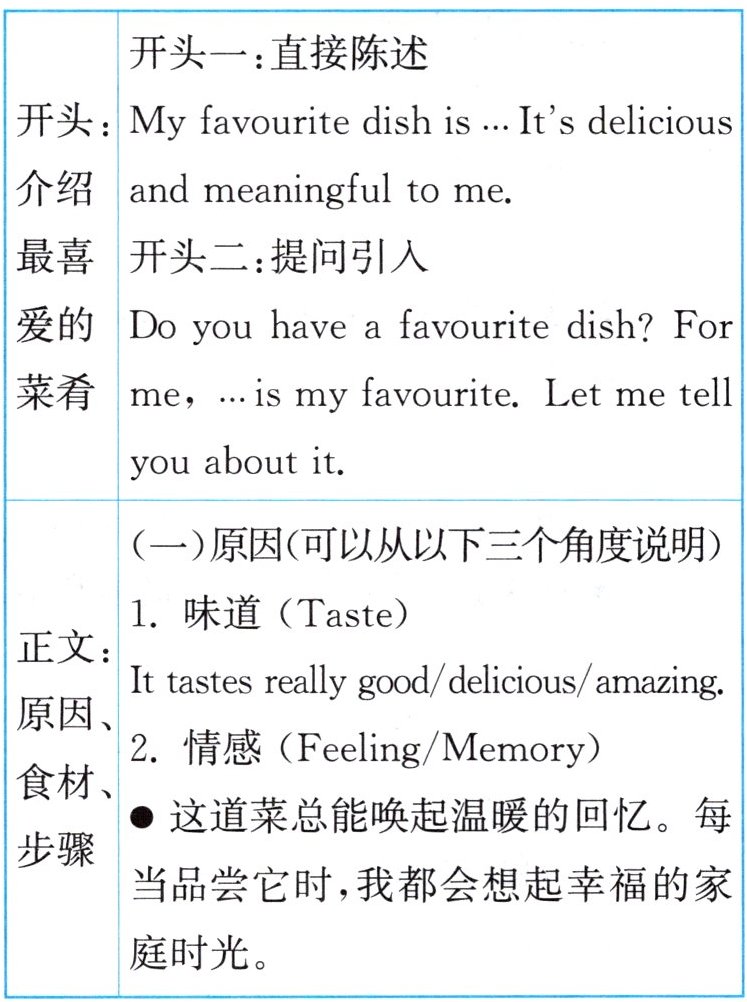
(一)原因(可以从以下三个角度说明)
1. 味道(Taste)
It tastes really good/delicious/amazing.
2. 情感(Feeling/Memory)
●这道菜总能唤起温暖的回忆。每当品尝它时,我都会想起幸福的家庭时光。
(Continued Table)
正文:
原因、食材、步骤
This dish brings back . Whenever I eat it, I the happy family time.
●妈妈过去常常在特别的日子里为我做这道菜,所以它让我感觉像家一样。
My mum make this dish for me on special days, so it home.
●这是我学会做的第一道菜,因此对我而言意义非凡。
It’s I learned to cook, so it’s very meaningful to me.
3. 健康(Health)
●这道菜含有蔬菜和鱼肉,因此对我的健康有好处。
The dish has vegetables and fish, so it’s .
●这道菜富含健康食材,比如新鲜蔬菜。
The dish healthy ingredients like fresh vegetables.
●吃这道菜有助于我保持健康和精力充沛。
Eating it helps me and energetic.
(二)食材列举
I need ...
(Continued Table)
正文:
原因、食材、步骤
(三)制作步骤
用First, Next, Then, After that, Finally等连接词串联步骤。
用wash, cut up, cut ... into ..., add ... to ..., pour ... into ..., boil, mix ... with ...等描述具体制作步骤。
结尾:
总结
结尾一:总结感受,强化喜爱
●总之,这道菜不仅美味,还充满爱。我真的很喜爱它!
All in all, this dish is delicious full of love. I really love it!
●这就是我最爱的菜肴。它的味道和背后的回忆,让它对我意义非凡。
That’s my favourite dish. Its taste and the memories behind it to me.
结尾二:邀请互动,拉近距离
●这就是我最爱的菜肴。为什么不试试制作它呢?我肯定你也会喜欢!
That’s my favourite dish. try making it? I’m sure you’ll like it too!
●你最爱的菜肴是什么?也许我们能一起分享更多美食!
What’s your favourite dish? Maybe we can delicious food together!
※根据以上指导写作短文。
注意:
1. 短文须包括所有提示内容,可适当发挥;
2. 词数80个左右。
一、审清题
1. 体裁:说明文。
2. 时态:描述自己喜爱的菜肴、原因、食材以及制作步骤,应使用一般现在时。
3. 人称:描述喜爱的菜肴、原因、食材时,应使用第一人称;介绍制作步骤时,应使用祈使句。
4. 要点:
①所有给出的提示内容都要写到。
②条理清晰,意思连贯,语句通顺,语法正确。
二、内容框架及语言
开头:
最喜爱的菜肴
开头一:直接陈述
My favourite dish is ... It’s delicious and meaningful to me.
开头二:提问引入
Do you have a favourite dish? For me, ...is my favourite. Let me tell you about it.
正文:
原因、食材、步骤
(一)原因(可以从以下三个角度说明)
1. 味道(Taste)
It tastes really good/delicious/amazing.
2. 情感(Feeling/Memory)
●这道菜总能唤起温暖的回忆。每当品尝它时,我都会想起幸福的家庭时光。
(Continued Table)
正文:
原因、食材、步骤
This dish brings back . Whenever I eat it, I the happy family time.
●妈妈过去常常在特别的日子里为我做这道菜,所以它让我感觉像家一样。
My mum make this dish for me on special days, so it home.
●这是我学会做的第一道菜,因此对我而言意义非凡。
It’s I learned to cook, so it’s very meaningful to me.
3. 健康(Health)
●这道菜含有蔬菜和鱼肉,因此对我的健康有好处。
The dish has vegetables and fish, so it’s .
●这道菜富含健康食材,比如新鲜蔬菜。
The dish healthy ingredients like fresh vegetables.
●吃这道菜有助于我保持健康和精力充沛。
Eating it helps me and energetic.
(二)食材列举
I need ...
(Continued Table)
正文:
原因、食材、步骤
(三)制作步骤
用First, Next, Then, After that, Finally等连接词串联步骤。
用wash, cut up, cut ... into ..., add ... to ..., pour ... into ..., boil, mix ... with ...等描述具体制作步骤。
结尾:
总结
结尾一:总结感受,强化喜爱
●总之,这道菜不仅美味,还充满爱。我真的很喜爱它!
All in all, this dish is delicious full of love. I really love it!
●这就是我最爱的菜肴。它的味道和背后的回忆,让它对我意义非凡。
That’s my favourite dish. Its taste and the memories behind it to me.
结尾二:邀请互动,拉近距离
●这就是我最爱的菜肴。为什么不试试制作它呢?我肯定你也会喜欢!
That’s my favourite dish. try making it? I’m sure you’ll like it too!
●你最爱的菜肴是什么?也许我们能一起分享更多美食!
What’s your favourite dish? Maybe we can delicious food together!
※根据以上指导写作短文。
答案
正文: warm memories, think of; used to, feels like; the first dish; good for my health; is full of/is rich in; stay/keep healthy 结尾:not only, but also; make it meaningful; Why not; share more
范文:
My favourite dish is stir-fried eggs and tomatoes.
I love it because my mum often makes it for me, and whenever I eat it, I think of the happy family time we share. The ingredients are easy to get: eggs, tomatoes, salt, sugar and oil. Now, here's how to make it. First, wash the tomatoes and cut them into pieces. Next, break the eggs into a bowl and mix them well. Then, heat some oil in the pan and add the eggs to it. Stir-fry for one minute. Next, take the eggs out of the pan. After that, cook the tomatoes in the pan until they're soft. Then, add a little salt and sugar. Finally, put the eggs back into the pan and mix them with the tomatoes.
That's my favourite dish. Its taste and the love behind it make it special to me.
解析
【分析】
首先审题明确要求:需写一篇介绍自己最喜爱菜肴的英语短文,体裁为说明文,时态用一般现在时,人称以第一人称为主,制作步骤用祈使句,词数80左右,要涵盖开头点明菜肴、正文说明原因、食材、制作步骤、结尾总结感受的所有要点。解题思路:1. 选择合适的开头(如直接陈述)点明喜爱的菜肴;2. 正文先从味道、情感角度说明喜爱的原因,再列举简单易取的食材,最后用First、Next等连接词串联制作步骤;3. 结尾总结强化喜爱之情,确保语言通顺、要点齐全。
【解析】
按照题目要求,先以直接陈述开头点明菜肴;正文部分先说明情感原因(唤起家庭回忆)、味道特点,再列出食材,接着用表示顺序的连接词(First、Next、Then、Finally)清晰描述制作步骤;结尾总结菜肴的意义,确保符合时态、人称要求,涵盖所有提示要点,词数达标。
【答案】
My favourite dish is stir-fried eggs and tomatoes. I love it because my mum often makes it for me, and whenever I eat it, I think of the happy family time we share. The ingredients are easy to get: eggs, tomatoes, salt, sugar and oil. Now, here's how to make it. First, wash the tomatoes and cut them into pieces. Next, break the eggs into a bowl and mix them well. Then, heat some oil in the pan and add the eggs to it. Stir-fry for one minute. Next, take the eggs out of the pan. After that, cook the tomatoes in the pan until they're soft. Then, add a little salt and sugar. Finally, put the eggs back into the pan and mix them with the tomatoes. That's my favourite dish. Its taste and the love behind it make it special to me.
【知识点】
英语说明文写作;一般现在时运用
【点评】
本题考查初中学生的英语书面表达能力,要求结合给定提示完成短文,涵盖所有要点,注重基础写作结构和语言运用的考查,是常见的英语写作题型。
【难度系数】
0.5
