

 登录
登录
第二节,阅读短文,从文后所列选项中选出最佳选项填入对应空白处,选项中有一项多余。
As the world faces environmental prob-
lems, new energy is becoming more and
more popular. 6. Many inventions
in this field have changed our lives, and
more are on the way.
7. They use sunlight to make
electricity. Unlike plastic or fossil fuels,
they don't create waste. Many families now
use solar panels on their roofs to power their
homes. High-speed trains in some countries
also use electricity from new energy, mak-
ing them fast and eco-friendly.
8. Large wind turbines(涡轮
机) look like giant fans. As the wind blows,
the turbines turn and create electricity.
These turbines are often built in eastern
parts of countries where winds are strong.
They don't need fuel and never run out of
power.
Batteries are also improving. 9.
New materials like special fibre and
bronze alloys are used to make batteries last
longer. Some even use ideas from old paper-
making techniques to make parts lighter and
cheaper.
10. It can be expensive to
build at first, and some people worry about
the cost. But with new technology, prices
are becoming more affordable. Experts be-
lieve that in the future, new energy will be
widely used all over the world, leading to a
cleaner and greener planet.
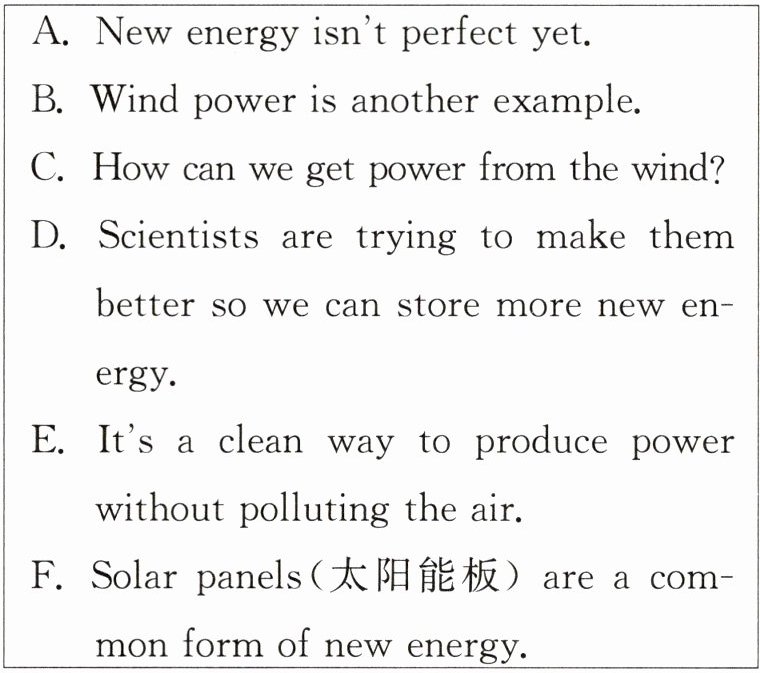
A. New energy isn't perfect yet.
B. Wind power is another example.
C. How can we get power from the wind?
D. Scientists are trying to make them better so we can store more new en- ergy.
E. It's a clean way to produce power without polluting the air.
F. Solar panels(太阳能板) are a com- mon form of new energy.
As the world faces environmental prob-
lems, new energy is becoming more and
more popular. 6. Many inventions
in this field have changed our lives, and
more are on the way.
7. They use sunlight to make
electricity. Unlike plastic or fossil fuels,
they don't create waste. Many families now
use solar panels on their roofs to power their
homes. High-speed trains in some countries
also use electricity from new energy, mak-
ing them fast and eco-friendly.
8. Large wind turbines(涡轮
机) look like giant fans. As the wind blows,
the turbines turn and create electricity.
These turbines are often built in eastern
parts of countries where winds are strong.
They don't need fuel and never run out of
power.
Batteries are also improving. 9.
New materials like special fibre and
bronze alloys are used to make batteries last
longer. Some even use ideas from old paper-
making techniques to make parts lighter and
cheaper.
10. It can be expensive to
build at first, and some people worry about
the cost. But with new technology, prices
are becoming more affordable. Experts be-
lieve that in the future, new energy will be
widely used all over the world, leading to a
cleaner and greener planet.
A. New energy isn't perfect yet.
B. Wind power is another example.
C. How can we get power from the wind?
D. Scientists are trying to make them better so we can store more new en- ergy.
E. It's a clean way to produce power without polluting the air.
F. Solar panels(太阳能板) are a com- mon form of new energy.
答案
6. E 7. F 8. B 9. D 10. A
解析
【分析】本题为英语阅读填空题,需结合上下文的话题连贯性、逻辑关系解题。解题思路:先通读全文把握每段主题,再逐一分析设空处前后句的内容,匹配选项的语境与逻辑:第6题需选解释新能源受欢迎原因的选项,第7题需选引出太阳能板话题的选项,第8题需选承接新能源例子(风力)的选项,第9题需选承接电池改进话题的选项,第10题需选引出新能源不足的选项。
【解析】6. 上文提到新能源越来越受欢迎,下文介绍该领域的发明,E选项“它是一种不污染空气的清洁能源生产方式”解释了新能源受欢迎的原因,符合语境;7. 下文围绕太阳能板展开,F选项“太阳能板是新能源的常见形式”引出该段主题,正确;8. 下文介绍风力涡轮机发电,B选项“风力是另一个例子”承接上文的新能源例子(太阳能),符合逻辑;9. 上文提到电池在改进,D选项“科学家正努力让它们更好,以便储存更多新能源”承接电池改进的话题,正确;10. 下文提到新能源初期成本高,A选项“新能源还不完美”引出下文的不足,正确。
【答案】6.E 7.F 8.B 9.D 10.A
【知识点】英语语篇衔接、阅读理解(七选五)
【点评】本题考查学生对英语语篇逻辑和上下文衔接的理解能力,属于中等难度的阅读题型,需结合每段主题和前后句的逻辑关系匹配选项。
【难度系数】0.5
【解析】6. 上文提到新能源越来越受欢迎,下文介绍该领域的发明,E选项“它是一种不污染空气的清洁能源生产方式”解释了新能源受欢迎的原因,符合语境;7. 下文围绕太阳能板展开,F选项“太阳能板是新能源的常见形式”引出该段主题,正确;8. 下文介绍风力涡轮机发电,B选项“风力是另一个例子”承接上文的新能源例子(太阳能),符合逻辑;9. 上文提到电池在改进,D选项“科学家正努力让它们更好,以便储存更多新能源”承接电池改进的话题,正确;10. 下文提到新能源初期成本高,A选项“新能源还不完美”引出下文的不足,正确。
【答案】6.E 7.F 8.B 9.D 10.A
【知识点】英语语篇衔接、阅读理解(七选五)
【点评】本题考查学生对英语语篇逻辑和上下文衔接的理解能力,属于中等难度的阅读题型,需结合每段主题和前后句的逻辑关系匹配选项。
【难度系数】0.5
四、阅读表达
阅读短文,根据要求完成文后的题目。
You may think that inventions are far away from your everyday lives. But in fact, almost everyone can invent. It's just that they do not recognize that their ideas could be the start of an invention.
Once inventors see their ideas have some practical value, they won't let them slip away.
For example, the inventor of the dishwasher, American Josephine Cochrane, loved to give dinner parties. But she found it took a long time to wash her dishes by hand and too many of them broke. She decided that a machine could do the job faster and with fewer mistakes. So in 1886 she set out to make one for herself.
Cochrane's most wonderful inventions are created to solve the problem. So the first and most important step is to find the problem. You can start by looking at what is wrong with the things you are using now. You can ask grandparents or neighbors if they remember ever saying, "I wish someone would invent something for..." Or you can look at people in different areas such as on the street or at school. Then you might notice situations or things in need of improvement. Remember to record your ideas and work. This will help you develop your invention and protect(保护)it when it is completed.
The next step is to think about possible solutions. An invention is a new way of solving a problem. So think of many varied(各种各样的)and unusual ways. You can often come up with a solution to a problem by looking at it from a different angle(角度)or thinking about it in a new way.
And the hardest part of inventing even for a lot of inventors is finding a problem and coming up with a solution. Once you have an idea, you can always get help to build your invention.
This problem-solving technique can also work in your everyday lives. So why not try it in your studies, in your relationships with others or even in the way you look at the world?
1. 完成句子。
Josephine Cochrane found it took a long time to wash her dishes .
2. 用英语表达文中画线单词 one 指代的内容。
3. 找出并写下第四段的主题句。
4. What is the hardest part of inventing?
5. 将文中画线句子翻译成汉语。
6. 根据文章内容完成以下题目,每空一词。
You may think inventions are far from your daily life. But almost everyone can invent. The first and most important step is to (1) the problem. For example, Josephine Cochrane (2) the dishwasher because washing dishes by hand took long and broke many dishes. She decided to make a (3) to help her. Next, think about different (4) to solve the problem. And the hardest part for many inventors is finding a problem and (5) up with a solution.
阅读短文,根据要求完成文后的题目。
You may think that inventions are far away from your everyday lives. But in fact, almost everyone can invent. It's just that they do not recognize that their ideas could be the start of an invention.
Once inventors see their ideas have some practical value, they won't let them slip away.
For example, the inventor of the dishwasher, American Josephine Cochrane, loved to give dinner parties. But she found it took a long time to wash her dishes by hand and too many of them broke. She decided that a machine could do the job faster and with fewer mistakes. So in 1886 she set out to make one for herself.
Cochrane's most wonderful inventions are created to solve the problem. So the first and most important step is to find the problem. You can start by looking at what is wrong with the things you are using now. You can ask grandparents or neighbors if they remember ever saying, "I wish someone would invent something for..." Or you can look at people in different areas such as on the street or at school. Then you might notice situations or things in need of improvement. Remember to record your ideas and work. This will help you develop your invention and protect(保护)it when it is completed.
The next step is to think about possible solutions. An invention is a new way of solving a problem. So think of many varied(各种各样的)and unusual ways. You can often come up with a solution to a problem by looking at it from a different angle(角度)or thinking about it in a new way.
And the hardest part of inventing even for a lot of inventors is finding a problem and coming up with a solution. Once you have an idea, you can always get help to build your invention.
This problem-solving technique can also work in your everyday lives. So why not try it in your studies, in your relationships with others or even in the way you look at the world?
1. 完成句子。
Josephine Cochrane found it took a long time to wash her dishes .
2. 用英语表达文中画线单词 one 指代的内容。
3. 找出并写下第四段的主题句。
4. What is the hardest part of inventing?
5. 将文中画线句子翻译成汉语。
6. 根据文章内容完成以下题目,每空一词。
You may think inventions are far from your daily life. But almost everyone can invent. The first and most important step is to (1) the problem. For example, Josephine Cochrane (2) the dishwasher because washing dishes by hand took long and broke many dishes. She decided to make a (3) to help her. Next, think about different (4) to solve the problem. And the hardest part for many inventors is finding a problem and (5) up with a solution.
答案
1. by hand
2. A dishwasher. /A machine.
3. So the first and most important step is to find the problem.
4. It is finding a problem and coming up with a solution.
5. 你经常可以通过从不同的角度看待问题,或者用一种新的方式思考问题来想出解决办法。
6. (1) find (2) invented (3) machine (4) ways (5) coming
2. A dishwasher. /A machine.
3. So the first and most important step is to find the problem.
4. It is finding a problem and coming up with a solution.
5. 你经常可以通过从不同的角度看待问题,或者用一种新的方式思考问题来想出解决办法。
6. (1) find (2) invented (3) machine (4) ways (5) coming
解析
【分析】本题为英语阅读理解题,包含完成句子、代词指代、主题句查找、问答、翻译、填空六种题型。解题思路为:先通读全文把握主旨,再针对每个小题定位原文对应段落,根据原文细节、逻辑关系逐一解答,注意单词形式和语义准确性。
【解析】1. 定位至原文第三段“But she found it took a long time to wash her dishes by hand”,可知填by hand;2. 原文第三段提到她要制作洗碗的机器,故画线词one指代a dishwasher;3. 第四段围绕“第一步是找问题”展开,主题句为“So the first and most important step is to find the problem”;4. 定位至原文倒数第二段“And the hardest part of inventing even for a lot of inventors is finding a problem and coming up with a solution”,可知答案;5. 画线句翻译需准确对应短语:come up with(想出)、angle(角度),译为“你经常可以通过从不同的角度看待问题,或者用一种新的方式思考问题来想出解决办法”;6. 结合原文对应内容:(1) find(对应第四段step);(2) invented(对应第三段她发明洗碗机的过去动作);(3) machine(对应原文“a machine could do the job”);(4) ways(对应第五段“many varied and unusual ways”);(5) coming(对应“coming up with a solution”,与finding并列)。
【答案】1. by hand
2. A dishwasher. /A machine.
3. So the first and most important step is to find the problem.
4. It is finding a problem and coming up with a solution.
5. 你经常可以通过从不同的角度看待问题,或者用一种新的方式思考问题来想出解决办法。
6. (1) find (2) invented (3) machine (4) ways (5) coming
【知识点】英语阅读理解、信息提取、代词指代
【点评】本题考查学生对英语阅读文章的细节理解、主旨把握及翻译能力,题型全面,需学生精准定位原文信息,难度适中,适合巩固英语阅读基础。
【难度系数】0.6
【解析】1. 定位至原文第三段“But she found it took a long time to wash her dishes by hand”,可知填by hand;2. 原文第三段提到她要制作洗碗的机器,故画线词one指代a dishwasher;3. 第四段围绕“第一步是找问题”展开,主题句为“So the first and most important step is to find the problem”;4. 定位至原文倒数第二段“And the hardest part of inventing even for a lot of inventors is finding a problem and coming up with a solution”,可知答案;5. 画线句翻译需准确对应短语:come up with(想出)、angle(角度),译为“你经常可以通过从不同的角度看待问题,或者用一种新的方式思考问题来想出解决办法”;6. 结合原文对应内容:(1) find(对应第四段step);(2) invented(对应第三段她发明洗碗机的过去动作);(3) machine(对应原文“a machine could do the job”);(4) ways(对应第五段“many varied and unusual ways”);(5) coming(对应“coming up with a solution”,与finding并列)。
【答案】1. by hand
2. A dishwasher. /A machine.
3. So the first and most important step is to find the problem.
4. It is finding a problem and coming up with a solution.
5. 你经常可以通过从不同的角度看待问题,或者用一种新的方式思考问题来想出解决办法。
6. (1) find (2) invented (3) machine (4) ways (5) coming
【知识点】英语阅读理解、信息提取、代词指代
【点评】本题考查学生对英语阅读文章的细节理解、主旨把握及翻译能力,题型全面,需学生精准定位原文信息,难度适中,适合巩固英语阅读基础。
【难度系数】0.6
