

 登录
七、核心素养 思维品质 任务型阅读。(1~8题1分,第9题2分,共10分)
阅读下面短文,根据所读内容,在文章后题的空格里填入最恰当的内容。注意:1~8题每个空格只填1个单词,第9题词数不少于20。
[2026 南京市建邺区模拟]AI is no longer a science-fiction idea. It has already become part of our life, especially in education. AI tutors and writing helpers are now common in classrooms around the world. Many educators like them because they are efficient. But more and more people are talking about the problems of using AI too much.
Some people support AI in schools. They say AI can give students personalized help. It can check students' performance right away, and give them special exercises, acting as a personal teacher for every learner. It can also free up teachers from daily grading, allowing them to spend time on more meaningful talks and activities and help develop important thinking skills. What's more, AI can make learning more interesting and make it possible for all the students, including those in faraway places, to use many resources.
However, people who disagree warn of serious risks. The biggest problem is that it gets in the way of developing thinking for yourself. If students always use AI to get quick answers, they may skip the hard but important work of thinking and solving problems. If they depend too much on AI, they may grow up to be good at using tools, but don't have the basic ability to think deeply. Moreover, depending too much on AI suggestions might create an "intellectual bubble" and reduce chances to see different ideas and opinions. The human side of a teacher—guiding, encouraging, and knowing how a student feels—is something AI cannot copy.
In short, AI is a powerful tool, but it should work as a helper, not a substitute(替代) for the heart of education—the human part. The challenge for educators and students is to find a balance. We must learn to use AI's strengths for getting things done well and personal learning, while actively protecting room for deep thinking, creativity, and the priceless human connection that truly moves learning forward.
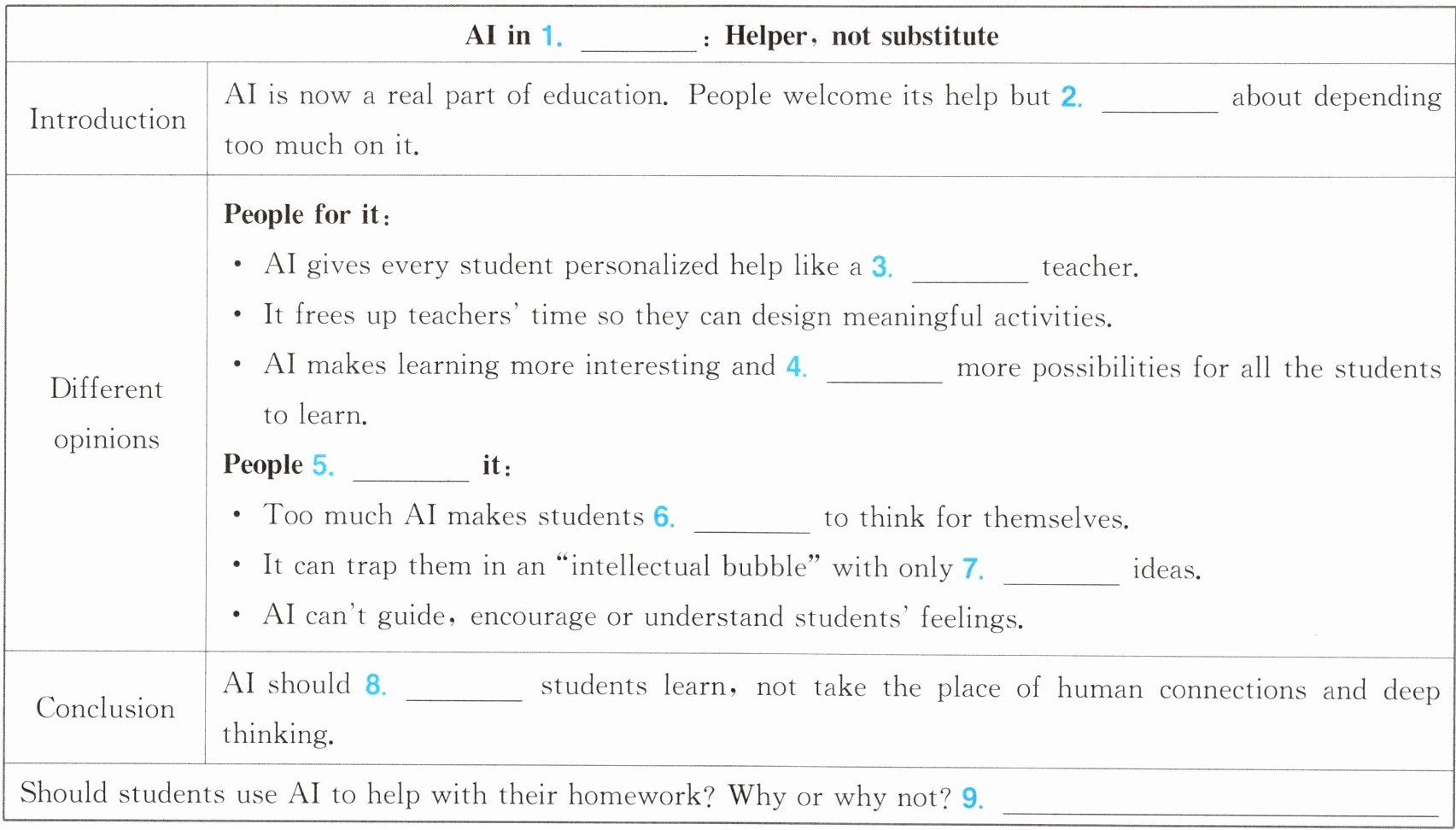
阅读下面短文,根据所读内容,在文章后题的空格里填入最恰当的内容。注意:1~8题每个空格只填1个单词,第9题词数不少于20。
[2026 南京市建邺区模拟]AI is no longer a science-fiction idea. It has already become part of our life, especially in education. AI tutors and writing helpers are now common in classrooms around the world. Many educators like them because they are efficient. But more and more people are talking about the problems of using AI too much.
Some people support AI in schools. They say AI can give students personalized help. It can check students' performance right away, and give them special exercises, acting as a personal teacher for every learner. It can also free up teachers from daily grading, allowing them to spend time on more meaningful talks and activities and help develop important thinking skills. What's more, AI can make learning more interesting and make it possible for all the students, including those in faraway places, to use many resources.
However, people who disagree warn of serious risks. The biggest problem is that it gets in the way of developing thinking for yourself. If students always use AI to get quick answers, they may skip the hard but important work of thinking and solving problems. If they depend too much on AI, they may grow up to be good at using tools, but don't have the basic ability to think deeply. Moreover, depending too much on AI suggestions might create an "intellectual bubble" and reduce chances to see different ideas and opinions. The human side of a teacher—guiding, encouraging, and knowing how a student feels—is something AI cannot copy.
In short, AI is a powerful tool, but it should work as a helper, not a substitute(替代) for the heart of education—the human part. The challenge for educators and students is to find a balance. We must learn to use AI's strengths for getting things done well and personal learning, while actively protecting room for deep thinking, creativity, and the priceless human connection that truly moves learning forward.
答案
1. education 根据“AI is no longer a science-fiction idea. It has already become part of our life, especially in education. ”可知,全文围绕教育领域中的 AI 展开,填 education 符合题意。
2. worry 根据“But more and more people are talking about the problems of using AI too much. ”可知,人们认可 AI,同时担忧过度使用的问题,固定搭配 worry about 表示“担忧”。
3. personal 根据“It can check students' performance right away, and give them special exercises, acting as a personal teacher for every learner. ”可知答案。
4. provides 根据“AI can make learning more interesting and make it possible for all the students, including those in faraway places, to use many resources”可知,AI 为所有学生提供学习机会,主语 AI 为单数,provide 用第三人称单数形式 provides。
5. against 根据“However, people who disagree warn of serious risks. ”可知,此处对应反对 AI 的人,against 表示“反对”。
6. fail 根据“The biggest problem is that it gets in the way of developing thinking for yourself. If students always use AI to get quick answers, they may skip the hard but important work of thinking and solving problems. ”可知,过度使用 AI 会让学生无法独立思考,fail to do sth. 表示“无法做某事”,填 fail 符合题意。
7. similar 根据“depending too much on AI suggestions might create an ‘intellectual bubble’ and reduce chances to see different ideas and opinions”可知,信息茧房里只能看到相似观点,看不到不同想法,填 similar 符合题意。
8. help 根据“AI is a powerful tool, but it should work as a helper, not a substitute for the heart of education—the human part”可知,AI 只能作为帮手辅助学生学习,情态动词后用原形 help 符合题意。
9. I think students can use AI to help with homework properly. AI can quickly sort out difficult knowledge and provide targeted exercises to improve learning efficiency. But students must not copy answers directly. They should think independently first, and only use AI to check ideas or solve confusing points.(言之有理即可)
