

 登录
登录
Mum: I found a broken toy in your room. What happened?
Son: 1.
Mum: But I saw you playing with your friend's toy yesterday.
Son: 2.
Mum: Son, is that the truth? 3.
Son: 4.
Mum: I'm not happy about the toy, but I'm proud of you for telling me the truth now. 5.
Son: 1.
A
Mum: But I saw you playing with your friend's toy yesterday.
Son: 2.
D
I was just looking at it.Mum: Son, is that the truth? 3.
B
Son: 4.
F
I accidentally broke it. I was afraid to tell you.Mum: I'm not happy about the toy, but I'm proud of you for telling me the truth now. 5.
C
答案
1. A 2. D 3. B 4. F 5. C
解析
【分析】本题为英语情景补全对话题,解题思路为:先通读对话,把握母子间关于玩具破损的交际语境,再结合每处空白的上下文逻辑(如提问、辩解、承认、后续话语等),匹配符合日常交际习惯的选项,确保对话逻辑通顺。
【解析】根据对话语境:1处妈妈询问玩具破损的情况,儿子需回应对应内容,匹配选项A;2处妈妈指出儿子昨天玩朋友的玩具,儿子辩解只是查看,匹配选项D;3处妈妈追问是否为真相,匹配选项B;4处儿子承认自己不小心弄坏玩具,匹配选项F;5处妈妈表扬儿子讲真话,匹配选项C。
【答案】1.A 2.D 3.B 4.F 5.C
【知识点】英语情景交际、补全对话
【点评】本题考查日常情景对话的语境理解与逻辑推理,需结合上下文内容匹配合适的交际用语,难度适中。
【难度系数】0.5
【解析】根据对话语境:1处妈妈询问玩具破损的情况,儿子需回应对应内容,匹配选项A;2处妈妈指出儿子昨天玩朋友的玩具,儿子辩解只是查看,匹配选项D;3处妈妈追问是否为真相,匹配选项B;4处儿子承认自己不小心弄坏玩具,匹配选项F;5处妈妈表扬儿子讲真话,匹配选项C。
【答案】1.A 2.D 3.B 4.F 5.C
【知识点】英语情景交际、补全对话
【点评】本题考查日常情景对话的语境理解与逻辑推理,需结合上下文内容匹配合适的交际用语,难度适中。
【难度系数】0.5
(二)木木还在为自己班级文化节的节目寻找灵感,她在阅读一篇线上报纸的学生投稿专栏。阅读下列材料,选择正确的答案。
Come and share your favourite saying from ancient China
“To improve a little every day makes great progress over time.”
This old saying has encouraged people for centuries. Take the calligrapher, Wang Xianzhi for example. He practised writing every day. He filled 18 big vats with water just to practise his strokes. Slowly, his writing became as beautiful as his father’s, and he became one of the most famous calligraphers in history. This saying reminds me that small, steady efforts are better than rushing. I’ve been learning to play the piano, and even 15 minutes of practice each day has helped me play my favourite songs now. (Zhang Wei)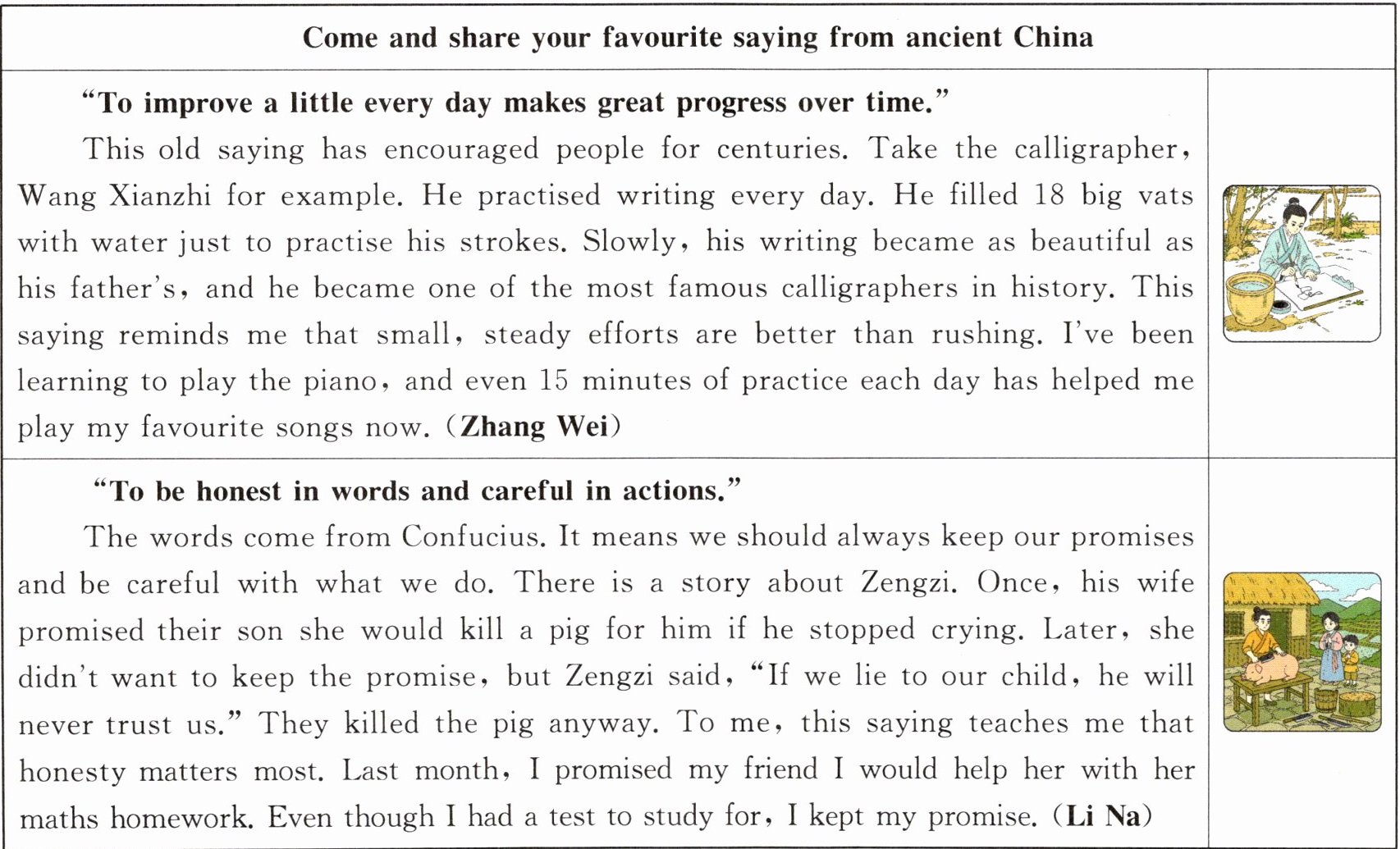
“To be honest in words and careful in actions.”
The words come from Confucius. It means we should always keep our promises and be careful with what we do. There is a story about Zengzi. Once, his wife promised their son she would kill a pig for him if he stopped crying. Later, she didn’t want to keep the promise, but Zengzi said, “If we lie to our child, he will never trust us.” They killed the pig anyway. To me, this saying teaches me that honesty matters most. Last month, I promised my friend I would help her with her maths homework. Even though I had a test to study for, I kept my promise. (Li Na)
(
A. YOUR VOICE B. HISTORY TODAY
C. SCIENCE WORLD D. SPORTS REPORT
(
A. Raising questions. B. Listing numbers.
C. Comparing two people. D. Giving examples.
(
A. Confucius. B. Zengzi. C. Wang Xianzhi. D. Li Na.
Come and share your favourite saying from ancient China
“To improve a little every day makes great progress over time.”
This old saying has encouraged people for centuries. Take the calligrapher, Wang Xianzhi for example. He practised writing every day. He filled 18 big vats with water just to practise his strokes. Slowly, his writing became as beautiful as his father’s, and he became one of the most famous calligraphers in history. This saying reminds me that small, steady efforts are better than rushing. I’ve been learning to play the piano, and even 15 minutes of practice each day has helped me play my favourite songs now. (Zhang Wei)
“To be honest in words and careful in actions.”
The words come from Confucius. It means we should always keep our promises and be careful with what we do. There is a story about Zengzi. Once, his wife promised their son she would kill a pig for him if he stopped crying. Later, she didn’t want to keep the promise, but Zengzi said, “If we lie to our child, he will never trust us.” They killed the pig anyway. To me, this saying teaches me that honesty matters most. Last month, I promised my friend I would help her with her maths homework. Even though I had a test to study for, I kept my promise. (Li Na)
(
A
)1. In which part of the online newspaper can we read this material?A. YOUR VOICE B. HISTORY TODAY
C. SCIENCE WORLD D. SPORTS REPORT
(
D
)2. Which writing skill is used in Zhang Wei’s part?A. Raising questions. B. Listing numbers.
C. Comparing two people. D. Giving examples.
(
B
)3. Who is mentioned in the story about keeping promises?A. Confucius. B. Zengzi. C. Wang Xianzhi. D. Li Na.
答案
1. A 2. D 3. B
解析
【分析】
第1题需判断材料所属报纸板块,材料是学生分享中国古谚语的投稿,属于读者表达观点的内容;第2题分析张伟的写作手法,他通过列举具体事例阐述谚语;第3题查找守诺故事中的人物,需定位对应故事内容。
【解析】
1. 本题考查报纸板块判断。材料是学生分享中国古谚语的投稿,属于读者表达观点的板块,A选项“YOUR VOICE(你的声音)”符合,B(今日历史)、C(科学世界)、D(体育报道)均与材料内容不符,故选A。
2. 本题考查写作技巧判断。张伟的段落先提出谚语,再列举王献之练字和自己练钢琴的例子支撑观点,运用了举例子的写作技巧,对应D选项,A(提问题)、B(列数字)、C(比较两人)均未体现,故选D。
3. 本题考查细节查找。关于守诺的故事,材料中提到曾子杀猪的故事,讲述信守承诺,故提到的人物是曾子,对应B选项,A(孔子)、C(王献之)、D(李娜)均不符合,故选B。
【答案】
1.A 2.D 3.B
【知识点】
英语阅读理解、细节理解、写作技巧
【点评】
本题围绕中国古谚语展开英语阅读理解,考查板块判断、写作技巧和细节查找,难度适中,仔细阅读材料即可找到答案。
【难度系数】
0.7
第1题需判断材料所属报纸板块,材料是学生分享中国古谚语的投稿,属于读者表达观点的内容;第2题分析张伟的写作手法,他通过列举具体事例阐述谚语;第3题查找守诺故事中的人物,需定位对应故事内容。
【解析】
1. 本题考查报纸板块判断。材料是学生分享中国古谚语的投稿,属于读者表达观点的板块,A选项“YOUR VOICE(你的声音)”符合,B(今日历史)、C(科学世界)、D(体育报道)均与材料内容不符,故选A。
2. 本题考查写作技巧判断。张伟的段落先提出谚语,再列举王献之练字和自己练钢琴的例子支撑观点,运用了举例子的写作技巧,对应D选项,A(提问题)、B(列数字)、C(比较两人)均未体现,故选D。
3. 本题考查细节查找。关于守诺的故事,材料中提到曾子杀猪的故事,讲述信守承诺,故提到的人物是曾子,对应B选项,A(孔子)、C(王献之)、D(李娜)均不符合,故选B。
【答案】
1.A 2.D 3.B
【知识点】
英语阅读理解、细节理解、写作技巧
【点评】
本题围绕中国古谚语展开英语阅读理解,考查板块判断、写作技巧和细节查找,难度适中,仔细阅读材料即可找到答案。
【难度系数】
0.7
