

 登录
登录
Ⅴ. 任务型阅读
阅读下面的短文,并根据所读内容在文章后表格中的空格里填入一个最恰当的单词。(每空一词)
Many Chinese who travel to the US find that though they have studied English for years,they have to “relearn” it as soon as they arrive.
Words that we learned in English classes are not pronounced the same way here. To truly be part of the “melting pot”,fluency in English is not enough. You need an accent(口音) to stand out.
When I first came to the US for graduate school,I was a nervous foreigner. I felt so out of place that I wanted to hide everything about me that was “different”. To talk like an American became one of my goals.
During my first term as a teaching assistant (TA,助手),my students complained they could not understand me. I learned later from a study that this complaint was common among US students with an international TA. It is called the “Oh,no!” syndrome(综合征). “Oh,no! Not another international TA,and not that accent again!”
So I imitated(模仿) the way native speakers talk over time. I made such good progress that American friends started to think highly of my English as having “almost no accent”. I took this as a sign of my success. Ever since,people have often thought of me as someone from many places:the Midwest,the West Coast,China,Japan and South Korea. Most often,people think I am from California.
Suddenly,conformity(一致) was no longer a praise:If I talk like an American,am I still Chinese? If I lose my Chinese accent,do I also lose my cultural identity(身份)? Am I denying (否认) my past by being lost in a new culture?
Now I realize that a person's accent is an everlasting record of their past cultural experience and it is a mark of one's experience.
As a fourth - year student in the US,I am no longer a nervous foreigner. My nervousness has been replaced by a wish to hold on to my cultural origins. Now I add some Chinese “accent” on purpose when I speak. I do not wish to speak “perfect” English because I am proud of who I am.
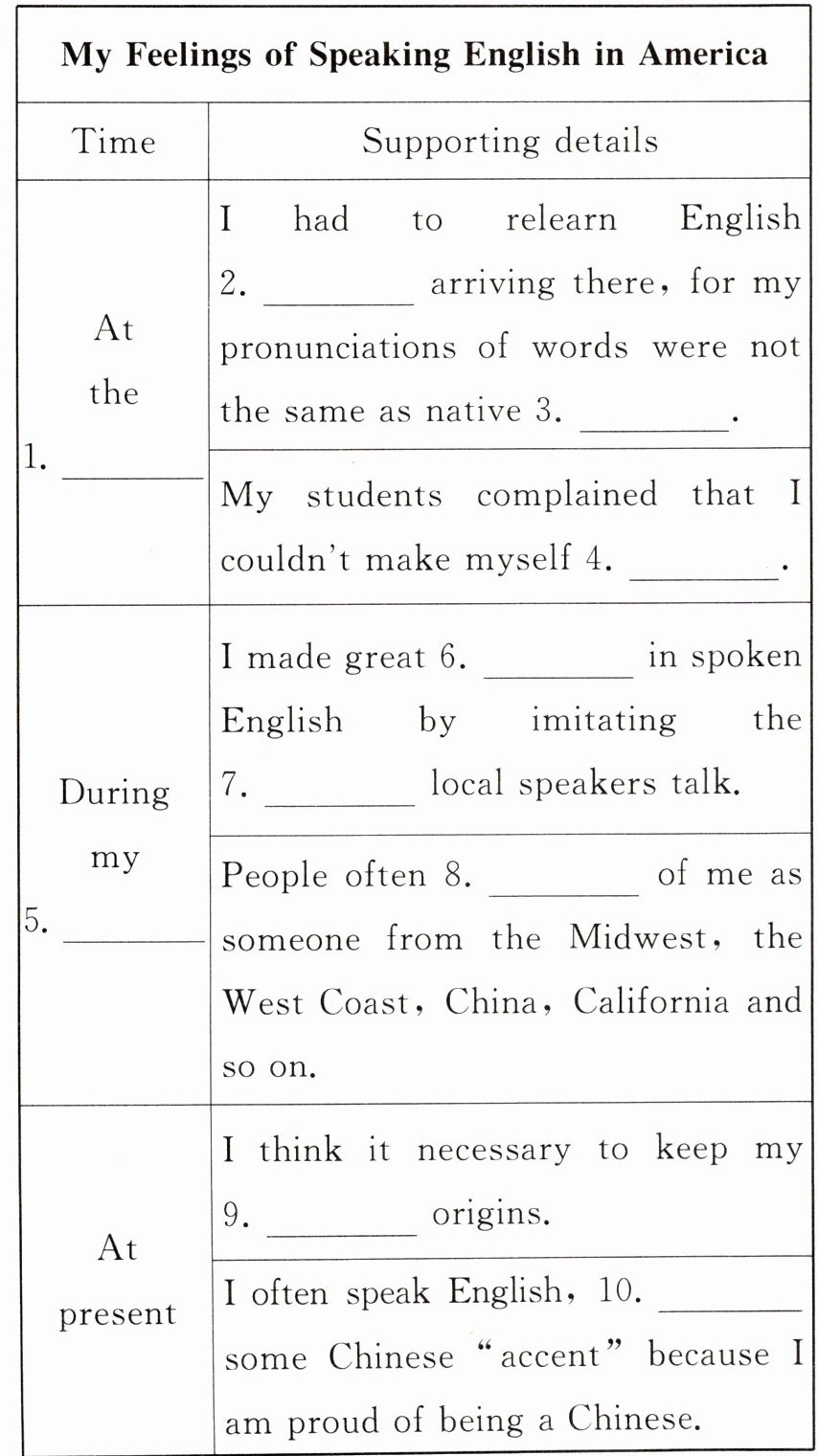
阅读下面的短文,并根据所读内容在文章后表格中的空格里填入一个最恰当的单词。(每空一词)
Many Chinese who travel to the US find that though they have studied English for years,they have to “relearn” it as soon as they arrive.
Words that we learned in English classes are not pronounced the same way here. To truly be part of the “melting pot”,fluency in English is not enough. You need an accent(口音) to stand out.
When I first came to the US for graduate school,I was a nervous foreigner. I felt so out of place that I wanted to hide everything about me that was “different”. To talk like an American became one of my goals.
During my first term as a teaching assistant (TA,助手),my students complained they could not understand me. I learned later from a study that this complaint was common among US students with an international TA. It is called the “Oh,no!” syndrome(综合征). “Oh,no! Not another international TA,and not that accent again!”
So I imitated(模仿) the way native speakers talk over time. I made such good progress that American friends started to think highly of my English as having “almost no accent”. I took this as a sign of my success. Ever since,people have often thought of me as someone from many places:the Midwest,the West Coast,China,Japan and South Korea. Most often,people think I am from California.
Suddenly,conformity(一致) was no longer a praise:If I talk like an American,am I still Chinese? If I lose my Chinese accent,do I also lose my cultural identity(身份)? Am I denying (否认) my past by being lost in a new culture?
Now I realize that a person's accent is an everlasting record of their past cultural experience and it is a mark of one's experience.
As a fourth - year student in the US,I am no longer a nervous foreigner. My nervousness has been replaced by a wish to hold on to my cultural origins. Now I add some Chinese “accent” on purpose when I speak. I do not wish to speak “perfect” English because I am proud of who I am.
答案
Ⅴ.【文章大意】本文是一篇记叙文。作者通过讲述自己在美国留学的经历说明了口音的重要性。
1. beginning 2. after 3. people's/speakers' 4. understood
5. stay 6. progress 7. way 8. thought 9. cultural 10. adding
1. beginning 2. after 3. people's/speakers' 4. understood
5. stay 6. progress 7. way 8. thought 9. cultural 10. adding
