

 登录
登录
5Ⅰ. Complete the passage with proper words according to the textbook.
Amy went 1.
Amy went 1.
camping
with her friends and her guide, Henry. Suddenly, Ms Green got a 2.call
from Amy. Some monkeys got into the 3.tent
. They ate all the food and broke the tent. Ms Green was 4.worried
and decided to get Amy back. But Henry 5.advised
Ms Green not to. He said that it was a good chance for the children to work as a team. He also 6.promised
to make sure they are completely safe.答案
Ⅰ. 1. camping 2. call 3. tent 4. worried 5. advised 6. promised
解析
【解析】
1. 依据固定短语"go camping"(去露营),此处填camping;
2. 根据语境,Green女士接到Amy的电话,"get a call"意为接到电话,填call;
3. 由后文"broke the tent"的提示,可知猴子进入了帐篷,填tent;
4. 得知情况后Green女士很担心,"worried"表示担忧的,符合语境;
5. "advise sb not to do sth"是固定搭配,意为建议某人不要做某事,此处Henry建议Green女士不要去,填advised;
6. "promise to do sth"表示承诺做某事,Henry承诺确保孩子们的安全,填promised。
【答案】
1. camping 2. call 3. tent 4. worried 5. advised 6. promised
【知识点】
固定短语搭配、语境词汇运用、动词搭配
【点评】
本题考查对课文内容的掌握及语境理解能力,需结合上下文语境和固定词汇短语搭配完成填空,能有效锻炼学生的语篇理解与词汇运用能力。
【难度系数】
0.6
1. 依据固定短语"go camping"(去露营),此处填camping;
2. 根据语境,Green女士接到Amy的电话,"get a call"意为接到电话,填call;
3. 由后文"broke the tent"的提示,可知猴子进入了帐篷,填tent;
4. 得知情况后Green女士很担心,"worried"表示担忧的,符合语境;
5. "advise sb not to do sth"是固定搭配,意为建议某人不要做某事,此处Henry建议Green女士不要去,填advised;
6. "promise to do sth"表示承诺做某事,Henry承诺确保孩子们的安全,填promised。
【答案】
1. camping 2. call 3. tent 4. worried 5. advised 6. promised
【知识点】
固定短语搭配、语境词汇运用、动词搭配
【点评】
本题考查对课文内容的掌握及语境理解能力,需结合上下文语境和固定词汇短语搭配完成填空,能有效锻炼学生的语篇理解与词汇运用能力。
【难度系数】
0.6
Ⅱ. Complete the conversation with proper sentences in the box. There is one extra option.
Jimmy: How can we stay here with no food and a broken tent?
Amy: It'll be dark soon. Shouldn't we go home?
Rob: Don't worry, Amy. Let's see what to do.
Jimmy: OK, Rob. 1.
Rob: There is fruit on the trees. Maybe we can eat that.
Jane: I read about safe fruit to eat. 2.
Guide: Of course, Jane. Please check with me before you eat anything.
Jimmy: But we can't eat only fruit.
Rob: 3.
Amy: I can help Jimmy with that.
Guide: Good idea. I'll go with you, kids. We can catch some fish together.
Jane: Good, Amy. 4.
Rob: How about using these tapes to fix it?
Guide: 5.
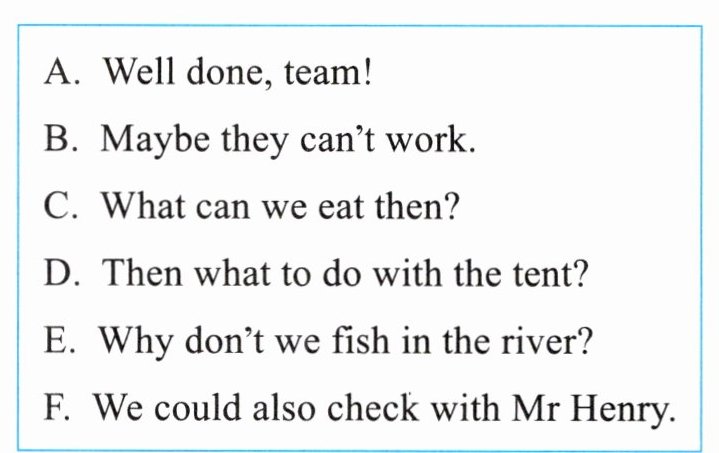
Jimmy: How can we stay here with no food and a broken tent?
Amy: It'll be dark soon. Shouldn't we go home?
Rob: Don't worry, Amy. Let's see what to do.
Jimmy: OK, Rob. 1.
C
Rob: There is fruit on the trees. Maybe we can eat that.
Jane: I read about safe fruit to eat. 2.
F
Guide: Of course, Jane. Please check with me before you eat anything.
Jimmy: But we can't eat only fruit.
Rob: 3.
E
Jimmy is good at fishing.Amy: I can help Jimmy with that.
Guide: Good idea. I'll go with you, kids. We can catch some fish together.
Jane: Good, Amy. 4.
D
Rob: How about using these tapes to fix it?
Guide: 5.
A
You really know how to work together to solve problems.答案
Ⅱ. 1. C 2. F 3. E 4. D 5. A
解析
【解析】
首先通读整个对话,明确对话场景为户外露营时遇到食物匮乏、帐篷损坏的困境,众人共同商讨解决办法。
1. 空1后Rob提到树上有水果可以吃,由此推断此处Jimmy是在询问解决食物问题的办法,故选C。
2. 空2前Jane说自己了解可安全食用的水果,空2后Guide回应“Of course, Jane. Please check with me before you eat anything”,可知此处Jane是在向Guide确认相关事宜,故选F。
3. 空3前Jimmy提出不能只吃水果,空3后提到Jimmy擅长钓鱼,由此推断此处Rob是提议钓鱼来获取食物,故选E。
4. 空4后Rob提议用胶带修理,结合对话开头提到的“broken tent”,可知此处Jane是在提及帐篷损坏的问题,故选D。
5. 空5前Rob提出修理帐篷的办法,空5后Guide表扬大家合作解决问题,由此推断此处Guide是赞同Rob的提议,故选A。
【答案】
Ⅱ. 1. C 2. F 3. E 4. D 5. A
【知识点】
情景对话补全,语境推理
【点评】
本题依托户外露营的交际场景,考查学生根据上下文语境推理补全对话的能力,要求学生掌握日常交际中提出建议、询问问题的常用表达,提升语篇衔接与语境理解能力。
【难度系数】
0.6
首先通读整个对话,明确对话场景为户外露营时遇到食物匮乏、帐篷损坏的困境,众人共同商讨解决办法。
1. 空1后Rob提到树上有水果可以吃,由此推断此处Jimmy是在询问解决食物问题的办法,故选C。
2. 空2前Jane说自己了解可安全食用的水果,空2后Guide回应“Of course, Jane. Please check with me before you eat anything”,可知此处Jane是在向Guide确认相关事宜,故选F。
3. 空3前Jimmy提出不能只吃水果,空3后提到Jimmy擅长钓鱼,由此推断此处Rob是提议钓鱼来获取食物,故选E。
4. 空4后Rob提议用胶带修理,结合对话开头提到的“broken tent”,可知此处Jane是在提及帐篷损坏的问题,故选D。
5. 空5前Rob提出修理帐篷的办法,空5后Guide表扬大家合作解决问题,由此推断此处Guide是赞同Rob的提议,故选A。
【答案】
Ⅱ. 1. C 2. F 3. E 4. D 5. A
【知识点】
情景对话补全,语境推理
【点评】
本题依托户外露营的交际场景,考查学生根据上下文语境推理补全对话的能力,要求学生掌握日常交际中提出建议、询问问题的常用表达,提升语篇衔接与语境理解能力。
【难度系数】
0.6
Ⅲ. Read and answer the questions.
We all enjoy being part of a group—there's no better way to work than teamwork, right? Actually, I disagree. Teamwork can be difficult. Even worse, teamwork can make our jobs harder.
Personalities can make teamwork difficult. There's often someone on the team who puts their needs first. The team often goes along with this. Teamwork can be difficult for an introvert (性格内向者), like me. It's hard to speak up when there's a dominant (主导的) member in the group or to deal with my least favourite—the people pleaser! They don't want to hurt anyone's feelings, so they say "yes" to every task. Just one difficult personality can make teamwork difficult. Put several challenging personality types together, and it's even harder.
Not having enough time together also makes teamwork challenging. For example, I was once on a team where we never had enough time to meet as a group. To successfully work as a team, you need time together—and lots of it.
A final reason teamwork is difficult is that there's often no training on how to work as a team. You can't just put people in a room and expect them to work well with each other. You need to train them—like you would train a group of football players. They aren't just given a ball and told to play. They practise, and they train. They also have different positions, know who does what, and how they affect one another.
Teamwork can be difficult, but working alone has its challenges, too. When my computer doesn't work, I don't have an IT person to turn to. When I have a great idea, I don't have anyone to share it with to see if it is really a great idea. Now I realise how good teamwork could be if it were done correctly.
(
A. To show the advantages of teamwork.
B. To explain why teamwork is difficult.
C. To tell people how to work in teams.
D. To encourage people to work alone.
(
A. Enough time is needed for good teamwork.
B. Working alone is better than teamwork.
C. Teamwork is a necessary part of our jobs.
D. If you get training, teamwork can be done well.
E. Different personalities make teamwork difficult.
3. In your opinion, does teamwork make jobs more difficult? Why or why not? (No more than 15 words)
We all enjoy being part of a group—there's no better way to work than teamwork, right? Actually, I disagree. Teamwork can be difficult. Even worse, teamwork can make our jobs harder.
Personalities can make teamwork difficult. There's often someone on the team who puts their needs first. The team often goes along with this. Teamwork can be difficult for an introvert (性格内向者), like me. It's hard to speak up when there's a dominant (主导的) member in the group or to deal with my least favourite—the people pleaser! They don't want to hurt anyone's feelings, so they say "yes" to every task. Just one difficult personality can make teamwork difficult. Put several challenging personality types together, and it's even harder.
Not having enough time together also makes teamwork challenging. For example, I was once on a team where we never had enough time to meet as a group. To successfully work as a team, you need time together—and lots of it.
A final reason teamwork is difficult is that there's often no training on how to work as a team. You can't just put people in a room and expect them to work well with each other. You need to train them—like you would train a group of football players. They aren't just given a ball and told to play. They practise, and they train. They also have different positions, know who does what, and how they affect one another.
Teamwork can be difficult, but working alone has its challenges, too. When my computer doesn't work, I don't have an IT person to turn to. When I have a great idea, I don't have anyone to share it with to see if it is really a great idea. Now I realise how good teamwork could be if it were done correctly.
(
B
)1. What's the purpose of the passage?A. To show the advantages of teamwork.
B. To explain why teamwork is difficult.
C. To tell people how to work in teams.
D. To encourage people to work alone.
(
ADE
)2. Which opinion may the writer agree with? (Choose three answers)A. Enough time is needed for good teamwork.
B. Working alone is better than teamwork.
C. Teamwork is a necessary part of our jobs.
D. If you get training, teamwork can be done well.
E. Different personalities make teamwork difficult.
3. In your opinion, does teamwork make jobs more difficult? Why or why not? (No more than 15 words)
Possible versions: Yes. Because teammates need more time to communicate and practise together./No. Because teammates can have different roles and make jobs easier.
答案
Ⅲ. 1. B 2. ADE 3. Possible versions: Yes. Because teammates need more time to communicate and practise together./No. Because teammates can have different roles and make jobs easier.
解析
【解析】
1. 主旨大意题:文章开篇提出作者不认同“团队合作是最佳工作方式”,随后从性格差异、团队共处时间不足、缺乏团队协作训练三个方面阐述团队合作的难点,因此本文目的是解释团队合作为何困难,选B。
2. 细节理解题:A选项对应第三段“To successfully work as a team, you need time together—and lots of it.”;D选项结合第四段“there's often no training on how to work as a team”及最后一段“Now I realise how good teamwork could be if it were done correctly”可推知;E选项对应第二段首句“Personalities can make teamwork difficult.”。B选项作者未表明独自工作优于团队合作,C选项文中未提及团队合作是工作必需部分,故选ADE。
3. 开放性试题:可根据自身观点作答,需符合字数要求,参考示例表述即可。
【答案】
1. B
2. ADE
3. Possible versions: Yes. Because teammates need more time to communicate and practise together./No. Because teammates can have different roles and make jobs easier.
【知识点】
阅读理解主旨判断、细节信息定位、开放性观点表述
【点评】
本题围绕“团队合作的难点”设置阅读考查,涵盖主旨把握、细节提取及开放性表达,既能检验学生的阅读理解能力,又能引导学生思考团队合作的利弊,提升思辨能力。
【难度系数】
0.6
1. 主旨大意题:文章开篇提出作者不认同“团队合作是最佳工作方式”,随后从性格差异、团队共处时间不足、缺乏团队协作训练三个方面阐述团队合作的难点,因此本文目的是解释团队合作为何困难,选B。
2. 细节理解题:A选项对应第三段“To successfully work as a team, you need time together—and lots of it.”;D选项结合第四段“there's often no training on how to work as a team”及最后一段“Now I realise how good teamwork could be if it were done correctly”可推知;E选项对应第二段首句“Personalities can make teamwork difficult.”。B选项作者未表明独自工作优于团队合作,C选项文中未提及团队合作是工作必需部分,故选ADE。
3. 开放性试题:可根据自身观点作答,需符合字数要求,参考示例表述即可。
【答案】
1. B
2. ADE
3. Possible versions: Yes. Because teammates need more time to communicate and practise together./No. Because teammates can have different roles and make jobs easier.
【知识点】
阅读理解主旨判断、细节信息定位、开放性观点表述
【点评】
本题围绕“团队合作的难点”设置阅读考查,涵盖主旨把握、细节提取及开放性表达,既能检验学生的阅读理解能力,又能引导学生思考团队合作的利弊,提升思辨能力。
【难度系数】
0.6
