

 登录
登录
Ⅲ. Read and complete the tasks.
The pan-Himalayan region is a good place to study plants. The Himalayas have very high mountains and very deep valleys. This makes it a special home for plants. Two-thirds of China's plants grow there, and many grow only in that place. By studying them, we learn about many China's plants.
Some plants there have cool ways to live in hard places. For example, snow lotuses cover their leaves like a little greenhouse to stay warm. Purple-blue flowers reflect(反射) sunlight to help look after their DNA. These show us how nature solves problems.
What is it like to work in the field? It is hard but exciting. In rainforests, we wear full hats to stop mosquitoes and ants. Once in Xizang, I tried to collect a small orchid(兰花). Suddenly, a group of local bees flew at me! The orchid's flowers looked like wasps' wings, so the insects thought I was hurting their friends. This experience taught me that plants can be very smart.
Why do I do this work? Because plants are important to us. Medicine, like artemisinin(青蒿素), came from plants and saved so many people. Hybrid rice started with wild plants and helped to end hunger. There are about 20,000 kinds of plants in the Himalayas. Who knows what else we might find? That hope gives me strength to continue my work.
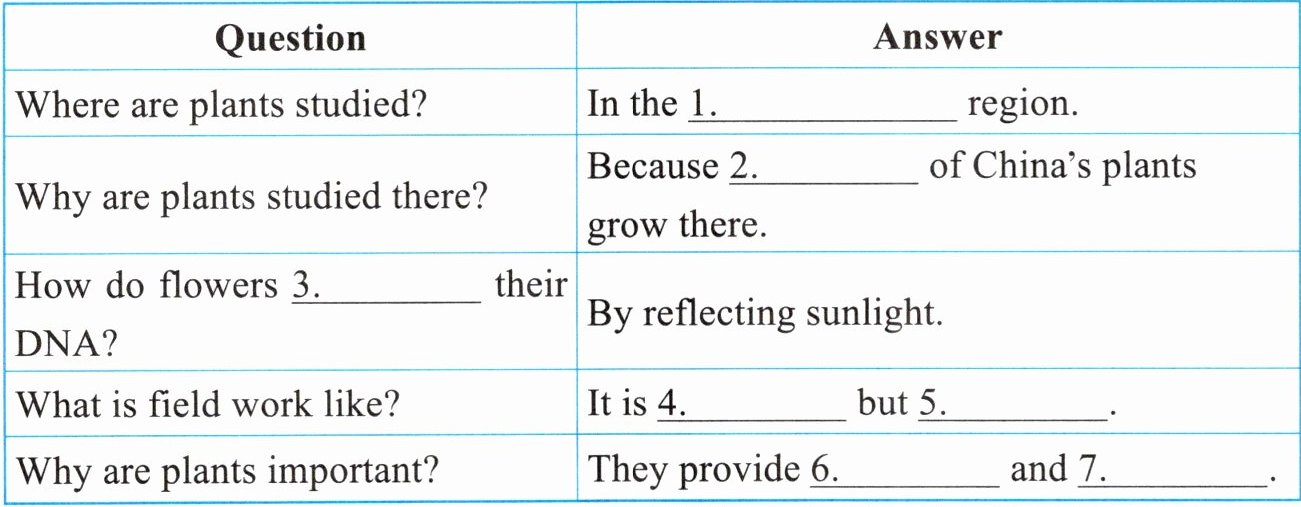
A. Complete the table. No more than two words for each blank.
B. Answer the question.
How do plants protect themselves in the environment? Give an example.
The pan-Himalayan region is a good place to study plants. The Himalayas have very high mountains and very deep valleys. This makes it a special home for plants. Two-thirds of China's plants grow there, and many grow only in that place. By studying them, we learn about many China's plants.
Some plants there have cool ways to live in hard places. For example, snow lotuses cover their leaves like a little greenhouse to stay warm. Purple-blue flowers reflect(反射) sunlight to help look after their DNA. These show us how nature solves problems.
What is it like to work in the field? It is hard but exciting. In rainforests, we wear full hats to stop mosquitoes and ants. Once in Xizang, I tried to collect a small orchid(兰花). Suddenly, a group of local bees flew at me! The orchid's flowers looked like wasps' wings, so the insects thought I was hurting their friends. This experience taught me that plants can be very smart.
Why do I do this work? Because plants are important to us. Medicine, like artemisinin(青蒿素), came from plants and saved so many people. Hybrid rice started with wild plants and helped to end hunger. There are about 20,000 kinds of plants in the Himalayas. Who knows what else we might find? That hope gives me strength to continue my work.
A. Complete the table. No more than two words for each blank.
B. Answer the question.
How do plants protect themselves in the environment? Give an example.
One possible version: Roses have thorns to protect themselves from being eaten by animals.
答案
Ⅲ. A. 1. pan-Himalayan 2. two-thirds 3. look after 4. hard
5. exciting 6. medicine 7. hybrid rice/food
B. One possible version: Roses have thorns to protect themselves from being eaten by animals.
5. exciting 6. medicine 7. hybrid rice/food
B. One possible version: Roses have thorns to protect themselves from being eaten by animals.
解析
【解析】
本题为任务型阅读题,需通读短文,根据题干在原文中定位对应内容,提取符合词数要求的信息完成填空与问答,重点考查对语篇细节信息的定位与提取能力。
【答案】
A. 1. pan-Himalayan
2. two-thirds
3. look after
4. hard
5. exciting
6. medicine
7. hybrid rice/food
B. One possible version: Roses have thorns to protect themselves from being eaten by animals.
【知识点】
任务型阅读、细节信息提取、语篇信息整合
【点评】
本题以喜马拉雅区域植物研究为载体,在考查阅读能力的同时,融入植物科普知识,既检验学生对语篇细节的捕捉能力,也能拓展学生的自然科学视野,兼具实用性与知识性。
【难度系数】
0.6
本题为任务型阅读题,需通读短文,根据题干在原文中定位对应内容,提取符合词数要求的信息完成填空与问答,重点考查对语篇细节信息的定位与提取能力。
【答案】
A. 1. pan-Himalayan
2. two-thirds
3. look after
4. hard
5. exciting
6. medicine
7. hybrid rice/food
B. One possible version: Roses have thorns to protect themselves from being eaten by animals.
【知识点】
任务型阅读、细节信息提取、语篇信息整合
【点评】
本题以喜马拉雅区域植物研究为载体,在考查阅读能力的同时,融入植物科普知识,既检验学生对语篇细节的捕捉能力,也能拓展学生的自然科学视野,兼具实用性与知识性。
【难度系数】
0.6
