

 登录
C
Project-based learning (项目化学习) is learning by doing. It gives learners the chance to get a deeper understanding of a topic. During the learning, learners solve problems by using real-world examples and challenges. Project-based learning is becoming widely used in schools. Students work on a project over a period of time from a week to a term. At the end of the project, they show their knowledge and skills by producing works to present to others. Let’s take the example of Sandra.
Sandra is an eleven-year-old student in a primary school. She wanted to know more about Greek mythology (希腊神话). Well, how did she do it?
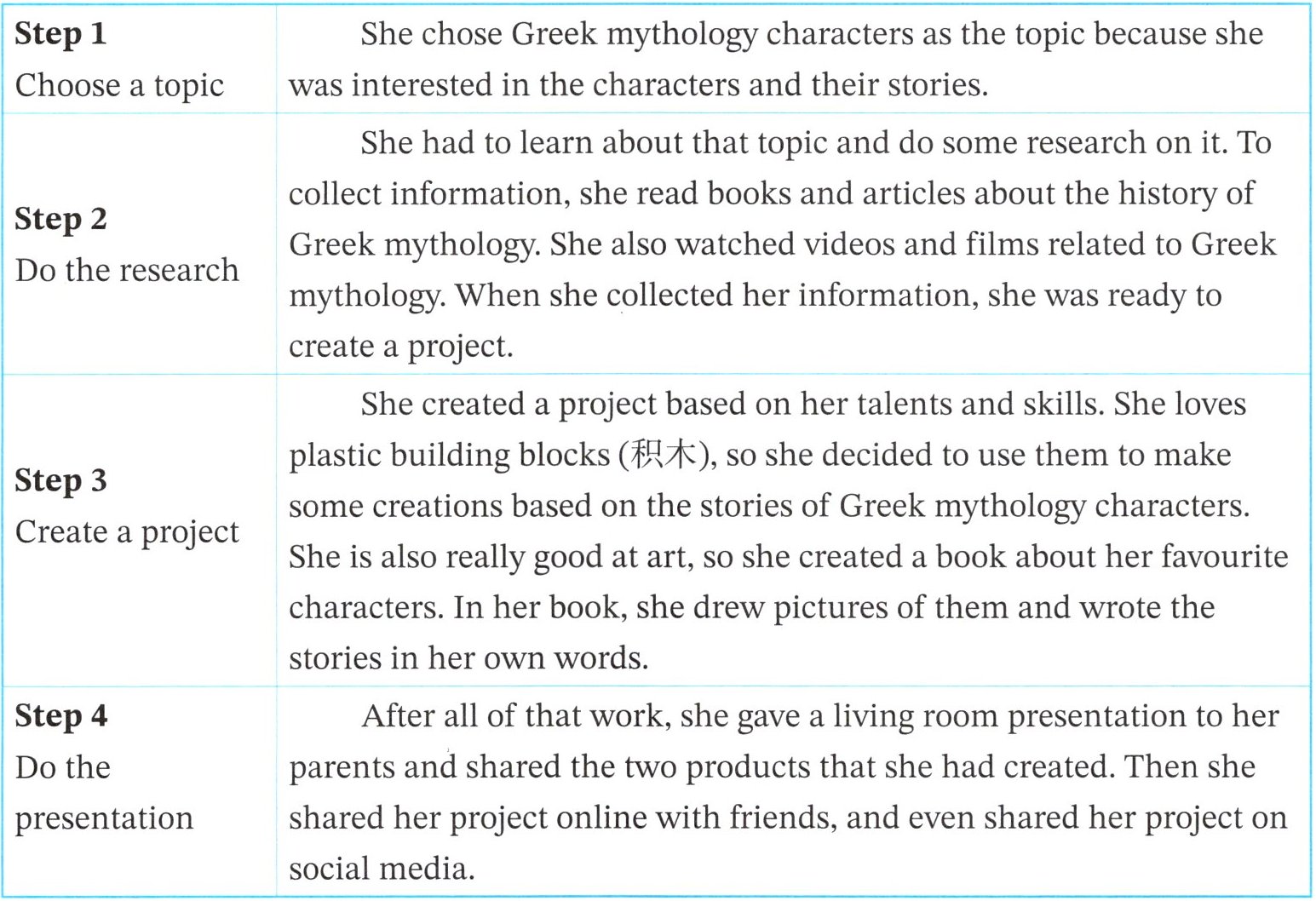
From the example of Sandra, we can see that project-based learning allows a student to learn about a topic and then create a project based on his or her talents and skills. Not everyone is a great test taker, but everyone is good at something. Through project work, students can not only learn deeply about a topic, but also have fun learning. So if you are interested in something, why not start with project-based learning?
(
A. A kind of test for students.
B. A way of learning by doing.
C. A challenge for top students only.
D. A subject taught in primary schools.
(
A. Because her teacher asked her to do so.
B. Because she wanted to share it on social media.
C. Because she was interested in them and their stories.
D. Because it was easy to collect information about them.
(
A. Watching films related to Greek mythology.
B. Making building block creations of the stories’ characters.
C. Reading books and articles about Greek mythology.
D. Watching videos related to Greek mythology.
(
A. She wrote songs.
B. She built block works.
C. She wrote a new novel.
D. She made a short video.
(
A. It is only for top students.
B. It helps everyone get good grades.
C. It should be students’ only way to study.
D. It helps students learn deeply and happily.
Project-based learning (项目化学习) is learning by doing. It gives learners the chance to get a deeper understanding of a topic. During the learning, learners solve problems by using real-world examples and challenges. Project-based learning is becoming widely used in schools. Students work on a project over a period of time from a week to a term. At the end of the project, they show their knowledge and skills by producing works to present to others. Let’s take the example of Sandra.
Sandra is an eleven-year-old student in a primary school. She wanted to know more about Greek mythology (希腊神话). Well, how did she do it?
From the example of Sandra, we can see that project-based learning allows a student to learn about a topic and then create a project based on his or her talents and skills. Not everyone is a great test taker, but everyone is good at something. Through project work, students can not only learn deeply about a topic, but also have fun learning. So if you are interested in something, why not start with project-based learning?
(
B
) 11. What is project-based learning according to Paragraph 1?A. A kind of test for students.
B. A way of learning by doing.
C. A challenge for top students only.
D. A subject taught in primary schools.
(
C
) 12. Why did Sandra choose Greek mythology characters as her topic?A. Because her teacher asked her to do so.
B. Because she wanted to share it on social media.
C. Because she was interested in them and their stories.
D. Because it was easy to collect information about them.
(
B
) 13. Which of the following did Sandra not do in Step 2?A. Watching films related to Greek mythology.
B. Making building block creations of the stories’ characters.
C. Reading books and articles about Greek mythology.
D. Watching videos related to Greek mythology.
(
B
) 14. What did Sandra do to create her project?A. She wrote songs.
B. She built block works.
C. She wrote a new novel.
D. She made a short video.
(
D
) 15. What can we learn about project-based learning from the last paragraph?A. It is only for top students.
B. It helps everyone get good grades.
C. It should be students’ only way to study.
D. It helps students learn deeply and happily.
答案
11. B 12. C 13. B 14. B 15. D
解析
【分析】本题为英语阅读理解细节类题目,需根据文章各段落及步骤中的具体信息,逐一对应各题选项进行判断。解题思路为:先定位每道题的问题关键词,再在原文中找到对应内容,对比选项得出正确答案。
【解析】
11题:根据第一段第一句“Project-based learning (项目化学习) is learning by doing.”可知,项目化学习是“做中学”的学习方式,对应选项B,故选B。
12题:根据Step1中的句子“She chose Greek mythology characters as the topic because she was interested in the characters and their stories.”可知,桑德拉选择希腊神话人物作为主题是因为她对这些人物和他们的故事感兴趣,对应选项C,故选C。
13题:Step2是做研究的步骤,内容包括读希腊神话的书籍和文章、看相关视频和电影;而制作积木作品是Step3的内容,因此Step2中桑德拉没有做的是选项B,故选B。
14题:根据Step3中的内容“she decided to use them (plastic building blocks) to make some creations based on the stories of Greek mythology characters”可知,桑德拉用积木制作了作品,对应选项B,故选B。
15题:根据最后一段中的句子“Through project work, students can not only learn deeply about a topic, but also have fun learning.”可知,项目化学习帮助学生深入且快乐地学习,对应选项D,故选D。
【答案】11.B 12.C 13.B 14.B 15.D
【知识点】英语阅读理解;细节理解题
【点评】本题围绕项目化学习的概念及实例展开,考查学生对原文细节信息的定位与理解能力,题目难度适中,只要仔细阅读原文即可正确解答。
【难度系数】0.7
