

 登录
登录
脚下风景:大地的“变形记”
How do you describe the surface of something? Round? Square? Or smooth? You might have different answers. But we can describe the Earth's surface through landforms. A landform is a natural feature of the Earth's surface. Mountains, hills, plateaus, and plains are four major types of landforms. A landform can be as large as a continent or as small as a pond.
Landforms are created by forces of nature. These forces could be wind, water, or ice. It usually takes a very long time for landforms to form, sometimes hundreds or thousands of years or even longer. For example, a valley may have started as a high hill. Over time, water and wind gradually wear down high land, sometimes forming plains and valleys. Many landforms are formed by water. So, the world around us is constantly changing, even if we can't see it happening!
What are the differences among the landforms? Valleys lie between hills or mountains, and there is usually a river at the bottom. A delta is another landform created by water. Deltas are found at the mouths of rivers and are formed by the deposition(沉积) of sediments (sand, soil, and rock) carried by the river. Hills and mountains are two other landforms. A hill is raised land, often with a rounded top. A mountain is typically higher than a hill. Most mountains are shaped like a cone, with a pointy top. However, some have flat tops, making them look like big tables.
阅读短文,选择最佳选项。
(
a. mountains b. ponds c. plains d. hills e. plateaus f. delta
A. a, b, c, f B. a, c, d, e C. a, b, c, e D. a, b, d, f
(
A. Why do landforms disappear? B. How are landforms formed?
C. What are the differences among landforms? D. Which landform is the most important to us?
(
A.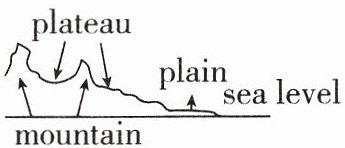 B.
B.  C. D.
C. D.
视频精讲 口语朗读
语篇类型: 说明文
难度星级: ★★★★
建议用时: /9 min
参考答案: P31
词汇积累
smooth /smuːð/ adj. 平滑的
landform /ˈlændfɔːm/ n. 地形;地貌
plateau /ˈplætəʊ/ n. 高原
force /fɔːs/ n. 力量
typically /ˈtɪpɪkli/ adv. 典型地
语法充电
as ... as ... 结构主要用于表示程度相等,意为“像……一样……”或“和……一样……”。
常用法: as+形容词/副词+as+比较对象。例如:
This book is as interesting as that one. 这本书和那本一样有趣。
He runs as fast as the wind. 他跑得像风一样快。
How do you describe the surface of something? Round? Square? Or smooth? You might have different answers. But we can describe the Earth's surface through landforms. A landform is a natural feature of the Earth's surface. Mountains, hills, plateaus, and plains are four major types of landforms. A landform can be as large as a continent or as small as a pond.
Landforms are created by forces of nature. These forces could be wind, water, or ice. It usually takes a very long time for landforms to form, sometimes hundreds or thousands of years or even longer. For example, a valley may have started as a high hill. Over time, water and wind gradually wear down high land, sometimes forming plains and valleys. Many landforms are formed by water. So, the world around us is constantly changing, even if we can't see it happening!
What are the differences among the landforms? Valleys lie between hills or mountains, and there is usually a river at the bottom. A delta is another landform created by water. Deltas are found at the mouths of rivers and are formed by the deposition(沉积) of sediments (sand, soil, and rock) carried by the river. Hills and mountains are two other landforms. A hill is raised land, often with a rounded top. A mountain is typically higher than a hill. Most mountains are shaped like a cone, with a pointy top. However, some have flat tops, making them look like big tables.
阅读短文,选择最佳选项。
(
B
)1. What are the four main kinds of landforms according to the text?a. mountains b. ponds c. plains d. hills e. plateaus f. delta
A. a, b, c, f B. a, c, d, e C. a, b, c, e D. a, b, d, f
(
B
)2. 主旨大意 Which of the following questions can be answered in Paragraph 2?A. Why do landforms disappear? B. How are landforms formed?
C. What are the differences among landforms? D. Which landform is the most important to us?
(
D
)3. 新考法 图片理解 In which picture can you find a valley?A.
B. C. D.视频精讲 口语朗读
语篇类型: 说明文
难度星级: ★★★★
建议用时: /9 min
参考答案: P31
词汇积累
smooth /smuːð/ adj. 平滑的
landform /ˈlændfɔːm/ n. 地形;地貌
plateau /ˈplætəʊ/ n. 高原
force /fɔːs/ n. 力量
typically /ˈtɪpɪkli/ adv. 典型地
语法充电
as ... as ... 结构主要用于表示程度相等,意为“像……一样……”或“和……一样……”。
常用法: as+形容词/副词+as+比较对象。例如:
This book is as interesting as that one. 这本书和那本一样有趣。
He runs as fast as the wind. 他跑得像风一样快。
答案
1. B 细节理解题。根据“Mountains, hills, plateaus, and plains are four major types of landforms.”可知,文中提到了山脉、丘陵、高原和平原这四种主要地形。故选 B。
易混辨析 plateau 和 mountain
plateau 高原,指海拔较高、相对平坦或略有起伏的地区,通常面积较大,地势相对平坦或略有起伏。高原上可能有河流、湖泊等自然景观,是许多动植物的栖息地。例如,青藏高原是中国最大的高原。
mountain 高山,指海拔较高、坡度陡峭的山地,通常具有明显的山峰和陡峭的坡度。高山地区常常有雪线、冰川等自然景观。例如,喜马拉雅山脉是世界上最高的山脉。
2. B 主旨大意题。第二段主要讲述了“Landforms are created by forces of nature. These forces could be wind, water, or ice.”,即地形是由自然力量如风、水或冰形成的,且形成需要很长时间,所以能回答选项 B“地形是如何形成的?”这个问题。故选 B。
3. D 推理判断题。根据“Valleys lie between hills or mountains, and there is usually a river at the bottom.”可知,山谷位于丘陵或山脉之间,底部通常有河流,图片 D 符合。故选 D。
易混辨析 plateau 和 mountain
plateau 高原,指海拔较高、相对平坦或略有起伏的地区,通常面积较大,地势相对平坦或略有起伏。高原上可能有河流、湖泊等自然景观,是许多动植物的栖息地。例如,青藏高原是中国最大的高原。
mountain 高山,指海拔较高、坡度陡峭的山地,通常具有明显的山峰和陡峭的坡度。高山地区常常有雪线、冰川等自然景观。例如,喜马拉雅山脉是世界上最高的山脉。
2. B 主旨大意题。第二段主要讲述了“Landforms are created by forces of nature. These forces could be wind, water, or ice.”,即地形是由自然力量如风、水或冰形成的,且形成需要很长时间,所以能回答选项 B“地形是如何形成的?”这个问题。故选 B。
3. D 推理判断题。根据“Valleys lie between hills or mountains, and there is usually a river at the bottom.”可知,山谷位于丘陵或山脉之间,底部通常有河流,图片 D 符合。故选 D。
