

 登录
登录
钱学森:一位科学家的“中国心”
“My career is in China, my achievement is in China, and my destination is in China too,” Qian Xuesen, the “Father of China’s Missile” and the “King of Rockets”, once said.
Qian Xuesen was born in Shanghai in 1911. He graduated in 1934 from Shanghai Jiaotong University. In 1935, he travelled to the US to study. He studied at the Massachusetts Institute of Technology and the California Institute of Technology. 1.
He had a strong will and never gave up. He studied rocketry in the US. Because he was so smart, he soon became a young professor. 2.
When Qian Xuesen was 44, he came back to his motherland. At that time, scientists in China knew little about rockets. 3.
5.
语篇类型: 记叙文
难度星级: ★★★★★
建议用时: /9 min
参考答案: P21
“My career is in China, my achievement is in China, and my destination is in China too,” Qian Xuesen, the “Father of China’s Missile” and the “King of Rockets”, once said.
Qian Xuesen was born in Shanghai in 1911. He graduated in 1934 from Shanghai Jiaotong University. In 1935, he travelled to the US to study. He studied at the Massachusetts Institute of Technology and the California Institute of Technology. 1.
G
He had a strong will and never gave up. He studied rocketry in the US. Because he was so smart, he soon became a young professor. 2.
A
When Qian Xuesen was 44, he came back to his motherland. At that time, scientists in China knew little about rockets. 3.
D
In 1956, he set up the first research institute of rockets and missiles. It was very hard. Qian and his team had to work on their own. 4. B
Then in 1970, they launched the first artificial satellite. Their work made our country safer.5.
F
He passed away on October 31, 2009, at the age of 98, but all the Chinese will remember him forever.语篇类型: 记叙文
难度星级: ★★★★★
建议用时: /9 min
参考答案: P21
答案
一、1. G 前文提到钱学森1935年赴美留学,先后就读于麻省理工学院和加州理工学院,因此此处应补充他在美国取得的学术成就(数学和航天学双博士学位)。
2. A 前文提到他在美国成为年轻教授,但后文转折讲述他回国报效祖国,因此此处需体现他虽在美国成功,但心系祖国。选项C符合客观现实,但在本文中与前后文逻辑不符,不要误选。
3. D 前文提到当时中国科学家对火箭知之甚少,后文则讲述钱学森1956年建立中国首个火箭导弹研究所,因此此处需体现他的回国为中国航天事业带来希望。
4. B 前文提到钱学森团队自主研究火箭和导弹,后文提到1970年发射首颗人造卫星,因此中间应补充1964年中国首颗原子弹爆炸的重大突破。
5. F 前文已讲述钱学森早期贡献(火箭、原子弹、卫星),此处需补充他影响的后续成就(2003年神舟五号载人飞船),体现其贡献的深远影响。选项E是钱学森在翻译方面的举例,与航天事业主线无关。
易错警示 第2题有可能误选选项C。“美国政府试图阻止他的归程”符合历史事实,但在本文中与前后文逻辑不符。
第5题有可能误选选项E。“他建议将‘LASER’译为‘激光’”符合历史事实,钱学森在翻译方面亦有贡献,但与本文航天事业主线无关。
2. A 前文提到他在美国成为年轻教授,但后文转折讲述他回国报效祖国,因此此处需体现他虽在美国成功,但心系祖国。选项C符合客观现实,但在本文中与前后文逻辑不符,不要误选。
3. D 前文提到当时中国科学家对火箭知之甚少,后文则讲述钱学森1956年建立中国首个火箭导弹研究所,因此此处需体现他的回国为中国航天事业带来希望。
4. B 前文提到钱学森团队自主研究火箭和导弹,后文提到1970年发射首颗人造卫星,因此中间应补充1964年中国首颗原子弹爆炸的重大突破。
5. F 前文已讲述钱学森早期贡献(火箭、原子弹、卫星),此处需补充他影响的后续成就(2003年神舟五号载人飞船),体现其贡献的深远影响。选项E是钱学森在翻译方面的举例,与航天事业主线无关。
易错警示 第2题有可能误选选项C。“美国政府试图阻止他的归程”符合历史事实,但在本文中与前后文逻辑不符。
第5题有可能误选选项E。“他建议将‘LASER’译为‘激光’”符合历史事实,钱学森在翻译方面亦有贡献,但与本文航天事业主线无关。
二、 新考法 开放问答 结合钱学森的经历和你的观点,回答问题。
What do you think of Qian Xuesen?
词汇积累
career /kəˈrɪə(r)/ n. 职业,事业
destination /ˌdestɪˈneɪʃn/ n. 目的地
missile /ˈmɪsaɪl/ n. 导弹
graduate /ˈɡrædʒueɪt/ v. 毕业
institute /ˈɪnstɪtjuːt/ n. 研究所
professor /prəˈfesə(r)/ n. 教授
artificial satellite 人造卫星
语法充电
1. “graduate from + 学校名称”表示“从……(学校)毕业”。
2. know little about 表示“对……知之甚少”。little 表示否定,意为“几乎没有”。a little 表示肯定,意为“一点”,修饰不可数名词。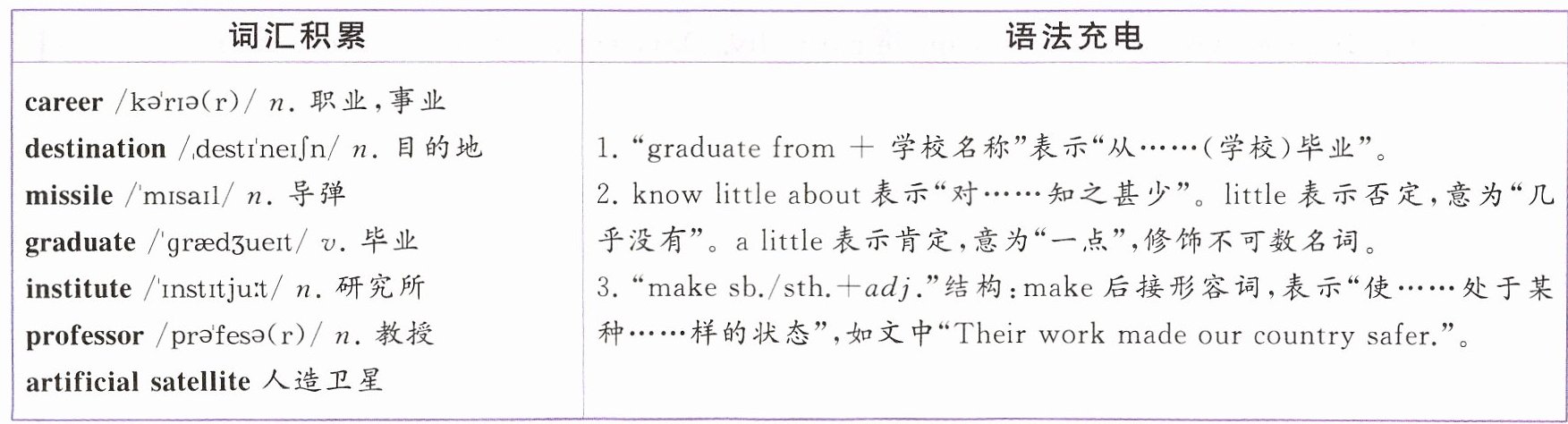
3. “make sb./sth.+adj.”结构:make 后接形容词,表示“使……处于某种……样的状态”,如文中“Their work made our country safer.”。
What do you think of Qian Xuesen?
词汇积累
career /kəˈrɪə(r)/ n. 职业,事业
destination /ˌdestɪˈneɪʃn/ n. 目的地
missile /ˈmɪsaɪl/ n. 导弹
graduate /ˈɡrædʒueɪt/ v. 毕业
institute /ˈɪnstɪtjuːt/ n. 研究所
professor /prəˈfesə(r)/ n. 教授
artificial satellite 人造卫星
语法充电
1. “graduate from + 学校名称”表示“从……(学校)毕业”。
2. know little about 表示“对……知之甚少”。little 表示否定,意为“几乎没有”。a little 表示肯定,意为“一点”,修饰不可数名词。
3. “make sb./sth.+adj.”结构:make 后接形容词,表示“使……处于某种……样的状态”,如文中“Their work made our country safer.”。
答案
二、I think Qian Xuesen was smart and helped to protect our country.(答案不唯一)
