

 登录
B(2024 重庆中考A卷)
Bill: (reading) "White like jade, bright as a mirror, thin as paper, sound
like a bell."
Mum: Is that for your Chinese story competition?
Bill: Yes. It describes porcelain(瓷器) in Jingdezhen, the "Porcelain
Capital of the World". You know porcelain is called china in English because it
was first made in China!
Mum: Interesting!
Bill: Many cities in China have a long history of porcelain industry. They
have created wonderful porcelain pieces.
Mum: Like Rongchang? We made a bowl in the workshop.
Bill: (smiling) Lots of fun. But that's pottery(陶器). Rongchang is called the "Pottery Capital of
China", with Yixing, Jianshui, and Qinzhou. Chinese pottery has a very long history. Porcelain
develops from pottery.
Mum: Any differences?
Bill: Er... (searching online) The clay(黏土) is different. And porcelain is fired at a
temperature above 1,200 ℃; pottery below 1,000 ℃.
Mum: But they look so similar.
Bill: They are called "Taoci" in Chinese. But porcelain feels harder and produces a clear sound.
Mum: (tapping a vase) Like this?
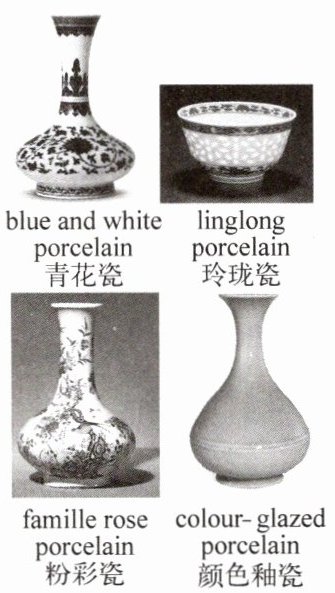
Bill: (nodding) It's blue and white porcelain, one of the four famous types in Jingdezhen, together
with linglong porcelain, famille rose porcelain and colour-glazed porcelain.
Mum: Any others?
Bill: Many well-known types there, and also in other cities, like Dehua near ancient Quanzhou.
Mum: The Silk Road on the sea?
Bill: Yes. Dehua porcelain was mainly collected by Europeans at that time. Along with China's
silk and tea, porcelain was one of the first goods traveling around the world.
Mum: Chinese porcelain has deeply influenced the world porcelain industry.
Bill: This is also in my story. And I'm thinking about what else I can talk about.
Mum: How about some Chinese artists? They create priceless works and have students from all over
the world. One of them said, "Colour is universal. There is no barrier between cultural
communications."
Bill: Yes! For cultural communication, there is no barrier; for Chinese culture, I will be a
carrier!
Mum: Excellent!
Bill: Thank you, Mum. How can I know that much like you? There's still something unclear.
Mum: Visiting a porcelain museum?
Bill: Good idea!
(
A. Chinese cities. B. Chinese history.
C. Chinese pottery. D. Chinese porcelain.
(
A. Porcelain feels much softer than pottery.
B. Porcelain is fired at a temperature above 1,200 ℃.
C. Pottery has a much shorter history than porcelain.
D. Pottery and porcelain use the same kind of clay.
(
A. A famous Chinese artist. B. Dehua near ancient Quanzhou.
C. The Silk Road on the sea. D. The influence of Chinese porcelain.
(
A. Because she knows nothing at all. B. Because she wants to be an artist.
C. Because she is encouraging her son. D. Because she is interested in her bowl.
Bill: (reading) "White like jade, bright as a mirror, thin as paper, sound
like a bell."
Mum: Is that for your Chinese story competition?
Bill: Yes. It describes porcelain(瓷器) in Jingdezhen, the "Porcelain
Capital of the World". You know porcelain is called china in English because it
was first made in China!
Mum: Interesting!
Bill: Many cities in China have a long history of porcelain industry. They
have created wonderful porcelain pieces.
Mum: Like Rongchang? We made a bowl in the workshop.
Bill: (smiling) Lots of fun. But that's pottery(陶器). Rongchang is called the "Pottery Capital of
China", with Yixing, Jianshui, and Qinzhou. Chinese pottery has a very long history. Porcelain
develops from pottery.
Mum: Any differences?
Bill: Er... (searching online) The clay(黏土) is different. And porcelain is fired at a
temperature above 1,200 ℃; pottery below 1,000 ℃.
Mum: But they look so similar.
Bill: They are called "Taoci" in Chinese. But porcelain feels harder and produces a clear sound.
Mum: (tapping a vase) Like this?
Bill: (nodding) It's blue and white porcelain, one of the four famous types in Jingdezhen, together
with linglong porcelain, famille rose porcelain and colour-glazed porcelain.
Mum: Any others?
Bill: Many well-known types there, and also in other cities, like Dehua near ancient Quanzhou.
Mum: The Silk Road on the sea?
Bill: Yes. Dehua porcelain was mainly collected by Europeans at that time. Along with China's
silk and tea, porcelain was one of the first goods traveling around the world.
Mum: Chinese porcelain has deeply influenced the world porcelain industry.
Bill: This is also in my story. And I'm thinking about what else I can talk about.
Mum: How about some Chinese artists? They create priceless works and have students from all over
the world. One of them said, "Colour is universal. There is no barrier between cultural
communications."
Bill: Yes! For cultural communication, there is no barrier; for Chinese culture, I will be a
carrier!
Mum: Excellent!
Bill: Thank you, Mum. How can I know that much like you? There's still something unclear.
Mum: Visiting a porcelain museum?
Bill: Good idea!
(
D
) 5. What will Bill mainly talk about in his Chinese story competition?A. Chinese cities. B. Chinese history.
C. Chinese pottery. D. Chinese porcelain.
(
B
) 6. What can we learn about porcelain and pottery?A. Porcelain feels much softer than pottery.
B. Porcelain is fired at a temperature above 1,200 ℃.
C. Pottery has a much shorter history than porcelain.
D. Pottery and porcelain use the same kind of clay.
(
D
) 7. What does the underlined word "This" refer to?A. A famous Chinese artist. B. Dehua near ancient Quanzhou.
C. The Silk Road on the sea. D. The influence of Chinese porcelain.
(
C
) 8. Why is Bill's mother always asking questions?A. Because she knows nothing at all. B. Because she wants to be an artist.
C. Because she is encouraging her son. D. Because she is interested in her bowl.
答案
【语篇导读】本文是比尔和妈妈关于中国瓷器的对话。他们谈到了不同类型的瓷器,以及其与陶器的区别。两人还探讨了中国艺术家对瓷器制作的贡献,并计划去博物馆进一步学习。
5. D 提示:细节理解题。根据对话中“Mum: Is that for your Chinese story competition?”和“Bill: Yes. It describes porcelain in Jingdezhen, the ‘Porcelain Capital of the World’.”可知,比尔将在中国故事比赛中谈论中国瓷器。
6. B 提示:细节理解题。根据对话中“And porcelain is fired at a temperature above $1,200°C$; pottery below $1,000°C$.”可知,瓷器的烧制温度要高于$1200°C$,而陶器要低于$1000°C$。
7. D 提示:词义指代题。根据画线词上一句“Mum: Chinese porcelain has deeply influenced the world porcelain industry.”可推断,比尔说的“This”指代妈妈提到的中国瓷器对世界瓷器产生的深远影响。
8. C 提示:推理判断题。在整个对话中,比尔的妈妈通过提问的方式,不断引导比尔深入讨论和分享关于中国瓷器和陶器的知识。这些问题不仅仅是出于她对某个具体话题的兴趣,更是为了鼓励和促进比尔学习和思考。
