

 登录
登录
Ⅳ. 根据上题中的短文,回答问题。
1. What does the underlined sentence mean?
2. Did Hua Luogeng have challenges in his learning?
3. What can we learn from Hua Luogeng?
1. What does the underlined sentence mean?
When you first read a book, it seems difficult and hard to understand, but as you learn more and understand it deeply, it becomes easier.
2. Did Hua Luogeng have challenges in his learning?
Yes, he did.
3. What can we learn from Hua Luogeng?
We should stay positive no matter what difficulties we meet in our lives and studies.
答案
1. When you first read a book, it seems difficult and hard to understand, but as you learn more and understand it deeply, it becomes easier.
2. Yes, he did.
3. We should stay positive no matter what difficulties we meet in our lives and studies.
(答案不唯一,仅供参考)
2. Yes, he did.
3. We should stay positive no matter what difficulties we meet in our lives and studies.
(答案不唯一,仅供参考)
解析
【分析】本题为基于短文的阅读理解题,第1题考查划线句子的含义,需结合短文语境理解其表达的核心意思;第2题考查细节判断,需从短文中华罗庚的学习经历判断是否存在挑战;第3题考查主旨感悟,需结合华罗庚的事迹提炼启示。
【解析】1. 结合短文语境,划线句子的含义是:当你第一次读一本书时,似乎很难理解,但随着你学习更多、理解更深入,它就变得容易了;2. 根据短文中华罗庚的学习经历,可知他在学习中遇到过挑战,故作出肯定回答;3. 从华罗庚克服困难的经历,可提炼出面对困难要保持积极态度的启示。
【答案】
1. When you first read a book, it seems difficult and hard to understand, but as you learn more and understand it deeply, it becomes easier.
2. Yes, he did.
3. We should stay positive no matter what difficulties we meet in our lives and studies.
【知识点】阅读理解(句意理解)、细节理解、主旨大意
【点评】本题为常规基础英语阅读理解题,考查学生对短文句意、细节及主旨的把握,符合英语阅读题的基础考查要求。
【难度系数】0.6
【解析】1. 结合短文语境,划线句子的含义是:当你第一次读一本书时,似乎很难理解,但随着你学习更多、理解更深入,它就变得容易了;2. 根据短文中华罗庚的学习经历,可知他在学习中遇到过挑战,故作出肯定回答;3. 从华罗庚克服困难的经历,可提炼出面对困难要保持积极态度的启示。
【答案】
1. When you first read a book, it seems difficult and hard to understand, but as you learn more and understand it deeply, it becomes easier.
2. Yes, he did.
3. We should stay positive no matter what difficulties we meet in our lives and studies.
【知识点】阅读理解(句意理解)、细节理解、主旨大意
【点评】本题为常规基础英语阅读理解题,考查学生对短文句意、细节及主旨的把握,符合英语阅读题的基础考查要求。
【难度系数】0.6
Ⅴ. 选择恰当的句子补全短文,其中有一项多余。
Do you find it hard to learn English? Here are some good suggestions for you.
1.
Talk to your friends you know in English. 2.
3.
The easiest language learning skill is to try! Don’t be afraid to make mistakes when you speak and write English. In fact, you will learn as much from your mistakes as you learn from your success. 4.
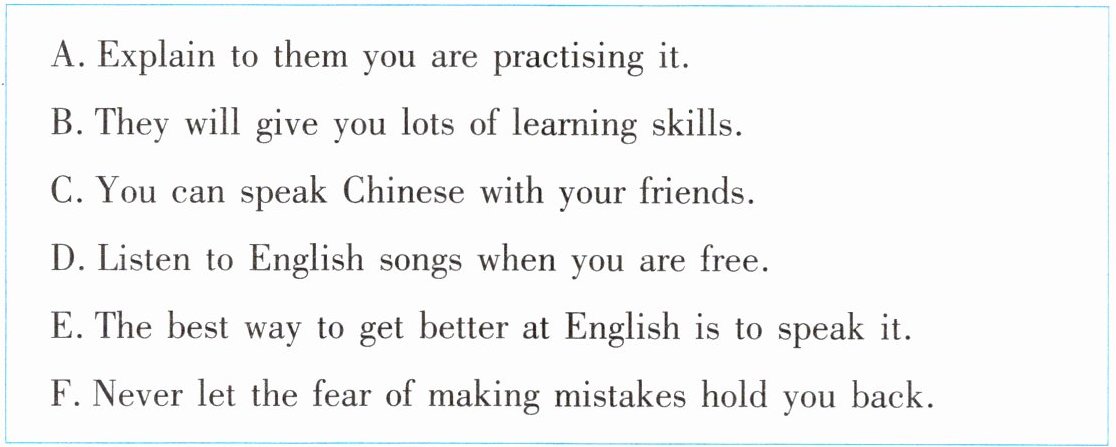
Do you find it hard to learn English? Here are some good suggestions for you.
1.
E
Even if there is no one around to speak to, talk to yourself. Name things as you pass them. This simple language learning skill will help you understand these everyday words.Talk to your friends you know in English. 2.
A
They may understand you even if they don’t speak it. Simple expressions like “Good morning!” in English will make those sentences more natural to you. Your friends may even start to learn a few sentences as well.3.
D
You’ll hear the language used in a real situation and this will help you judge the pronunciation even better. You will also come to further understand and better enjoy the culture behind the language.The easiest language learning skill is to try! Don’t be afraid to make mistakes when you speak and write English. In fact, you will learn as much from your mistakes as you learn from your success. 4.
F
It’s a good way to find an English club. It’s helpful to speak with other people who are still going through the course of learning English. 5. B
答案
1. E 2. A 3. D 4. F 5. B
解析
【分析】
本题为英语补全短文题,需先通读全文理解每段主旨,再结合空格前后的语境逻辑,匹配最合适的句子。解题时要关注空格前后的关键词,如第1空后强调“talk to yourself”(和自己说话),对应“说英语”的核心;第2空前提到“和朋友用英语交谈”,需衔接朋友的反应;第3空后涉及“hear the language”(听语言),对应听英语的方式;第4空前提到“不要怕犯错”,需承接该主题;第5空前说和学英语的人交流,需匹配对方的帮助。
【解析】
1. 第1空:空格后提到“即使周围没人也和自己说话”,核心是“说英语”,E选项“提高英语最好的方法是说英语”契合该主旨,故选E。
2. 第2空:空格前说“和朋友用英语交谈”,A选项“向他们解释你在练习它”能让朋友理解自己的行为,符合语境,故选A。
3. 第3空:空格后提到“听到真实场景的语言,帮助判断发音”,D选项“有空时听英文歌”是听英语的有效方式,契合语境,故选D。
4. 第4空:空格前说“不要怕犯错”,F选项“不要让犯错的恐惧阻碍你”承接该主题,故选F。
5. 第5空:空格前说“和学英语的人交流”,B选项“他们会给你很多学习技巧”符合交流带来的帮助,故选B。
【答案】
1. E 2. A 3. D 4. F 5. B
【知识点】
英语补全短文、英语学习方法
【点评】
本题围绕英语学习方法展开,需结合上下文逻辑匹配句子,难度适中,只要理清每段主旨和语境关联即可正确作答。
【难度系数】
0.6
本题为英语补全短文题,需先通读全文理解每段主旨,再结合空格前后的语境逻辑,匹配最合适的句子。解题时要关注空格前后的关键词,如第1空后强调“talk to yourself”(和自己说话),对应“说英语”的核心;第2空前提到“和朋友用英语交谈”,需衔接朋友的反应;第3空后涉及“hear the language”(听语言),对应听英语的方式;第4空前提到“不要怕犯错”,需承接该主题;第5空前说和学英语的人交流,需匹配对方的帮助。
【解析】
1. 第1空:空格后提到“即使周围没人也和自己说话”,核心是“说英语”,E选项“提高英语最好的方法是说英语”契合该主旨,故选E。
2. 第2空:空格前说“和朋友用英语交谈”,A选项“向他们解释你在练习它”能让朋友理解自己的行为,符合语境,故选A。
3. 第3空:空格后提到“听到真实场景的语言,帮助判断发音”,D选项“有空时听英文歌”是听英语的有效方式,契合语境,故选D。
4. 第4空:空格前说“不要怕犯错”,F选项“不要让犯错的恐惧阻碍你”承接该主题,故选F。
5. 第5空:空格前说“和学英语的人交流”,B选项“他们会给你很多学习技巧”符合交流带来的帮助,故选B。
【答案】
1. E 2. A 3. D 4. F 5. B
【知识点】
英语补全短文、英语学习方法
【点评】
本题围绕英语学习方法展开,需结合上下文逻辑匹配句子,难度适中,只要理清每段主旨和语境关联即可正确作答。
【难度系数】
0.6
Ⅵ. 阅读理解。
As a student, I was most afraid to answer questions in class, and I found that the students around were just like me. At the beginning of each class, when the teacher asked a question, I always lowered my head because I was afraid that the teacher saw me. One day, in a foreign
language class, Mr Black gave us a lesson. He wanted us to be active in class, so he asked us some questions, but no one answered. “Let me tell you a story first,” he said. “When I came to my university to study, the university often invited some people to make speeches. Before the beginning of every speech, I found an interesting thing. The students around me always took a cardboard folded in half, wrote their names boldly with the most eye-catching colour, and then placed the cardboard on the seat. So when the speaker needed the answers from the students, he could see and call a listener's name directly.”
“I couldn't understand that. My classmate told me the speakers were all top people who meant chances. When your answer was to his surprise, it meant he might give you more chances. In fact, I really saw a few students got great chances because of that.”
After listening to the story, I understood that the chance would not find you itself. You must show yourself all the time so that you could find a chance on the card.
(
A. Read aloud.
B. Take notes.
C. Be active.
D. Listen carefully.
(
A. To know each other at once.
B. To get them called by the speaker.
C. To make the speaker happy.
D. To show they are good at art.
(
A. 引人注目的
B. 眼睛疼痛的
C. 目光呆滞的
D. 睡眼蒙眬的
(
A. Doing as others do is necessary.
B. Answering questions bravely is easy.
C. Attracting others' attention is interesting.
D. Showing yourself bravely can win chances.
As a student, I was most afraid to answer questions in class, and I found that the students around were just like me. At the beginning of each class, when the teacher asked a question, I always lowered my head because I was afraid that the teacher saw me. One day, in a foreign
language class, Mr Black gave us a lesson. He wanted us to be active in class, so he asked us some questions, but no one answered. “Let me tell you a story first,” he said. “When I came to my university to study, the university often invited some people to make speeches. Before the beginning of every speech, I found an interesting thing. The students around me always took a cardboard folded in half, wrote their names boldly with the most eye-catching colour, and then placed the cardboard on the seat. So when the speaker needed the answers from the students, he could see and call a listener's name directly.”
“I couldn't understand that. My classmate told me the speakers were all top people who meant chances. When your answer was to his surprise, it meant he might give you more chances. In fact, I really saw a few students got great chances because of that.”
After listening to the story, I understood that the chance would not find you itself. You must show yourself all the time so that you could find a chance on the card.
(
C
)1. What did Mr Black want the students to do in his class?A. Read aloud.
B. Take notes.
C. Be active.
D. Listen carefully.
(
B
)2. Why did the students around Mr Black put the cardboard with their names on the seat?A. To know each other at once.
B. To get them called by the speaker.
C. To make the speaker happy.
D. To show they are good at art.
(
A
)3. What does the underlined word “eye-catching” in paragraph 1 mean in Chinese?A. 引人注目的
B. 眼睛疼痛的
C. 目光呆滞的
D. 睡眼蒙眬的
(
D
)4. What does the writer mainly tell us?A. Doing as others do is necessary.
B. Answering questions bravely is easy.
C. Attracting others' attention is interesting.
D. Showing yourself bravely can win chances.
答案
1. C 2. B 3. A 4. D
解析
【分析】
做这类英语阅读理解题,需先通读全文把握核心大意,再针对每道题的题干关键词回原文定位对应信息,结合语境分析选项:第1题找Mr Black的教学目的,第2题找学生放卡片的原因,第3题结合上下文猜测词义,第4题提炼文章主旨。
【解析】
1. 细节理解题:根据原文第一段“Mr Black gave us a lesson. He wanted us to be active in class”,可知布莱克先生希望学生在课堂上活跃,对应选项C。
2. 细节理解题:根据原文第一段“when the speaker needed the answers from the students, he could see and call a listener's name directly”,可知学生放写有名字的卡片是为了让演讲者直接叫到自己,对应选项B。
3. 词义猜测题:“eye-catching”修饰颜色,结合语境表示颜色显眼,即“引人注目的”,对应选项A。
4. 主旨大意题:根据最后一段“you must show yourself all the time so that you could find a chance”,可知文章主旨是勇敢展示自己能赢得机会,对应选项D。
【答案】
1. C 2. B 3. A 4. D
【知识点】
英语阅读理解、细节查找、词义猜测、主旨归纳
【点评】
本文是一篇关于抓住机会的教育类短文,题目侧重考查信息提取、词义猜测和主旨提炼,难度适中,需学生具备基础的阅读分析能力。
【难度系数】
0.6
做这类英语阅读理解题,需先通读全文把握核心大意,再针对每道题的题干关键词回原文定位对应信息,结合语境分析选项:第1题找Mr Black的教学目的,第2题找学生放卡片的原因,第3题结合上下文猜测词义,第4题提炼文章主旨。
【解析】
1. 细节理解题:根据原文第一段“Mr Black gave us a lesson. He wanted us to be active in class”,可知布莱克先生希望学生在课堂上活跃,对应选项C。
2. 细节理解题:根据原文第一段“when the speaker needed the answers from the students, he could see and call a listener's name directly”,可知学生放写有名字的卡片是为了让演讲者直接叫到自己,对应选项B。
3. 词义猜测题:“eye-catching”修饰颜色,结合语境表示颜色显眼,即“引人注目的”,对应选项A。
4. 主旨大意题:根据最后一段“you must show yourself all the time so that you could find a chance”,可知文章主旨是勇敢展示自己能赢得机会,对应选项D。
【答案】
1. C 2. B 3. A 4. D
【知识点】
英语阅读理解、细节查找、词义猜测、主旨归纳
【点评】
本文是一篇关于抓住机会的教育类短文,题目侧重考查信息提取、词义猜测和主旨提炼,难度适中,需学生具备基础的阅读分析能力。
【难度系数】
0.6
