

 登录
登录
提思维 分析判断 阅读材料,完成下列任务。
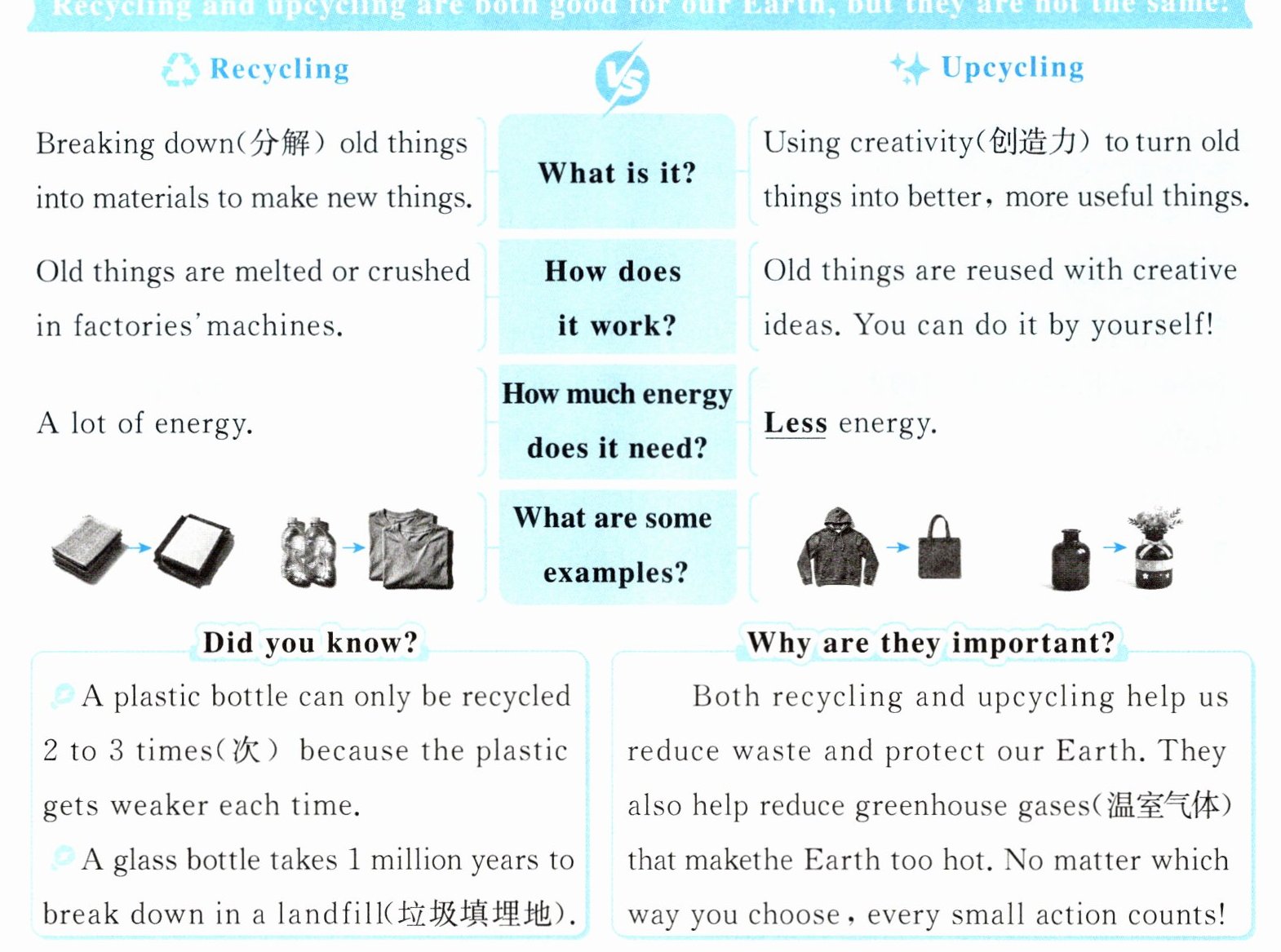
Recycling and upcycling are both good for our Earth, but they are not the same!
♻️ Recycling
Breaking down(分解)old things into materials to make new things.
Old things are melted or crushed in factories' machines.
A lot of energy.
Did you know?
A plastic bottle can only be recycled 2 to 3 times(次)because the plastic gets weaker each time.
A glass bottle takes 1 million years to break down in a landfill(垃圾填埋地).
✨ Upcycling
What is it? Using creativity(创造力) to turn old things into better, more useful things.
How does it work? Old things are reused with creative ideas. You can do it by yourself!
How much energy does it need? Less energy.
What are some examples?
Why are they important?
Both recycling and upcycling help us reduce waste and protect our Earth. They also help reduce greenhouse gases(温室气体) that make the Earth too hot. No matter which way you choose, every small action counts!
任务一:根据材料内容,选择正确的答案。
(
A. Turn plastic bottles into clothes. B. Turn glass bottles into new glass windows.
C. Make a hat with a cardboard box.
(
A. 更多的 B. 更少的 C. 相同的
(
A. Protect our Earth. B. Make new machines. C. Use more energy.
(
A. To teach us how to make things with old things. B. To show us how to protect the Earth.
C. To explain the difference between recycling and upcycling.
任务二:根据材料内容或结合生活实际,回答问题。
1. How many times can a plastic bottle be recycled?
2. Which do you think is more interesting, recycling or upcycling? Why?
Recycling and upcycling are both good for our Earth, but they are not the same!
♻️ Recycling
Breaking down(分解)old things into materials to make new things.
Old things are melted or crushed in factories' machines.
A lot of energy.
Did you know?
A plastic bottle can only be recycled 2 to 3 times(次)because the plastic gets weaker each time.
A glass bottle takes 1 million years to break down in a landfill(垃圾填埋地).
✨ Upcycling
What is it? Using creativity(创造力) to turn old things into better, more useful things.
How does it work? Old things are reused with creative ideas. You can do it by yourself!
How much energy does it need? Less energy.
What are some examples?
Why are they important?
Both recycling and upcycling help us reduce waste and protect our Earth. They also help reduce greenhouse gases(温室气体) that make the Earth too hot. No matter which way you choose, every small action counts!
任务一:根据材料内容,选择正确的答案。
(
C
)1. Which of the following is an example of upcycling?A. Turn plastic bottles into clothes. B. Turn glass bottles into new glass windows.
C. Make a hat with a cardboard box.
(
B
)2. The underlined word “Less” means “B
”.A. 更多的 B. 更少的 C. 相同的
(
A
)3. According to the material, what do both recycling and upcycling help us do?A. Protect our Earth. B. Make new machines. C. Use more energy.
(
C
)4. What is the main purpose of this material?A. To teach us how to make things with old things. B. To show us how to protect the Earth.
C. To explain the difference between recycling and upcycling.
任务二:根据材料内容或结合生活实际,回答问题。
1. How many times can a plastic bottle be recycled?
2 to 3 times.
2. Which do you think is more interesting, recycling or upcycling? Why?
I think upcycling is more interesting because I can use my creativity to make useful things.
答案
任务一:1. C 2. B 3. A 4. C
任务二:1. 2 to 3 times.
2. I think upcycling is more interesting because I can use my creativity to make useful things.
任务二:1. 2 to 3 times.
2. I think upcycling is more interesting because I can use my creativity to make useful things.
解析
【分析】
首先,任务一的选择题需结合材料细节逐一判断:1题需明确upcycling的定义,对比选项找出符合创意改造旧物的例子;2题结合上下文语境猜测Less的含义;3题定位材料最后一段,提取两者共同作用的内容;4题根据材料开头及整体结构,判断主旨。任务二的第1题直接定位材料对应细节,第2题结合upcycling的特点给出合理开放回答。
【解析】
任务一:
1. 细节理解题:根据upcycling的定义“Using creativity to turn old things into better, more useful things”,A项塑料瓶变衣服属于recycling的例子,B项玻璃瓶变新窗户属于recycling,C项用纸箱做帽子符合upcycling的创意改造,故选C。
2. 词义猜测题:材料中recycling需要“A lot of energy”,upcycling的能量需求是“Less”,对比可知Less意为“更少的”,故选B。
3. 细节理解题:根据材料最后一段“Both recycling and upcycling help us reduce waste and protect our Earth”,可知两者共同帮助保护地球,故选A。
4. 主旨大意题:材料开头点明两者不同,全文对比介绍recycling和upcycling的定义、方式等,目的是解释两者的区别,故选C。
任务二:
1. 细节理解题:根据材料“Did you know?”部分“A plastic bottle can only be recycled 2 to 3 times”,可知答案为2 to 3 times。
2. 开放题:结合upcycling可发挥创造力的特点,给出合理回答,参考示例为“I think upcycling is more interesting because I can use my creativity to make useful things.”
【答案】
任务一:1. C 2. B 3. A 4. C
任务二:1. 2 to 3 times.
2. I think upcycling is more interesting because I can use my creativity to make useful things.
【知识点】
英语阅读理解、细节理解、主旨大意
【点评】
本题围绕回收与升级改造的区别展开,考查学生提取细节、猜测词义、理解主旨的能力,贴近生活实际,题目难度适中,易于学生作答。
【难度系数】
0.7
首先,任务一的选择题需结合材料细节逐一判断:1题需明确upcycling的定义,对比选项找出符合创意改造旧物的例子;2题结合上下文语境猜测Less的含义;3题定位材料最后一段,提取两者共同作用的内容;4题根据材料开头及整体结构,判断主旨。任务二的第1题直接定位材料对应细节,第2题结合upcycling的特点给出合理开放回答。
【解析】
任务一:
1. 细节理解题:根据upcycling的定义“Using creativity to turn old things into better, more useful things”,A项塑料瓶变衣服属于recycling的例子,B项玻璃瓶变新窗户属于recycling,C项用纸箱做帽子符合upcycling的创意改造,故选C。
2. 词义猜测题:材料中recycling需要“A lot of energy”,upcycling的能量需求是“Less”,对比可知Less意为“更少的”,故选B。
3. 细节理解题:根据材料最后一段“Both recycling and upcycling help us reduce waste and protect our Earth”,可知两者共同帮助保护地球,故选A。
4. 主旨大意题:材料开头点明两者不同,全文对比介绍recycling和upcycling的定义、方式等,目的是解释两者的区别,故选C。
任务二:
1. 细节理解题:根据材料“Did you know?”部分“A plastic bottle can only be recycled 2 to 3 times”,可知答案为2 to 3 times。
2. 开放题:结合upcycling可发挥创造力的特点,给出合理回答,参考示例为“I think upcycling is more interesting because I can use my creativity to make useful things.”
【答案】
任务一:1. C 2. B 3. A 4. C
任务二:1. 2 to 3 times.
2. I think upcycling is more interesting because I can use my creativity to make useful things.
【知识点】
英语阅读理解、细节理解、主旨大意
【点评】
本题围绕回收与升级改造的区别展开,考查学生提取细节、猜测词义、理解主旨的能力,贴近生活实际,题目难度适中,易于学生作答。
【难度系数】
0.7
