

 登录
10. 若$a^2 - 3ab + b^2 = 0$,且$a>b>0$,则$\dfrac{b+a}{b-a}$的值为(
A.$\sqrt{2}$
B.$-\sqrt{2}$
C.$\sqrt{5}$
D.$-\sqrt{5}$
D
)A.$\sqrt{2}$
B.$-\sqrt{2}$
C.$\sqrt{5}$
D.$-\sqrt{5}$
答案
10. D 解析:$\because a^2 - 3ab + b^2 = 0$,$\therefore a^2 - 2ab + b^2 = ab$, $a^2 + 2ab + b^2 = 5ab$,$\therefore (b-a)^2 = ab$, $(b+a)^2 = 5ab$,$\therefore b-a = ±\sqrt{ab}$, $b+a = ±\sqrt{5ab}$.$\because a>b>0$,$\therefore b-a = -\sqrt{ab}$, $b+a = \sqrt{5ab}$,$\therefore \dfrac{b+a}{b-a} = \dfrac{\sqrt{5ab}}{-\sqrt{ab}} = -\sqrt{5}$.故选 D.
11. 已知 $ x = 9 - 2y $,则 $ 3\sqrt{x - 2y} ÷ \sqrt{4x^2 - 16y^2} = $
$\dfrac{1}{2}$
.答案
11. $\dfrac{1}{2}$ 解析: $\because x = 9 - 2y$,$\therefore x + 2y = 9$,$\therefore 3 \sqrt{x-2y} ÷ \sqrt{4x^2 - 16y^2} = \dfrac{3}{2}\sqrt{\dfrac{x-2y}{(x+2y)(x-2y)}} = \dfrac{3}{2}\sqrt{\dfrac{1}{x+2y}} = \dfrac{3}{2} × \dfrac{1}{3} = \dfrac{1}{2}$.
12. 如图,在矩形ABCD中,AB=2,BC=3,若点E是边CD的中点,连接AE,过点B作BF⊥AE于点F,则AE·BF的值为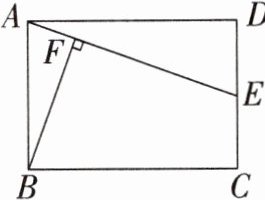
6
. 答案
12. 6 解析:如图,连接 BE, 在矩形 ABCD 中, $\because AB = 2, BC = 3$,
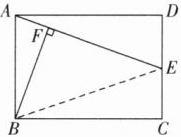 $\therefore CD = AB = 2, AD = BC = 3, ∠C = ∠D = 90°$.$\because E$ 是边 CD 的中点,$\therefore CE = DE = \dfrac{1}{2} CD = 1$, $\therefore AE = \sqrt{AD^2 + DE^2} = \sqrt{10}$.
$\because S_{△ ADE} + S_{△ BCE} + S_{△ ABE} = S_{\mathrm{矩形}ABCD}, BF ⊥ AE$,$\therefore \dfrac{1}{2} AD · DE + \dfrac{1}{2} BC · CE + \dfrac{1}{2} AE · BF = AB · BC$,即$\dfrac{1}{2} ×3×1 + \dfrac{1}{2} ×3×1 + \dfrac{1}{2} ×\sqrt{10} BF = 2×3$, 解得 $BF = \dfrac{6}{\sqrt{10}}$,$\therefore AE · BF = \sqrt{10} × \dfrac{6}{\sqrt{10}} = 6$.
13.计算:
(1) $\frac{-\sqrt{45y^2}}{3\sqrt{5y}}$ $(y>0)$;
(2) $\sqrt{\frac{2}{45}} ÷ \frac{3}{2}\sqrt{1\frac{3}{5}}$;
(3) $\frac{1}{2}a\sqrt{ab^2} ÷ 4a\sqrt{\frac{a}{b}}(a>0,b>0)$。
(1) $\frac{-\sqrt{45y^2}}{3\sqrt{5y}}$
$(y>0)$;(2) $\sqrt{\frac{2}{45}} ÷ \frac{3}{2}\sqrt{1\frac{3}{5}}$;
(3) $\frac{1}{2}a\sqrt{ab^2} ÷ 4a\sqrt{\frac{a}{b}}(a>0,b>0)$。
答案
13. (1) 原式$=-\dfrac{1}{3} · \sqrt{9y} = -\sqrt{y}$.
(2) 原式 $= \sqrt{\dfrac{2}{45}} ÷ \sqrt{(\dfrac{3}{2})^2 ×\dfrac{8}{5}} = \sqrt{\dfrac{2}{45}} ÷ \sqrt{\dfrac{18}{5}} = \sqrt{\dfrac{2}{45}×\dfrac{5}{18}} = \dfrac{1}{9}$.
(3) 原式 $= \sqrt{(\dfrac{a}{2})^2 · ab^2} ÷ \sqrt{(4a)^2 · \dfrac{a}{b}} = \sqrt{\dfrac{a^3b^2}{4}} ÷ \sqrt{\dfrac{16a^3}{b}} = \sqrt{\dfrac{a^3b^2}{4} · \dfrac{b}{16a^3}} = \dfrac{b}{8}\sqrt{b}$.
14. (1) 已知 $y = \frac{\sqrt{(x-1)^2}}{x-1} + 3$,若 $x<1$,求 $y · \sqrt{3y} ÷ \sqrt{\frac{1}{y^4}} · \sqrt{\frac{1}{y}}$ 的值。
(2) 已知 $y = \sqrt{2x-5} + \sqrt{10-4x} + 1$,$x,y$ 均为实数,求 $x\sqrt{2x} ÷ \sqrt{\frac{x}{y}}$ 的值。
(3) 已知 $\sqrt{\frac{9-x}{x-6}} = \frac{\sqrt{9-x}}{\sqrt{x-6}}$,且 $x$ 为偶数,求 $(1+x) · \sqrt{\frac{1-2x+x^2}{x^2-1}}$ 的值。
(2) 已知 $y = \sqrt{2x-5} + \sqrt{10-4x} + 1$,$x,y$ 均为实数,求 $x\sqrt{2x} ÷ \sqrt{\frac{x}{y}}$ 的值。
(3) 已知 $\sqrt{\frac{9-x}{x-6}} = \frac{\sqrt{9-x}}{\sqrt{x-6}}$,且 $x$ 为偶数,求 $(1+x) · \sqrt{\frac{1-2x+x^2}{x^2-1}}$ 的值。
答案
14. (1) $\because x < 1$,$\therefore y = \dfrac{|x-1|}{x-1} + 3 = \dfrac{-(x-1)}{x-1} + 3 = 2$. 原式 $= y · \sqrt{3y} · \sqrt{y^4} · \sqrt{\dfrac{1}{y}} = \sqrt{3} y^3$. 当 $y=2$ 时,原式 $= 8\sqrt{3}$.
(2) 由题意,得 $\begin{cases}2x-5≥0, \\10-4x≥0,\end{cases}$ 解得 $x = \dfrac{5}{2}$,$\therefore y = 1$.$\because x \sqrt{2x} ÷ \sqrt{\dfrac{x}{y}} = x \sqrt{2x ÷ \dfrac{x}{y}} = x \sqrt{2y}$,$\therefore$ 当 $x = \dfrac{5}{2},y=1$ 时,原式 $= \dfrac{5\sqrt{2}}{2}$.
(3) 由题意,得 $\begin{cases}9-x≥0, \\x-6>0,\end{cases}$ 解得 $6<x≤9$.$\because x$ 为偶数,$\therefore x=8$,$\therefore (1+x) · \sqrt{\dfrac{1-2x+x^2}{x^2-1}} = (1+x) · \sqrt{\dfrac{(x-1)^2}{(x+1)(x-1)}} = \sqrt{\dfrac{(x+1)^2(x-1)^2}{(x+1)(x-1)}} = \sqrt{(x+1)(x-1)} = \sqrt{9×7} = 3\sqrt{7}$.
15. 原创题 阅读下列材料,回答问题.
我们知道一次函数$y=kx+b(k≠0,k,b$是常数)的图象是一条直线,到高中学习时,直线通常写成$Ax+By+C=0(A^2+B^2≠0,A,B,C$是常数)的形式,点$P(x_0,y_0)$到直线$Ax+By+C=0$的距离可用公式$d=\frac{|Ax_0+By_0+C|}{\sqrt{A^2+B^2}}$计算.
根据以上材料解答下列问题:
(1)求点$Q(-1,3)$到直线$y=2x-5$的距离;
(2)直线$x+\sqrt{6}y=5$沿$y$轴向上平移7个单位长度得到另一条直线,求这两条平行直线之间的距离.
我们知道一次函数$y=kx+b(k≠0,k,b$是常数)的图象是一条直线,到高中学习时,直线通常写成$Ax+By+C=0(A^2+B^2≠0,A,B,C$是常数)的形式,点$P(x_0,y_0)$到直线$Ax+By+C=0$的距离可用公式$d=\frac{|Ax_0+By_0+C|}{\sqrt{A^2+B^2}}$计算.
根据以上材料解答下列问题:
(1)求点$Q(-1,3)$到直线$y=2x-5$的距离;
(2)直线$x+\sqrt{6}y=5$沿$y$轴向上平移7个单位长度得到另一条直线,求这两条平行直线之间的距离.
答案
15. (1)$y=2x-5$ 可变形为 $2x-y-5=0$,即 $A=2,B=-1,C=-5$,$\therefore$ 点 $Q(-1,3)$ 到直线 $2x-y-5=0$ 的距离 $d = \dfrac{|2×(-1)+(-1)×3-5|}{\sqrt{2^2+(-1)^2}} = \dfrac{10}{\sqrt{5}} = 2\sqrt{5}$,$\therefore$ 点 $Q(-1,3)$ 到直线 $y=2x-5$ 的距离为 $2\sqrt{5}$.
(2) 将 $y=0$ 代入 $x+\sqrt{6}y=5$ 得 $x=5$,$\therefore$ 点 $(5,0)$ 在直线 $x+\sqrt{6}y=5$ 上,将点 $(5,0)$ 沿 $y$ 轴方向向上平移 7 个单位长度得点 $(5,7)$,$\therefore$ 点 $(5,7)$ 在平移后的直线上.$\because x+\sqrt{6}y=5$ 可变形为 $x+\sqrt{6}y-5=0$,$\therefore$ 点 $(5,7)$ 到直线 $x+\sqrt{6}y-5=0$ 的距离为 $d = \dfrac{|1×5+\sqrt{6}×7-5|}{\sqrt{1^2+(\sqrt{6})^2}} = \dfrac{7\sqrt{6}}{\sqrt{7}} = \sqrt{42}$.$\because$ 两直线平行,$\therefore$ 这两条平行直线之间的距离为 $\sqrt{42}$.
(2) 将 $y=0$ 代入 $x+\sqrt{6}y=5$ 得 $x=5$,$\therefore$ 点 $(5,0)$ 在直线 $x+\sqrt{6}y=5$ 上,将点 $(5,0)$ 沿 $y$ 轴方向向上平移 7 个单位长度得点 $(5,7)$,$\therefore$ 点 $(5,7)$ 在平移后的直线上.$\because x+\sqrt{6}y=5$ 可变形为 $x+\sqrt{6}y-5=0$,$\therefore$ 点 $(5,7)$ 到直线 $x+\sqrt{6}y-5=0$ 的距离为 $d = \dfrac{|1×5+\sqrt{6}×7-5|}{\sqrt{1^2+(\sqrt{6})^2}} = \dfrac{7\sqrt{6}}{\sqrt{7}} = \sqrt{42}$.$\because$ 两直线平行,$\therefore$ 这两条平行直线之间的距离为 $\sqrt{42}$.
