

 登录
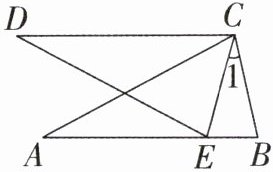
8. ★★★ (2025·六安期中)如图,已知$△ ABC ≌ △ DEC$,点E在边AB上,且$∠ ACB = ∠ CEB$,则图中与$∠ 1$相等的角有 (
A.4个
B.3个
C.2个
D.1个
A
)A.4个
B.3个
C.2个
D.1个
答案
A 解析:$\because △ ABC≌△ DEC,\therefore ∠ ACB=∠ DCE,\therefore ∠ ACB-∠ ACE=∠ DCE-∠ ACE$,即$∠ 1=∠ ACD$.
$\because △ ABC≌△ DEC,\therefore ∠ A=∠ D$.
$\because ∠ ACB=∠ DCE,∠ ACB=∠ CEB,\therefore ∠ CEB=∠ DCE$,$\therefore DC// AB,\therefore ∠ ACD=∠ A,\therefore ∠ 1=∠ A$.
$\because ∠ A=∠ D,\therefore ∠ 1=∠ D$.
$\because DC// AB,\therefore ∠ D=∠ AED,\therefore ∠ 1=∠ AED$.综上,与$∠ 1$相等的角有4个.故选 A.
$\because △ ABC≌△ DEC,\therefore ∠ A=∠ D$.
$\because ∠ ACB=∠ DCE,∠ ACB=∠ CEB,\therefore ∠ CEB=∠ DCE$,$\therefore DC// AB,\therefore ∠ ACD=∠ A,\therefore ∠ 1=∠ A$.
$\because ∠ A=∠ D,\therefore ∠ 1=∠ D$.
$\because DC// AB,\therefore ∠ D=∠ AED,\therefore ∠ 1=∠ AED$.综上,与$∠ 1$相等的角有4个.故选 A.
9. ★★★ (2025·亳州月考)已知$△ ABC$的三边长分别为$6,4,3$,$△ DEF$的三边长分别为$3x-1,2y-2,3$,若这两个三角形全等,则$x+y=$
$\dfrac{16}{3}$或$\dfrac{17}{3}$
.答案
$\dfrac{16}{3}$或$\dfrac{17}{3}$ 解析:$\because △ ABC$和$△ DEF$全等,$△ ABC$的三边长分别为6,4,3,$△ DEF$的三边长分别为$3x-1,2y-2,3$,
$\therefore 当\begin{cases}3x-1=6,\\2y-2=4\end{cases}时,解得\begin{cases}x=\dfrac{7}{3},\\y=3,\end{cases}\therefore x+y=\dfrac{7}{3}+3=\dfrac{16}{3}$;
当$\begin{cases}3x-1=4,\\2y-2=6\end{cases}时,解得\begin{cases}x=\dfrac{5}{3},\\y=4,\end{cases}\therefore x+y=\dfrac{5}{3}+4=\dfrac{17}{3}$.
综上所述,$x+y=\dfrac{16}{3}$或$\dfrac{17}{3}$.故答案为$\dfrac{16}{3}$或$\dfrac{17}{3}$.
10. ★★★ 如图,在△ABC中,AB=8,已知△ABC≌△ADE,点D落在边BC上,P是线段BD上一点,若△AEF的面积比△CDF的面积大25,则点P到线段AB和线段AD的距离之和为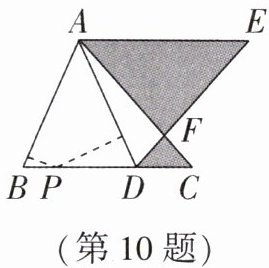
$\dfrac{25}{4}$
。答案
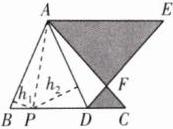
$\dfrac{25}{4}$ 解析:$\because △ ABC≌△ ADE,\therefore AD=AB=8,S_{△ ABC}=S_{△ ADE},\therefore S_{△ ABD}+S_{△ ADF}+S_{△ CDF}=S_{△ ADF}+S_{△ AEF},\therefore S_{△ ABD}=S_{△ AEF}-S_{△ CDF}.\because △ AEF$ 的面积比 $△ CDF$ 的面积大 25, $\therefore S_{△ ABD}=S_{△ AEF}-S_{△ CDF}=25$. 如图,设点 $P$ 到线段 $AB$ 和线段 $AD$ 的距离分别为 $h_1,h_2$, 连接 $AP$.
$\because S_{△ ABD}=S_{△ ABP}+S_{△ ADP},\therefore \dfrac{1}{2}×8h_1+\dfrac{1}{2}×8h_2=25,\therefore h_1+h_2=\dfrac{25}{4},\therefore$ 点 $P$ 到线段 $AB$ 和线段 $AD$ 的距离之和为 $\dfrac{25}{4}$.
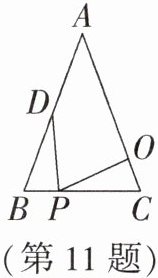
11. 如图,在$△ ABC$中,$AB=AC=24\ \mathrm{cm}$,$BC=16\ \mathrm{cm}$,点$D$为$AB$的中点,如果点$P$在线段$BC$上以$4\ \mathrm{cm/s}$的速度由点$B$向点$C$运动,同时,点$O$在线段$CA$上由点$C$向点$A$运动.当点$O$的运动速度为
4或6
$\mathrm{cm/s}$时,能够在某一时刻$△ BPD$与$△ COP$全等.答案
4或6 解析:$\because$ 在 $△ ABC$ 中,$AB=AC=24\ \mathrm{cm}$,点 $D$ 为 $AB$ 的中点,$\therefore BD=\dfrac{1}{2}AB=12\ \mathrm{cm}$,$∠ B=∠ C$,$\therefore$ 在 $△ BPD$ 与 $△ COP$ 中,$∠ B=∠ C$. 当 $△ BPD≌△ COP$ 时, 有 $BD=CP$,$BP=CO$,$\therefore CP=BC-BP=BD=12\ \mathrm{cm}$,$\therefore 16-BP=12$, 解得 $BP=4\ \mathrm{cm}$,$\therefore CO=BP=4\ \mathrm{cm}$.$\because$ 点 $P$ 的运动速度为 $4\ \mathrm{cm/s}$,$\therefore$ 点 $P$ 运动的时间为 $4÷4=1(\mathrm{s})$,$\therefore$ 点 $O$ 运动的时间也是 $1\ \mathrm{s}$,$\therefore$ 点 $O$ 的运动速度是 $4÷1=4\ (\mathrm{cm/s})$. 当 $△ DBP≌△ OCP$ 时, 有 $DB=CO=12\ \mathrm{cm}$,$BP=CP$,$\therefore BP=CP=\dfrac{1}{2}BC=8\ \mathrm{cm}$,$\therefore$ 点 $P$ 运动的时间是 $8÷4=2(\mathrm{s})$,$\therefore$ 点 $O$ 运动的时间也是 $2\ \mathrm{s}$,$\therefore$ 点 $O$ 运动的速度是 $12÷2=6(\mathrm{cm/s})$. 综上所述,点 $O$ 运动的速度是 $4\ \mathrm{cm/s}$ 或 $6\ \mathrm{cm/s}$.
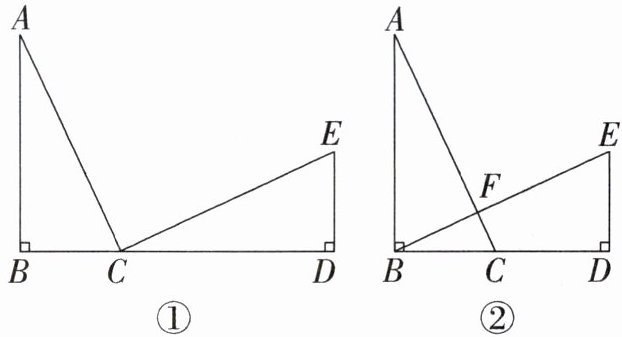
12. ★★★ 已知:如图①,$AB ⊥ BD$,$DE ⊥ BD$,点C是BD上一点,且$△ ABC ≌ △ CDE$.
(1)试判断AC与CE的位置关系,并说明理由.
(2)如图②,若把$△ CDE$沿直线BD向左移动,使$△ CDE$的顶点C与B重合,AC与BE交于点F,此时AC与BE的位置关系怎样?请说明理由.
(3)如图②,若$S_{△ ABC}=12$,$AF:CF=3:1$,求
四边形CDEF的面积.
(1)试判断AC与CE的位置关系,并说明理由.
(2)如图②,若把$△ CDE$沿直线BD向左移动,使$△ CDE$的顶点C与B重合,AC与BE交于点F,此时AC与BE的位置关系怎样?请说明理由.
(3)如图②,若$S_{△ ABC}=12$,$AF:CF=3:1$,求
四边形CDEF的面积.
答案
(1)$AC⊥ CE$. 理由如下.$\because AB⊥ BD,\therefore ∠ B=90°,\therefore ∠ A+∠ ACB=90°$.$\because △ ABC≌△ CDE,\therefore ∠ A=∠ DCE,∠ ACB=∠ E,\therefore ∠ DCE+∠ ACB=90°$.$\because ∠ DCE+∠ ACB+∠ ACE=180°,\therefore ∠ ACE=90°,\therefore AC⊥ CE$.
(2)$AC⊥ BE$. 理由如下: $\because △ ABC≌△ BDE,\therefore ∠ A=∠ EBD,∠ ACB=∠ E$.$\because ∠ ABC=90°,\therefore ∠ A+∠ ACB=90°,\therefore ∠ EBD+∠ ACB=90°,\therefore ∠ BFC=90°,\therefore AC⊥ BE$.
(3)$\because S_{△ ABC}=12,AF:CF=3:1,\therefore S_{△ BFC}=\dfrac{1}{4}S_{△ ABC}=3$.
$\because △ ABC≌△ BDE,\therefore S_{△ BDE}=S_{△ ABC}=12,\therefore$ 四边形 $CDEF$ 的面积 $=12-3=9$.
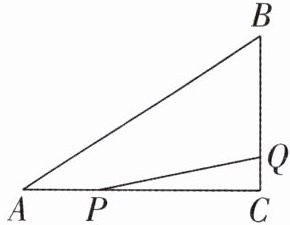
13. (2026·长春期末)在 $Rt△ ABC$ 中,$∠ C=90°, AC=12, BC=8$,动点 $P$ 从点 $A$ 出发,沿点 $A—C—A$ 以每秒2个单位长度的速度向终点 $A$ 运动,同时动点 $Q$ 从点 $C$ 出发,沿 $C—B—C$ 以每秒1个单位长度的速度做往返运动(到达 $B$ 后立即沿 $BC$ 返回 $C$),连接 $PQ$.当点 $P$ 到达点 $A$ 时,$P, Q$ 同时停止运动.设点 $P$ 的运动时间为 $t$ 秒$(t>0)$.
(1) 在点 $P$ 从点 $A$ 运动到点 $C$ 的过程中,线段 $CP$ 的长为
(2) 当点 $P$ 与点 $C$ 重合时,求线段 $BQ$ 的长;
(3) 当 $△ CPQ$ 为等腰直角三角形时,求 $t$ 值;
(4) 分别过点 $P, Q$ 作 $PD ⊥ AB$ 于点 $D$,$QE ⊥ AB$ 于点 $E$.当 $△ APD ≌ △ QBE$ 时,直接写出 $t$ 的值.
(1) 在点 $P$ 从点 $A$ 运动到点 $C$ 的过程中,线段 $CP$ 的长为
$12-2t$
;(用含 $t$ 的代数式表示)(2) 当点 $P$ 与点 $C$ 重合时,求线段 $BQ$ 的长;
(3) 当 $△ CPQ$ 为等腰直角三角形时,求 $t$ 值;
(4) 分别过点 $P, Q$ 作 $PD ⊥ AB$ 于点 $D$,$QE ⊥ AB$ 于点 $E$.当 $△ APD ≌ △ QBE$ 时,直接写出 $t$ 的值.
答案
(1)$12-2t$ 解析:由题意得 $PA=2t,\therefore CP=AC-PA=12-2t$.
(2)当点 $P$ 与点 $C$ 重合时,$t=\dfrac{12}{2}=6,\therefore$ 点 $Q$ 的运动路程为 $1×6$.$\because BC=8>6,\therefore$ 当点 $P$ 与点 $C$ 重合时,点 $Q$ 在从点 $C$ 运动到点 $B$ 的途中,$\therefore BQ=BC-CQ=8-6=2$.
(3)点 $P$ 从点 $A$ 运动到点 $C$ 的时间为 $\dfrac{12}{2}=6$ (秒),点 $P$ 从点 $A$ 出发再回到点 $A$ 的时间为 $\dfrac{12+12}{2}=12$ (秒),当点 $Q$ 在从点 $C$ 运动到点 $B$ 的时间为 $\dfrac{8}{1}=8$ (秒).$\because ∠ C=90°$,$△ CPQ$ 是等腰直角三角形,$\therefore CP=CQ$. 当 $0<t≤6$ 时,则 $12-2t=t$,解得 $t=4$. 当 $6<t≤8$ 时,则 $2(t-6)=t$,解得 $t=12$ (舍去); 当 $8<t≤12$ 时,则 $2(t-6)=8-(t-8)$,解得 $t=\dfrac{28}{3}$. 综上所述,$t$ 的值为 4 或 $\dfrac{28}{3}$.
(4)$t$ 的值为 $\dfrac{8}{3}$ 或 $\dfrac{32}{3}$. 解析: 当 $0<t≤6$ 时,$\because △ APD≌△ QBE,\therefore AP=QB,\therefore 2t=8-t$,解得 $t=\dfrac{8}{3}$; 当 $6<t≤8$ 时,$\because △ APD≌△ QBE,\therefore AP=QB,\therefore 12-2(t-6)=8-t$,解得 $t=16$ (舍去); 当 $8<t≤12$ 时,$\because △ APD≌△ QBE,\therefore AP=QB,\therefore 12-2(t-6)=t-8$,解得 $t=\dfrac{32}{3}$. 综上所述,$t$ 的值为 $\dfrac{8}{3}$ 或 $\dfrac{32}{3}$.
